





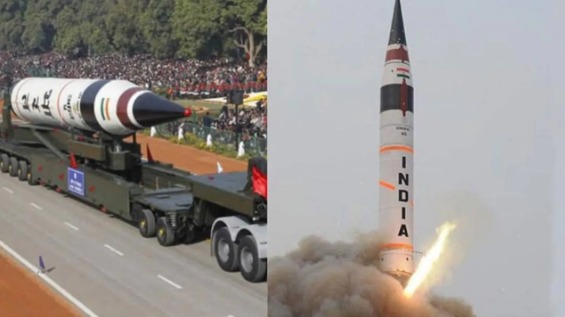
India has successfully carried out a test of an advanced Agni-series missile equipped with Multiple Independently Targetable Reentry Vehicle (MIRV) technology under “Mission Divyastra,” marking a major milestone in the country’s strategic defence capabilities. With this achievement, India has become the sixth nation in the world to demonstrate MIRV capability, joining an exclusive group of advanced missile powers.
The missile was launched on May 8 from the Abdul Kalam Island off the coast of Odisha. The launch produced a bright trajectory in the sky that was reportedly visible across Odisha, West Bengal, and even parts of neighbouring Bangladesh, with several videos of the event going viral on social media. Authorities have not disclosed further operational details of the test.
Ahead of the launch, a large-scale Notice to Airmen (NOTAM) was issued, restricting air and maritime movement over an unusually wide zone. Unlike earlier missile tests that covered a range of 1,500–2,000 kilometres, this exercise reportedly declared a restricted area of nearly 3,500 kilometres, extending from eastern India to the deep Indian Ocean region, indicating a high-end strategic trial.
MIRV technology enables a single missile to carry multiple warheads, each capable of striking different targets independently. It also allows deployment of decoys to confuse enemy missile defence systems, making interception significantly more difficult. Defence experts note that such capability enhances second-strike potential and strengthens strategic deterrence.
While the missile is believed to have a range exceeding 5,000 kilometres, officials have not revealed details such as speed, payload, or configuration. Defence analysts describe the successful test as a significant advancement in India’s missile technology, underscoring its growing indigenous capabilities in strategic weapons development.