





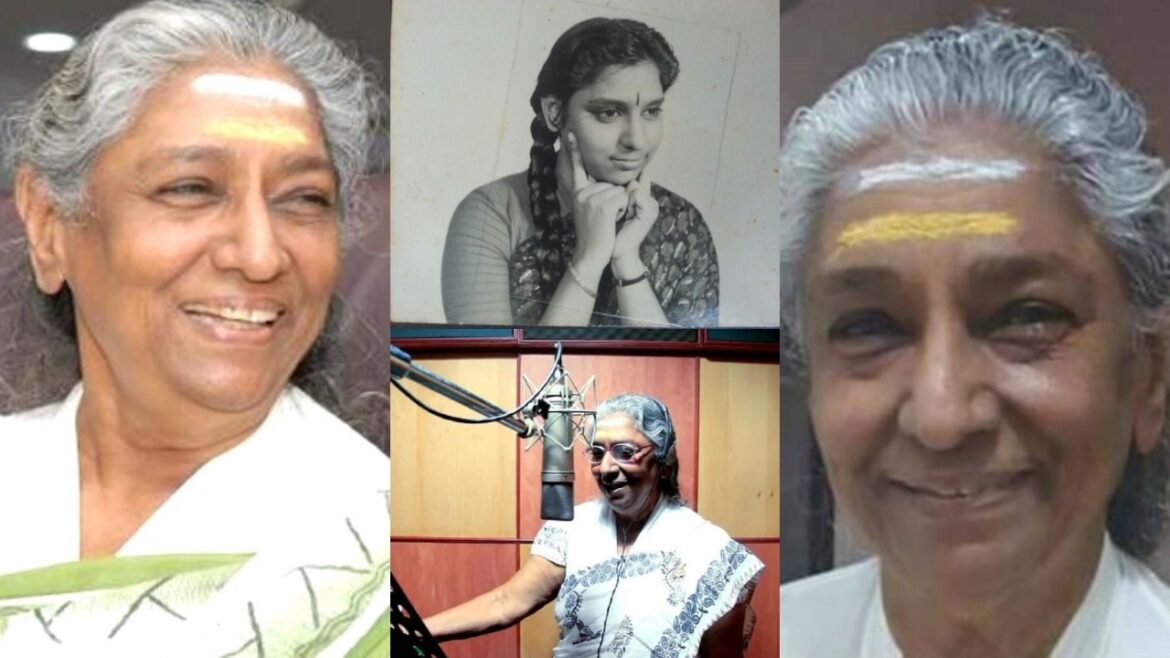
Deep sorrow has gripped the Telugu film industry with the passing of legendary singer S. Janaki. Having battled age-related ailments for some time, she breathed her last while undergoing treatment at a hospital in Mysuru. Over a career spanning more than 62 years, Janaki sang nearly 50,000 songs in Telugu, Tamil, Malayalam, and Kannada, with the majority of her renditions being in Malayalam and Kannada. She won the National Award for Best Female Playback Singer four times and received state awards on 31 occasions. Known as Gana Kokila and Apara Gana Saraswathi, this singer who enthralled South Indian cinema for over five decades leaves behind an extraordinary vocal legacy and musical journey.
Though many rivers flow, the Ganga holds a unique distinction — touching countless places and transforming them into sacred sites, changing its name along its course. Similarly, though the film world has had many playback singers, S. Janaki’s uniqueness remains unparalleled. She was the Saraswathi of song who breathed life into the compositions of numerous music directors with her sweet voice, showcasing their talent to the world. Divine sweetness in her voice, effortless command over the highest octaves, and rare skill in vocal mimicry and modulation defined her distinctive style. With the maturity of her voice, she brought characters to life — from a six-year-old child to a sixty-year-old woman — matching each role’s age perfectly. Whether displaying classical proficiency or infusing energy into folk tunes, she excelled equally in both.
Born on April 23, 1938, in Palapatla village near Repalle in Guntur district, Janakamma learned music under Nadaswaram maestro Paidiswamy with the encouragement of her father Sriramamurthy. After winning an award from then-President Babu Rajendra Prasad at the All India Radio competitions in 1957, she was selected as a staff singer at Chennai’s AVM Studios. While newcomers typically avoided sad songs, Janakamma began her career unhesitatingly with a tragic song as her very first recording. Her immense talent first became widely known with the film ‘Muripinche Muvvalu’ (1962). She astonished the music world by singing ‘Ningara Velane Deva’ in Tamil and ‘Nee Leela Padedha Deva’ in Telugu at an extremely high pitch, matching the Nadaswaram note blown by maestro Karukurichi Arunachalam — so much so that legendary singer P. Leela herself suggested Janakamma’s name, saying it would be difficult for her to sing at that pitch.
Her voice matched not just the Nadaswaram but any instrument capable of soaring sound waves. In ‘Sannai Appanna’ (1980), she melted hearts singing ‘Kadilinchu Nee Kaliki Hrudayam’ in tune with Ustad Bismillah Khan’s shehnai. Similarly, in ‘Saptapadi’ (1981), she poured out her vocal rhythms competing with the flute in ‘Nemalliki Nerpina Nadakalive’. Bringing a song to life through rhythmic laughter alone, without any lyrics, is no ordinary feat — yet in ‘Jyothi’ (1976), singing alongside Balu in Chakravarthy’s composition ‘Sirimalle Puvvalle Navvu’, Janakamma matched every note Balu sang with laughter set to the rhythm, capturing listeners’ hearts.
In ‘Shankarabharanam’, her portrayal of a ten-year-old girl shivering with cold by a riverbank — singing while staying in tune yet sounding as though faltering — stands as proof of her vocal maturity. In the same film’s ‘Samaja Vara Gamana’, while depicting a bride enraptured upon seeing her groom during the traditional pelli chupulu ceremony, she brilliantly transformed a classical raga into an expression of romantic longing by touching the forbidden note rishabham. In ‘Saptapadi’s ‘Govullu Tellana… Gopayya Nallana’, Janakamma’s versatility was unparalleled — one voice belonged to a ten-year-old boy, the other to a three-year-old infant, and she distinctly rendered the innocent, off-key voice of the toddler alongside the slightly more attuned voice of the boy within the same song, leaving listeners astonished.
In the 1964 film ‘Poojaphalam’, the ornamentations (gamakas) she poured into the line ‘Sheelaminthaina Viduvajalanu Ra’ flowed more powerfully than the murmuring waves of the Godavari. In ‘Chilaka Josyam’s ‘Raja O Raja’, her intoxicating laughter for Allu Ramalingaiah and Ramaprabha, and the sensuous rendering of ‘Sarasalu Chaalu Srivaru’ in ‘Siva’, were uniquely hers. Janakamma turned the art of humming — where the heroine simply responds with wordless sounds to the hero’s singing — into a craft of its own. In ‘Siri Sampadalu’ (1964), her humming of “Aa… Oo… Aha” in response to Ghantasala’s question in ‘Ee Pagalu Reyiga Pandu Vennelaga Marinadhemi Cheli’ revealed the very soul of the song.
In ‘Ravanude Ramudaithe’s ‘Ravi Varmake Andani’, her alaap at the top register at the end of every stanza painted a vivid musical picture. In ‘Aakali Rajyam’, as the hero improvised poetry with the tune “Tanna Nanna Nana”, her ability to convey a range of emotions through wordless sounds alone testified to her extraordinary skill. The sighs she rendered while writing a love letter in ‘Srivariki Premalekha’, and her shifting of voice between a young bride and an old woman in ‘Srivari Shobhanam’s ‘Alaka Panupu Ekkanela’, were remarkable — she carried a conversation between two people of different ages within a single song using just her own voice, creating history.
In ‘Chandrahasa’s ‘O Veena Cheli Naa Priya Sakhi’, she merged seamlessly with the veena’s sound, while in ‘Illu Illalu’, alongside Rajababu, she brought humour alive in the folk-style Burrakatha ‘Vinara Surammakoothuru Magadu’. From serious classical music to side-splitting comic songs, everything was within her grasp. During the 1980s, the combination of music maestro Ilaiyaraaja, singing legend S.P. Balasubrahmanyam, and Janakamma took South Indian cinema by storm. Songs like ‘Edalo Laya Egase Laya’ from ‘Anveshana’ and ‘Ninu Chudaka Nenundalenu’ from ‘Neerajanam’ saw her alaaps flowing in competition with Balu’s voice, offering pure nectar to music lovers.
Though she began her Telugu journey early on with Ghantasala in the film ‘MLA’ with the song ‘Nee Asa Adayasa’, it took time for her to establish herself, as P. Susheela was already singing for the leading heroines at the time. Janakamma proved her mettle singing for secondary roles initially, and secured a permanent place in Telugu hearts with songs like ‘Neeli Meghalalo’ from ‘Bava Maradallu’ (1961) and ‘Pagale Vennelanu’ from ‘Poojaphalam’ (1964). Starting from the era of Savitri, Anjali Devi, and Jamuna, through Jayaprada, Jayasudha, Sridevi, and Radhika, all the way to Vijayashanti, Sowndarya, and Ramba, Janakamma lent her voice to nearly five generations of heroines. Whether light melodies, folk songs, or club-dance vamp numbers, she remains the only singer after L.R. Eswari to have impressed at that level.
Beyond singing, she also left her mark in music composition. S. Janaki composed music for the film ‘Mounaporatam’, produced by Usha Kiran Movies, becoming the third woman music director in Telugu film history after Bhanumathi and P. Leela. She was honoured with ten Nandi Awards, four National Awards, and more than 25 awards from various states. Her song ‘Jilibili Palukulaku’ from ‘Sitara’ won her a National Award. She also received the Tamil Nadu government’s ‘Kalaimamani’, the Karnataka government’s ‘Basava Bhushana’ title, and an honorary doctorate from Mysore University.
Having ruled the world of music for decades, Janakamma protested the Central government’s belated announcement of the Padma Bhushan, believing South Indian artists were not being given due recognition in time, and rejected the award as an act of self-respect, asserting that the honour due to artists should come with timely priority. Having sung more than 30,000 songs in Telugu, Tamil, Kannada, Malayalam, Hindi, and foreign languages including English and Japanese, S. Janaki remains an invaluable treasure gifted to the world of music. Her cascade of melody will continue to flow forever, and her singing will keep blossoming new springs in the hearts of Indians.