





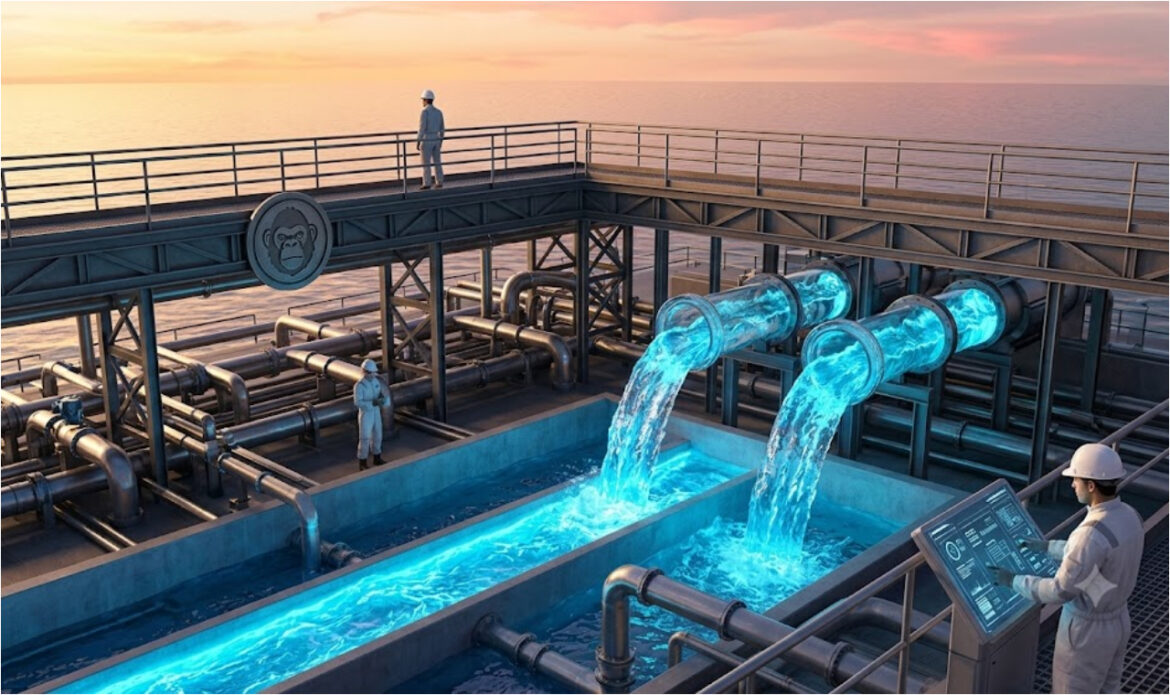
Japan has unveiled a remarkable breakthrough in clean energy technology. The country has successfully launched a new method of generating electricity by combining discharged wastewater with seawater, without causing any harm to the environment. Japan’s first osmotic power plant is now operational at the Mamizu Pia seawater treatment facility in Fukuoka City. This makes it only the second such facility in the world after Denmark.
What Exactly Is Blue Energy?
Wherever freshwater from rivers meets the sea, a form of energy is quietly released into nature. When freshwater and saltwater mix, “free energy” is released according to thermodynamic principles. This energy, generated based on the salinity difference between the two types of water, is called salinity gradient energy, or more simply, Blue Energy. It works on a principle similar to how batteries function.
The plant operates based on the same osmosis process by which plant roots draw water from soil, or by which cells in the human body retain moisture. Here, freshwater and saltwater are placed on either side of a semi-permeable membrane resembling plastic. This membrane allows only water molecules to pass through while blocking salt. As a result, water naturally flows rapidly toward the saltwater side.
The plant uses a specialized method called pressure-retarded osmosis. As water crosses the membrane and moves toward the saltwater side, which is deliberately kept under pressure, pressure and flow build up sharply at that point. This pressurized water is pushed through a turbine, which turns a generator — functioning much like a small hydroelectric dam to produce electricity. No fuel is burned in this process, and no carbon dioxide is released.
Mamizu Pia in Fukuoka is a desalination facility. While ordinary seawater contains about 3.5 percent salt, the concentrated brine left over after the treatment process here contains 8 percent salt — more than double the salinity of regular seawater. For freshwater, the facility uses water sourced from a nearby wastewater treatment plant. The greater the salinity difference between the two types of water, the stronger the pressure of the water flow, resulting in higher electricity output.
This technology involves no fuels such as coal, gas, or diesel, and produces no carbon emissions whatsoever. Alongside power generation, it also serves as an effective method of wastewater management, offering a solution to two problems simultaneously. Unlike solar or wind energy, this method does not depend on weather conditions, allowing the plant to operate continuously, twenty-four hours a day, regardless of day or night.
The plant currently generates approximately 880,000 kilowatt-hours of electricity annually, enough to meet the needs of about 300 Japanese households. However, the technology is not yet being rolled out widely; it will be made available for broader use only after full-scale development. Researchers estimate that if implemented at scale, this technology could help meet as much as 15 percent of global electricity demand.