





- Ravi Prakash

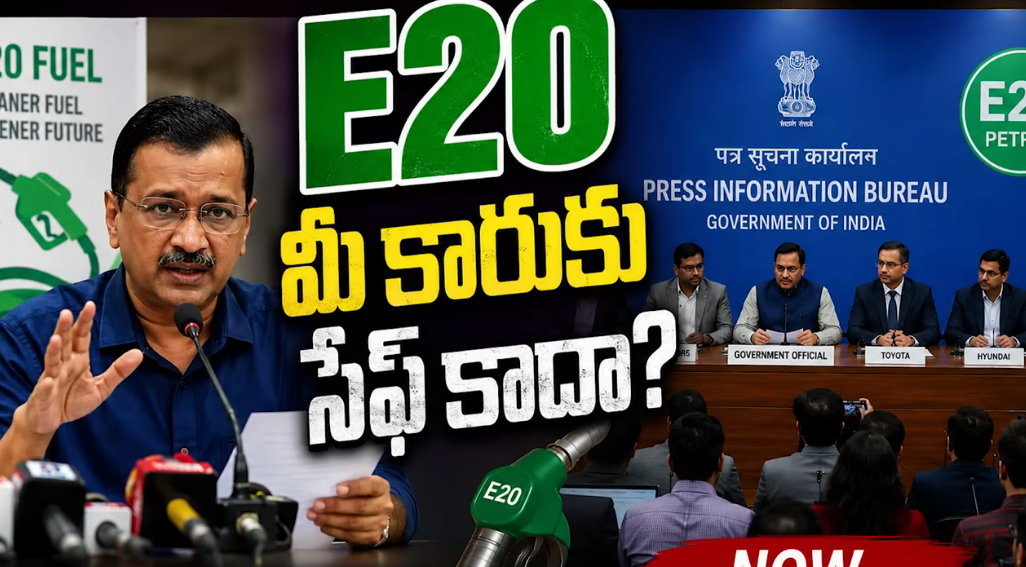
A growing controversy over E20 petrol has moved from social media into the heart of national politics, after former Delhi Chief Minister Arvind Kejriwal wrote to 29 automobile manufacturers demanding written clarification on the fuel’s safety for vehicles manufactured before 2023.
Background: A Dispute That Started Online
Over the past several days, thousands of vehicle owners have taken to social media alleging that their cars, bikes, and scooters have developed problems since they began using E20 petrol. The government has firmly maintained that E20 is 100 percent safe. At a press conference, top automobile companies also stepped forward to assure the public that even pre-2023 vehicles can safely use E20, with the only stated drawback being a possible drop in mileage — not mechanical damage.
That position has since come under scrutiny. Kejriwal has written to 29 automobile companies raising pointed questions, and singled out three manufacturers in particular for sharper criticism: Toyota, Maruti Suzuki, and Hero MotoCorp. Representatives of these companies had appeared alongside government officials in recent days to declare that E20 use is safe even in vehicles built before 2023, with mileage reduction cited as the sole caveat.
Kejriwal is now demanding that this claim be put in writing rather than stated verbally. He has given the companies a one-week deadline to respond to three specific questions: whether E20 petrol is safe for vehicles manufactured before 2023; whether reduced mileage is the only consequence of its use; and whether the companies can officially guarantee that no damage will occur to older vehicles as a result of using the fuel.
Kejriwal has announced that his team will independently reach out to owners of older vehicles, mechanics, garages, and repair workshops to document ground-level experiences with E20 petrol — a move that signals the dispute has expanded beyond online discourse into an organized political campaign.
Separately, vehicle owners across India have reported that since April, many petrol stations have stopped stocking lower-ethanol blends such as E5 or E10, leaving owners of pre-2023 vehicles — including models from 2018 through 2022 — with little choice but to use E20.
The Core of the Dispute: Owner’s Manuals vs. Public Statements
According to Kejriwal, the central contradiction lies in the manufacturers’ own owner’s manuals. He cited Toyota’s manual, which states that vehicles can use gasoline blended with up to 10 percent ethanol, and further advises that if a driver notices reduced drivability or mileage while using ethanol-blended fuel, they should switch back to standard, ethanol-free unleaded petrol. Kejriwal noted that this directly conflicts with Toyota representatives’ recent public statements endorsing E20 use in older vehicles.
He raised a similar point regarding Maruti Suzuki, whose owner’s manual reportedly carries an identical 10 percent ethanol limit and the same recommendation to revert to ethanol-free petrol if performance issues arise. Kejriwal alleged that manufacturers including Maruti Suzuki, Toyota Kirloskar, and Hero MotoCorp altered their public position under pressure from the central government — an allegation the companies have not accepted.
The dispute has also gained traction on social media, where users have circulated images of older owner’s manuals, particularly for Royal Enfield motorcycles, which reportedly specify that the vehicles were designed for E10 or lower ethanol content and warn of potential long-term issues from higher blends, including degradation of fuel tank coatings, deterioration of rubber hoses and tubing, corrosion within the fuel system, and reduced overall performance.
Kejriwal has additionally alleged that the central government asked six major automobile companies — Maruti Suzuki, Toyota Kirloskar, Hero MotoCorp, Hyundai, Bajaj Auto, and TVS Motor Company — to publicly reassure consumers of E20’s safety, and claims that not all of the companies agreed to do so. These claims have not been independently confirmed by the companies named.
Industry and Government Response
At a press conference held on July 4, representatives from Maruti Suzuki, Toyota, Hyundai, Hero MotoCorp, TVS, and Bajaj appeared alongside government officials to reiterate that E20 petrol is safe for both new E20-compatible vehicles and older E10 vehicles currently in use.
Toyota representative Vikram Gulati stated that comprehensive testing on older vehicles, in line with international standards, was completed prior to E20’s market rollout. Maruti Suzuki executive Rahul Bharti cited company service data covering 2.8 crore vehicles serviced last year, of which more than 1.5 crore were over three years old — predating the E20 rollout. According to Bharti, this dataset showed no evidence of engine part degradation or corrosion linked to E20 use. Maruti Suzuki also stated that no retrofitting is required for existing petrol vehicles to use the fuel.
This claim stands in contrast to earlier reports from 2025 suggesting that Maruti Suzuki was developing an “E20 upgrade kit” for vehicles aged 10 to 15 years, involving replacement of ethanol-resistant rubber seals, fuel hoses, gaskets, and plastic components. The company’s current position does not reference such a kit.
Hero MotoCorp has stated that its service records show no evidence of E20-related damage in two-wheelers.
However, reports in The Times of India and The Indian Express have referenced an unpublished study by the Automotive Research Association of India (ARAI) suggesting that while long-term E20 use does not appear to harm the engine block, smaller rubber components and fuel lines may wear out faster than expected, potentially requiring earlier replacement. These findings have not been officially published or confirmed.
Broader Ethanol Roadmap
India’s ethanol blending program is not expected to stop at E20. Standards for E22, E25, E27, and E30 fuels have already been cleared by the Bureau of Indian Standards. ARAI has been tasked with conducting field trials on E25, involving E10 and E20 vehicles driven up to 150,000 kilometers to assess mileage, engine condition, and component wear. Results are expected by the end of 2027, after which the International Center for Automotive Technology will review the findings before the Ministry of Petroleum makes a final decision on commercial rollout. No official decision on E25 or E30 has been made at this stage.
Consumer Concerns
Critics have raised questions about consumer choice, noting that in countries such as the United States, Germany, and Brazil, motorists retain the option to choose fuel blends suited to their vehicle’s age, an option that is increasingly unavailable in India.
A separate, unofficial technical study attributed to ARAI reportedly found mixed results across engine tests using E20 fuel. One BS4 engine completed testing without issue, while a BS6 turbocharged engine from a leading manufacturer reportedly began showing problems after 265 hours of testing, and another manufacturer’s engine reportedly showed thermo-mechanical failure in its exhaust valve after 800 hours. Two-wheeler engines reportedly performed comparatively well across tests.
It is widely acknowledged — including by government and industry representatives — that E20 petrol use results in a mileage reduction of 2 to 6 percent. Critics note that ethanol’s higher oxygen content and moisture-retention properties may accelerate wear in fuel hoses, rubber seals, gaskets, and plastic components in older vehicles, potentially necessitating earlier-than-expected repairs. Industry experts have generally stopped short of predicting immediate engine failure, instead pointing to a greater likelihood of long-term maintenance costs.
Supporters of ethanol blending argue that it reduces India’s dependence on imported crude oil, benefits farmers, and strengthens energy security. Critics counter that consumers bear the associated risk without corresponding benefits, noting that petrol prices and maintenance costs have not decreased, and that the freedom to choose preferred fuel blends at retail outlets has diminished.
Outlook
The dispute now centers on whether automobile manufacturers will respond in writing to Kejriwal’s queries and stand by the assurances given at the July 4 press conference. The central unresolved question, according to critics, remains one of accountability: if a vehicle designed for E10 sustains long-term engine damage after prolonged use of E20 petrol, responsibility for the resulting cost — and whether it falls on the government, oil companies, manufacturers, or vehicle owners — remains undetermined.