





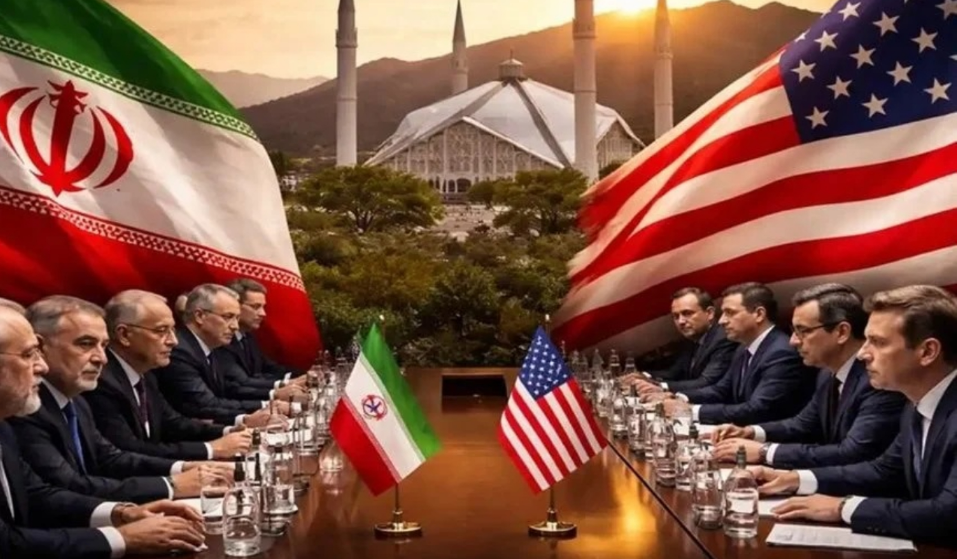
Tensions in the Strait of Hormuz have flared up again as the United States and Iran offer sharply differing interpretations of Article-5 provisions in the recently signed temporary Memorandum of Understanding (MoU) between the two countries. Under the agreement reached on June 17 between US President Donald Trump and Iranian President Masoud Pezeshkian, both sides were required to halt military action and resolve disputes through dialogue. However, within days of the deal being signed, attacks on commercial vessels followed by US military retaliatory action brought these peace efforts to a grinding halt.
Article-5 of the temporary agreement focuses entirely on restoring safe passage for commercial vessels through the Strait of Hormuz. Under its provisions, Iran must ensure free passage for commercial ships travelling between the Persian Gulf and the Sea of Oman and back, with no toll charges levied for 60 days. Within 30 days, Iran must also initiate demining operations to clear military and technical obstructions hampering normal navigation. Additionally, Iran is required to consult with Oman and other Gulf nations to define the future administration and maritime services of the strait in accordance with international law.
The root cause of the current confrontation is that both sides have been interpreting the written provisions of the agreement in ways that favour their own positions. Washington wants vessel movement to proceed under the coordination of Oman and the International Maritime Organization (IMO), with unimpeded passage guaranteed for all. Iran, however, insists that during this transitional period the strait remains entirely under its supervision, and that all vessels must coordinate with Tehran.
As the dispute deepened, Iran’s Islamic Revolutionary Guard Corps (IRGC) ordered that only the northern shipping corridor within Iranian territorial waters be used, causing vessel traffic to drop significantly. In the course of these developments, the Singapore-flagged vessel *Ever Lovely* and the Panama-flagged *Kiku* came under drone and missile attacks. Blaming Iran for these strikes, US Central Command carried out retaliatory attacks on Iranian missile sites and radar installations.
US President Donald Trump defended the military action, accusing Iran on social media of violating the ceasefire agreement, and issued stark warnings implying that Iran’s very existence would be at risk if it continued to act defiantly. In response, the IRGC launched missiles and drones at US military bases in Kuwait and Bahrain, while Iran’s foreign ministry condemned the American strikes as a violation of both the UN Charter and the agreement.
Despite the severe warnings being exchanged, the US and Iran have agreed to temporarily suspend military action and hold face-to-face talks in Doha, the capital of Qatar. Since approximately one-fifth of the world’s oil supply passes through the Strait of Hormuz, even a minor escalation there is enough to throw international energy markets into turmoil. The future of this peace agreement now rests entirely on the outcome of Tuesday’s Doha talks and how the two sides resolve the Article-5 dispute.