





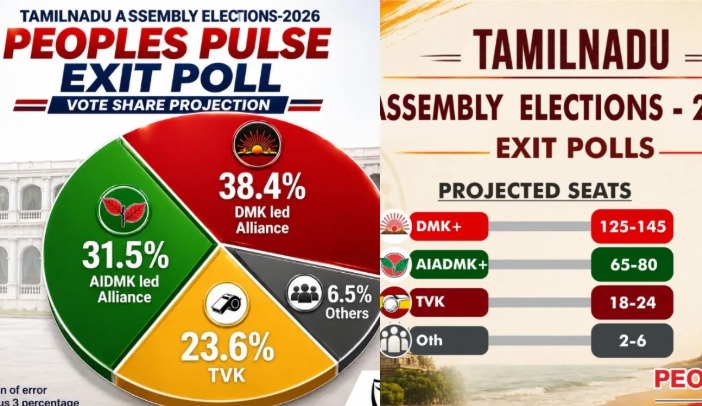
Exit poll projections for the Tamil Nadu Assembly elections present a sharply divided picture, pointing to a close and highly competitive contest between the two major alliances. A survey by People’s Pulse indicates that the ruling Dravida Munnetra Kazhagam (DMK)-led alliance is likely to retain power with 125–145 seats, comfortably crossing the majority mark of 118, backed by a vote share of 38.4% amid a record voter turnout of 84%.
The main opposition All India Anna Dravida Munnetra Kazhagam (AIADMK) is projected to secure 65–80 seats in this survey, while actor-turned-politician Vijay’s Tamilaga Vettri Kazhagam (TVK) is expected to emerge as a significant force with 18–24 seats, potentially reshaping the state’s political dynamics by splitting anti-incumbency votes.
The survey further suggests that women and Muslim voters have largely favored the DMK alliance, with welfare schemes playing a crucial role in consolidating support. Despite expectations of strong youth backing for Vijay, a notable share of first-time voters is said to have leaned towards the DMK, strengthening its electoral prospects.
In contrast, surveys conducted by VoteVibe and CNN-News18 project a narrow edge for the AIADMK alliance, estimating 114–124 seats with a marginally higher vote share of 39.9% compared to DMK’s 38.9%, highlighting the possibility of a power shift depending on final vote consolidation.
According to these projections, TVK could secure around 4–10 seats with approximately 15.8% vote share, gaining traction particularly among women and younger voters. In terms of leadership preference, Chief Minister M. K. Stalin remains the frontrunner with 39.1% support, followed closely by Edappadi K. Palaniswami, while Vijay ranks third.
Voting trends indicate a clear demographic and regional divide, with youth and minority communities largely supporting the DMK alliance, while OBC and upper-caste voters have shown a preference for AIADMK. Regionally, AIADMK appears stronger in northern and western parts of the state, whereas DMK holds an edge in delta and southern regions; with unemployment, inflation and drug-related issues emerging as key concerns, the final outcome for all 234 seats will be determined on May 4, keeping political suspense high until the official results are declared.