





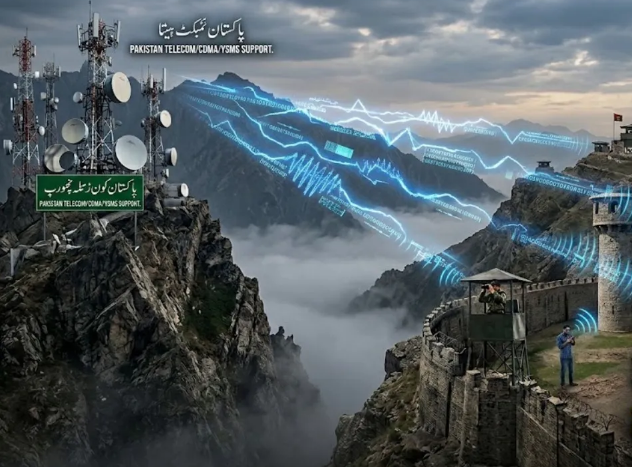
Pakistan has allegedly intensified efforts to sustain terror networks operating along the Jammu and Kashmir border by transmitting cellular signals across the Line of Control (LoC), raising fresh security concerns for Indian authorities. Security officials claim that the cross-border telecom activity is enabling terrorists to maintain communication with handlers based in Pakistan-occupied Kashmir (PoK), despite international regulations prohibiting such transmissions.
According to security agencies, Pakistan has been sending mobile network signals into Indian territory from telecom towers installed close to the LoC in PoK. Officials allege that these signals have become a critical communication channel for terrorists, facilitating contact with handlers and support networks operating across the border.
The issue has gained significance amid reports of increased infiltration attempts through the strategically important South Pir Panjal mountain ranges. Security officials believe the telecom infrastructure is playing a key role in supporting cross-border terror operations and sustaining communication links between infiltrators and their coordinators.
Authorities say the impact of these signals varies across the region. While the high mountain ranges of Kashmir block a substantial portion of the transmissions, the comparatively flat terrain of the Jammu region allows the signals to penetrate deeper into Indian territory. As a result, mobile signals originating from Pakistan have reportedly been detected in several sensitive areas, including Kathua, Rajouri and Poonch districts.
Security agencies have also identified the presence of Pakistani telecom signals near high-security facilities such as Kot Bhalwal Jail in Jammu. Officials claim that despite the installation of advanced jamming systems in several prisons, the incoming signals continue to bypass security measures, allowing unauthorized communication through illegally possessed mobile phones.
Authorities allege that terrorists lodged in prisons are exploiting these communication channels to remain in contact with handlers in PoK and local support networks, commonly referred to as Over Ground Workers (OGWs). Jammu and Kashmir currently has 14 prisons and two correctional homes, making the issue a significant concern for law enforcement agencies.
Security officials have further pointed to a possible Chinese technological link behind the telecom infrastructure. According to reports, the towers installed along the Pakistan side of the border are operating on CDMA technology supplied by China. Officials say the technology offers advanced encryption capabilities and supports communication platforms that are difficult to monitor through conventional electronic surveillance methods.
The use of CDMA technology, which can simultaneously support multiple signals, is reportedly creating additional challenges for Indian intelligence and cyber-monitoring agencies. Security officials contend that the encrypted nature of these communications makes tracking terrorist networks and intercepting their communications considerably more difficult.
Indian authorities have also alleged that Pakistan’s actions constitute a violation of international telecommunications norms. Officials argue that the transmission of high-intensity cellular signals across borders is contrary to Article 45 of the Constitution of the International Telecommunication Union (ITU), which requires member states to prevent harmful or unauthorized radio and cellular transmissions from affecting neighboring countries.
Under the ITU framework, all 193 member nations, including India and Pakistan, are expected to cooperate in ensuring that radio and telecom transmissions originating from their territories do not interfere with neighboring states. Security officials maintain that the alleged cross-border signal transmissions are inconsistent with these obligations.
Indian security agencies believe the telecom activity is part of a broader effort to facilitate terrorism and infiltration operations in Jammu and Kashmir. The developments have once again drawn attention to the growing role of technology and telecommunications infrastructure in cross-border security challenges and counter-terrorism operations along the India-Pakistan border.