





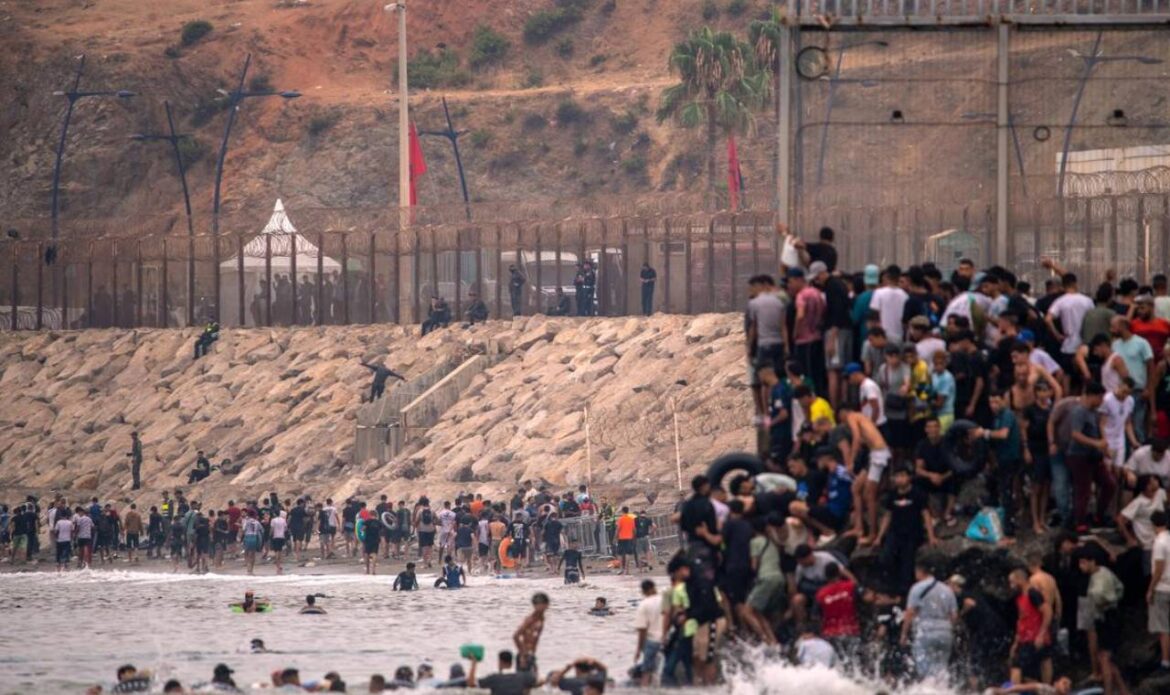
Thousands of migrants overwhelmed security forces to cross into Ceuta, Spain’s North African territory bordering Morocco, marking the largest mass entry into Spanish territory since the 2021 migration crisis. While Spanish authorities have not released an official figure, between 2,000 and 3,000 migrants are reported to have entered Ceuta within just a few hours. Many arrived by sea, while others broke through the border fences separating the enclave from Morocco.
The massive influx has placed severe strain on police, reigniting concerns over migration at the European Union’s only land border with Africa. As the surge intensified, Ceuta’s regional government urged Madrid to declare a state of emergency and deploy additional security forces. Spain’s Guardia Civil reported that migrants were entering in large numbers by sea via the Tarajal breakwater, bypassing deployed police. Videos circulating on social media showed groups of migrants swimming around the breakwater using inflatable tubes and makeshift rafts.
Others forced open a gate at the border fence and ran into Ceuta, with some reportedly shouting pro-Spain slogans as they entered the enclave. The scenes evoked memories of the extraordinary migration crisis of May 2021, when nearly 10,000 migrants from Morocco and sub-Saharan Africa entered Ceuta within just a few days. Along with the nearby Spanish territory of Melilla, Ceuta remains the EU’s only land border with Africa and has long served as a key gateway for migrants seeking to reach Europe.
As the number of arriving migrants steadily rose, Ceuta’s regional president, Juan Jesús Vivas, appealed to Madrid to deploy the military to restore public order, strengthen security, and temporarily close the border with Morocco to prevent further incursions. However, Spain’s Ministry of Defence clarified that there were no immediate plans to deploy military personnel. Prime Minister Pedro Sánchez later responded, stating that the government remained fully committed to providing an immediate response to the crisis.
Following his conversation with Vivas, Sánchez said that all necessary resources were being mobilized and that Spain was working with Morocco and international authorities to prepare the measures needed to restore normalcy as quickly as possible. Without disclosing specific steps, he said this was the right moment to build solutions through responsibility and cooperation.
Spain’s Interior Ministry said it remained in constant coordination with Moroccan authorities and noted that thousands of illegal crossing attempts had been thwarted in recent days. It added that anyone found to have entered Spain illegally would be deported immediately, and alleged that human trafficking networks were exploiting the situation to their advantage.