





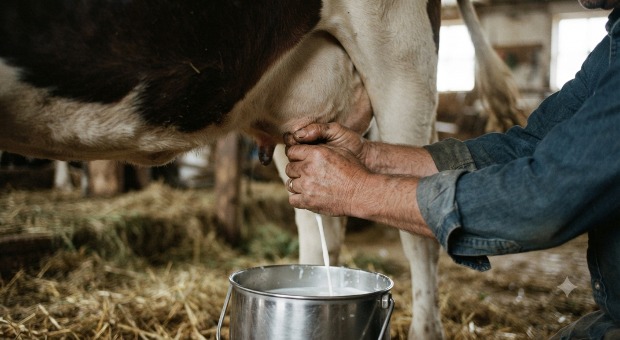
Amid growing concerns over adulteration in packet milk, many consumers in Hyderabad have been switching to raw milk bought directly from cows and buffaloes, despite the higher cost involved. However, a new study has found that such raw milk sold in the city contains faecal bacteria, yeast, and Salmonella, which can cause intestinal infections and diarrhoea in children. The study was conducted jointly by the Royal Veterinary College (London), the London School of Hygiene and Tropical Medicine, and the International Livestock Research Institute, with key support from the National Institute of Nutrition (NIN) and PV Narasimha Rao Telangana Veterinary University, and was published in a journal by The Royal Society Publishing House.
As part of the study, researchers collected 42 milk samples, 20 water samples, and 24 cattle feed samples from the Addagutta and Warasiguda areas of Hyderabad. Faecal bacteria was found in 90.5 percent of milk samples, while yeast and mould were detected in 95.2 percent. About a third of the samples contained Salmonella-like bacteria, 31 percent had food-poisoning-causing Staphylococcus aureus, and 12 percent contained the dangerous E. coli bacteria.
Researchers also found that 67 percent of cattle feed samples contained aflatoxins, a highly dangerous natural toxin commonly found in contaminated cattle feed, maize, and groundnuts. When cattle consume such contaminated feed, the toxin passes into their milk and subsequently into humans who consume it. World Health Organisation studies note that pregnant women consuming such milk may give birth to underweight babies with growth-related problems. Researchers said faecal bacteria typically enters milk through contaminated water used during milking and handling.
Experts have pointed out a key difference between packet milk and raw milk. Packet milk sold commercially is pasteurised — heated to 71.7 degrees Celsius for 15 seconds and then rapidly cooled to 4 degrees — meaning it only needs to be brought to a boil before consumption. Raw milk collected directly from cattle, however, is unpasteurised and must be boiled on low heat for a longer duration, with an additional five minutes of simmering after it comes to a boil, in order to kill harmful bacteria.
To ensure safety, experts recommend that consumers buy milk only from government-certified labs or verified dairy farms, and boil all milk — whether packet or raw — for at least ten minutes before drinking. They also advised dairy farmers to maintain clean sheds, wash udders with clean water before milking, wash their hands with soap before handling udders, use only chlorinated water to clean milk cans, and conduct periodic thermal and bacterial testing to build consumer confidence.