





- Ravi Prakash

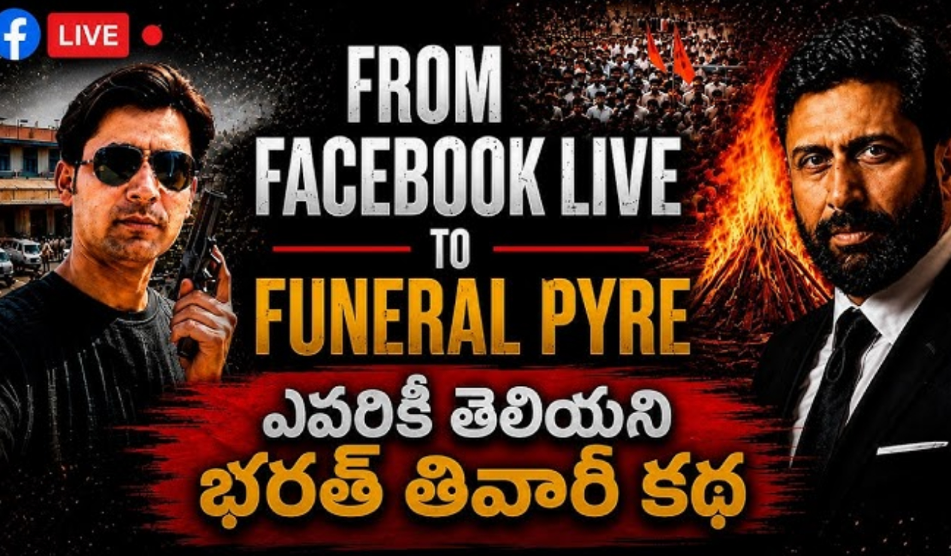
On the morning of June 17, 2026, Bharat Bhushan Tiwari climbed to the rooftop of his home in the Shapur area of Bhojpur district, a country-made pistol in his hand, and went live on Facebook. What followed over the next several hours — broadcast in real time to thousands of viewers — ended in his death and ignited a controversy that has shaken Bihar to its foundations.
The central question is unresolved: did Bharat Bhushan Tiwari surrender before police opened fire?
Who Was Bharat Bhushan Tiwari?
Tiwari was not a career criminal, nor a political figure. He was a 27-year-old resident of the Shapur belt who had spent two years as a vocal advocate for families displaced by riverbank erosion and annual flooding — communities that alleged the state had failed to provide functional rehabilitation. He recorded videos from affected areas, used Facebook Live to document conditions in camps, questioned officials by name, and demanded accountability on promises made to flood victims.
His supporters describe a man who was always accessible to ordinary people — one who submitted complaints, followed up with officials, and showed up where few others would. His Facebook presence was substantial, his following loyal.
But his own videos tell a more complicated story. Over time, observers noted a visible shift in his public manner: restraint gave way to confrontation, anger grew louder, and in some posts he spoke of acquiring weapons and leading a rebellion against a system he described as indifferent to the poor. Whether those statements reflected political rhetoric, personal anguish, or something more alarming is now part of what the judicial inquiry must determine.
On June 16th — the day before the fatal encounter — the police issued a public statement. It did not describe Bharat Bhushan Tiwari as a criminal or a terrorist. It described him as a person whose mental state appeared unstable and said arrangements were being made to take him to a psychiatric facility for treatment.
Within 24 hours, that same person was dead from a police bullet.
The Day Before: What the Police Statement Said — and Didn’t Do
On June 16th, police received credible information that Tiwari possessed an illegal firearm and was carrying it. Officers went to his home. They spent hours negotiating. Family members were present. Villagers watched. By most accounts, the situation was tense but did not explode. Police departed without taking Tiwari into custody and without seizing the weapon.
That decision is now at the centre of the controversy.
The June 16th statement is unambiguous: police believed Bharat needed care, not incarceration. They knew he had a weapon. They spent hours at his home. They left without resolving the situation. The next morning, their operation ended in his death.
Critics — including members of the ruling party — are now asking why the weapon was not seized on June 16th; why Tiwari was not taken for a medical evaluation on June 16th; and whether the events of June 17th were a preventable tragedy.
By the morning of June 17th, Tiwari had returned to Facebook Live. The audience grew rapidly. Thousands watched as he stood on his rooftop, pistol visible, making statements to the assembled police forces below. Officers repeatedly appealed for him to surrender. In footage circulated after the incident, Tiwari can be seen firing shots into the air. The situation, by any measure, was volatile.
Over time, the confrontation moved from the rooftop to the entrance of the home. Tiwari’s mother was present. Police were talking with him. Witnesses, along with those watching the livestream, described what appeared to be a de-escalating situation — a standoff winding toward a peaceful conclusion.
Then the Facebook Live cut off.
What happened in the minutes after the livestream ended is the question Bihar cannot resolve. Two irreconcilable accounts have emerged.
Tiwari’s family — and his father, explicitly — say that Bharat had already surrendered. Multiple videos, which subsequently went viral, appear to show the weapon on the ground, with Tiwari no longer holding it. His supporters contend the confrontation was over.
Police tell a different story. According to official sources, Tiwari picked up the weapon again after the livestream ended and fired at officers. Police maintain they fired in self-defence to protect both their personnel and nearby civilians.
Between these two versions — one of a man shot after laying down his weapon, the other of a man who turned dangerous again when cameras went dark — lies the truth Bihar is waiting for.
The footage spread rapidly. Within hours, the controversy had outgrown its village origins and consumed the state.
Tiwari’s family filed complaints. Civil society organisations called the incident a staged encounter. Opposition leaders demanded answers. More unusually, senior figures within the ruling coalition also spoke out publicly, some displaying the videos and questioning the circumstances of the shooting.
Four police personnel connected to the incident were suspended. The suspension deepened public suspicion rather than alleviating it — prompting police officials to clarify that removal pending inquiry is standard procedure and does not constitute an admission of guilt.
The Bihar government ordered a judicial inquiry, to be conducted by a retired High Court judge. The inquiry is now the only mechanism through which the competing claims can be authoritatively adjudicated.
Thousands gathered at Tiwari’s funeral procession. Roads were filled. The turnout crossed every expectation — young people, women, the elderly, people from multiple communities, many of them raising slogans demanding truth. Whatever the final legal finding, the public response made clear that the death of Bharat Bhushan Tiwari had struck a nerve that went far beyond one family in Bhojpur.
Bihar is not, at this moment, debating whether Bharat Bhushan Tiwari was a saint or a criminal. The state’s attention has converged on a narrower, more urgent question — one with implications that extend well beyond this case.
When a person puts down their weapon and signals surrender, what is the law required to do?
The answer cannot vary by caste, religion, political affiliation, or personal history. The Constitution does not prescribe different standards of justice for the powerful and the powerless. If Tiwari posed an ongoing threat when shots were fired, police must produce credible evidence. If he had already surrendered, that fact must be established with equal rigour and its consequences must follow. A judicial inquiry exists precisely to make that determination — not to satisfy any political party, and not to service social media outrage, but to give the people of Bihar, including Tiwari’s family and the officers involved, a factual account of what happened.
Several things are not in dispute. Tiwari had an illegal weapon. He fired it in the air. He made statements that alarmed officials. He created a situation that required an active police response. The law provides remedies for each of those facts. Courts exist to apply those remedies. The rule of law — not rage, not retribution — is what should have governed the final moments of that confrontation.
Whether it did is what the inquiry must now determine.
Bihar is waiting.