





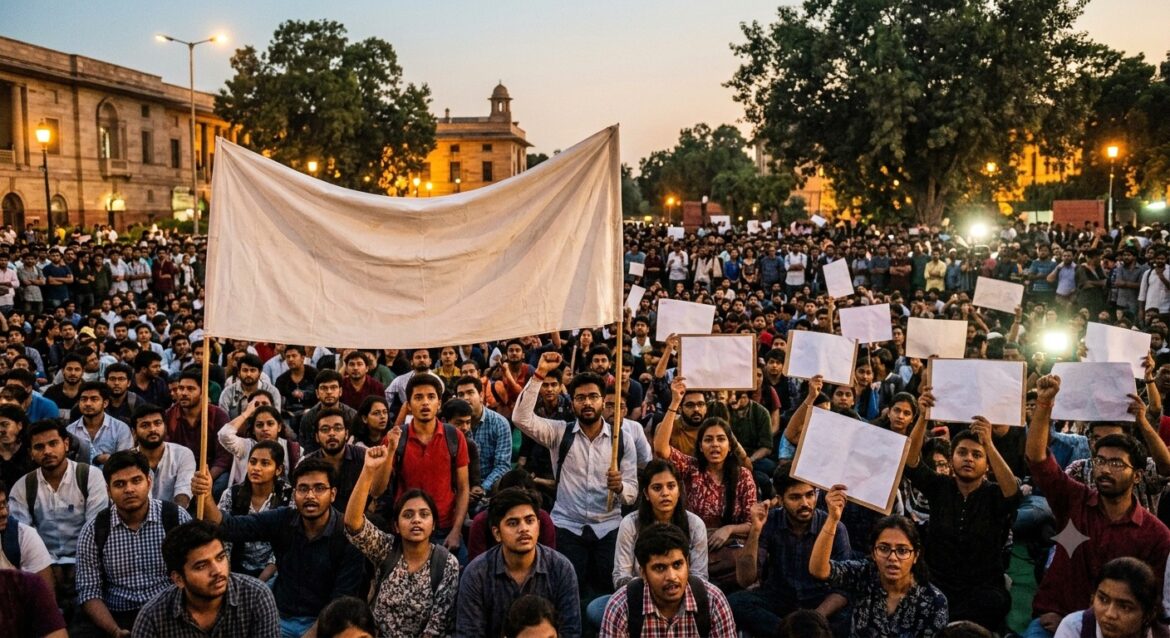
New Delhi — A quiet but decisive shift is taking shape in Indian politics, and its clearest recent expression came during the nationwide protests over the NEET-UG paper leak. Student demonstrations demanding the resignation of the Union Education Minister showed, in unmistakable terms, that India’s young people are no longer content to be silent spectators of national affairs. The episode was never only about a compromised medical entrance exam — it marked, in effect, the formal political coming-of-age of India’s newest generation of voters.
A Resignation That Reshaped the Conversation
The resignation of Union Education Minister Dharmendra Pradhan, following weeks of unrest over rigging and leak allegations in the NEET-UG examination, has added a new dimension to national politics. The episode made one thing clear: governments can no longer afford to dismiss the concerns of the country’s youth — broadly defined here as those between 18 and 32 years of age.
What began as a protest over fair examination procedures escalated rapidly into a broader movement demanding accountability from the government and reform of the education system. The speed with which this happened illustrated something larger: a generation raised on the internet and social media can now mobilize — and steer the national conversation — almost overnight.
Youth Will Be the Largest Voting Bloc by 2029
By the time India holds its next general election in 2029, citizens aged 18 to 32 are projected to make up the country’s largest adult population group — and, by extension, its most consequential vote bank.
The numbers are striking. Population projections suggest that this age cohort will number approximately 380 million by 2029, comprising roughly 199 million men and 181 million women. That would make it larger than the generation just ahead of it — the 33-to-45 age group — whose population is estimated at around 357 million by the same year.
What Issues Will Define the Election
This youth bloc will include large numbers of students, first-time voters, and people early in their careers. As a result, analysts expect the 2029 campaign to be shaped less by traditional political themes and more by issues such as employment, quality education, cost of living, inflation, environmental concerns, and demands for transparent governance.
Just behind this group stands an even larger cohort: children who will remain below voting age in 2029 but who, at an estimated 417 million, will constitute India’s single largest age group overall.
A Shrinking Share, a Growing Voice
Interestingly, the youth share of India’s overall electorate has been gradually declining as the country’s elderly population grows. In 1988, voters aged 18 to 29 made up 38.3 percent of the electorate. That figure fell to 30.1 percent by 2024, and is projected to decline further to 27.8 percent by the 2029 general election. In practical terms, this means roughly one in four voters in 2029 will fall between the ages of 18 and 29.
Why does a shrinking share still translate into growing influence? Analysts argue that this generation’s power lies not just in raw numbers but in its digital fluency, its capacity for big-picture thinking, and its ability to mobilize within minutes through social media. The NEET controversy stands as the clearest recent example of how quickly this generation can turn a single grievance into a matter of national urgency.
Alongside this shift, India’s broader population structure is also changing. The share of children in the population is falling, even as the middle-aged and elderly population expands rapidly. Among men, this demographic share is projected to fall from 45.2 percent in 1989 to 27.8 percent by 2029; among women, from 44.8 percent to 27.3 percent over the same period.
The Middle-Aged and Elderly Population Is Expanding
The share of Indians aged 46 to 61 has already climbed to nearly 18 percent of the population, while the population of senior citizens aged 62 and above is expected to roughly double, reaching an estimated 10 to 11 percent.
A Force No Party Can Afford to Underestimate
What started as a demand for the Union Education Minister’s resignation over the NEET paper leak has evolved into something larger: a rallying point for the political emergence of India’s new generation. When India goes to the polls in 2029, an estimated 380 million young voters will hold significant sway over the outcome — a bloc no political party can afford to take lightly. As the NEET episode demonstrated, this is the first generation of Indians equipped to turn any grievance into a nationwide debate within minutes, and it is likely to shape the country’s political discourse for years to come.