





- Ravi Prakash

A clarification from the Ministry of External Affairs has ignited a national debate. At its centre lies a question most Indians have never thought to ask.
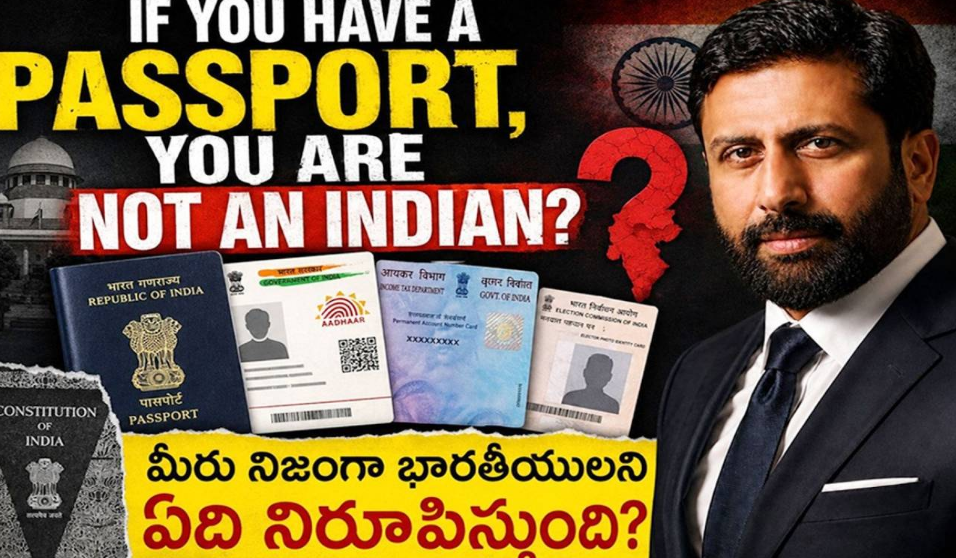
Pick up an Indian passport. It reads “Republic of India” on the cover. It carries the Ashoka Chakra. It was issued by the Government of India. And inside, printed clearly, it says “Indian.”
Now consider this question. If someone tomorrow demands proof that you are an Indian citizen — can you show this passport?
The instinctive answer, for most people, would be an emphatic yes. If you hold an Indian passport, you are an Indian citizen. It is simple. It is logical. And for decades, crores of Indians have lived by that assumption.
But there is a twist. Simply holding a passport may not be enough. And that single legal reality has now triggered one of the most significant legal and political debates the country has seen in recent years. Because the Ministry of External Affairs has made something explicitly clear.
A passport is a journey document. It is not a certificate of citizenship.
That statement left crores of Indians stunned. Social media erupted almost immediately. Opposition parties accused the government of manufacturing deliberate confusion. Former bureaucrats questioned the logic. Legal experts entered the debate from multiple directions. Television studios converted it into a political battleground. But in the middle of all this noise, one central question went unanswered.
If a passport is not the final proof of citizenship — then what is?
The answer requires going beyond the political noise — through the Constitution, the Citizenship Act, the Passports Act, and court judgments — to find out what the law actually says. Because what emerges is something that shockingly, most Indians do not know. What legally proves that you are an Indian citizen?
The Ministry of External Affairs did not suddenly announce a new law. It did not cancel Indian passports. It did not declare passport holders to be foreigners. What the government did was clarify provisions that have existed in law for a very long time.
The government’s position is straightforward. An Indian passport is primarily a document of identification — a document issued for the purpose of travel. Citizenship, however, is separately determined under the Citizenship Act of 1955. That one distinction became the central flashpoint of the entire controversy.
The explanation for why this created such confusion is equally straightforward. Until now, most Indians have treated passport and citizenship as interchangeable. Legally, the two are closely related. But legally, they are also distinct. And one specific provision buried inside the Passports Act has made this confusion considerably worse.
Under Section 20 of the Passports Act, 1967, in emergency situations and keeping public interest in mind, the Central Government holds the power to issue a passport even to a person who is not an Indian citizen. The law itself provides for that exception.
This does not mean any foreigner can walk into a Passport Seva Kendra and receive an Indian passport. This is a power that rests exclusively with the Central Government, exercisable only in extraordinarily rare and specific circumstances under strict conditions. It is not a general rule. It is an exception for highly unusual cases. But the mere existence of this provision in law became sufficient to fuel a major strand of the national debate.
Shiv Sena UBT leader Aaditya Thackeray raised three pointed questions. If a passport is not proof of citizenship, what exactly do police verify before one is issued? Is India issuing passports to foreigners under the label of travel documents? And will statements like these create global confusion about the credibility of Indian passports? These are not questions to be dismissed as purely political. They are the same questions ordinary Indians across the country began asking.
A sharper reaction came from former IPS officer Yashwant Azad, who responded with biting sarcasm. If a passport is not proof — and if Aadhaar is not proof — and if Voter ID is not proof — then who exactly are we? Should Indians be identified as zombies who arrived from Mars?
Azad’s post pointed to something far deeper than political disagreement. It put on full display the anxiety running through ordinary citizens — the fear that after a lifetime of carrying government-issued documents, there may be no single paper that conclusively establishes who they are.
Noted lyricist Javed Akhtar added his voice on X. “The Ministry of External Affairs is saying that a passport is only a travel document, not proof of citizenship. Seriously??? So they’re giving out this travel document without being fully convinced that the person is actually an Indian citizen? This is honestly laughable.”
The question Akhtar raised captured what millions of ordinary Indians were thinking. The Indian government itself conducts a police inquiry before issuing a passport. That passport specifically states the holder’s nationality as “Indian.” How, then, can that same government maintain that the passport is merely a travel document and not valid proof of citizenship?
That question raised the temperature of the debate significantly. And it exposed a deeper systemic failure. If crores of Indians have no clarity on which document legally establishes their citizenship, the system has comprehensively failed in communicating this to the people it governs.
Senior journalist Rahul Shivshankar entered the debate from the opposite direction, arguing that while the controversy appears extraordinary, the legal position it reflects is not new at all.
According to Shivshankar, Indian citizenship has never rested on a single document. Courts have always examined a combination of records — birth date entries, parents’ citizenship, school records, electoral rolls, passports, government records, residence certificates, and other official documentation. His argument was precise: the Ministry of External Affairs is not changing the law. It is reiterating what courts have already established and settled long ago.
Senior advisor in the Ministry of Information and Broadcasting, Kanchan Gupta, went a step further. He argued that a passport is a travel document and nothing more — and that this is true in every country in the world, not just India. He connected this clarification to the National Register of Citizens and to citizenship identity cards proposed for the future, arguing that the combination would finally eliminate the longstanding confusion around citizenship. Whether one agrees or disagrees with his political vision is a separate debate. The legal clarification itself, he maintained, is grounded in existing law.
What is clear from the government’s position is this. The External Affairs Ministry was not sharing a personal opinion. Their legal argument flows directly from the framework of existing statutes. The Passport Manual itself states that a passport is primarily a travel document issued to citizens of the country. And it immediately references Section 20 of the Passports Act — the provision most Indians have never heard of — which confirms that even a non-citizen can, in exceptional circumstances, be issued one by the Central Government.
Every Indian child, upon birth, receives a birth certificate. Aadhaar follows. Then perhaps a PAN card. A driving licence. A Voter ID. And eventually, possibly, an Indian passport. But at no point in this entire journey does any person receive a single document that is sufficient by itself to legally prove citizenship in every situation.
That is because Indian citizenship is governed entirely by a separate and distinct law — the Citizenship Act of 1955.
This is the legal foundation the External Affairs Ministry’s clarification rests on. And it is the same foundation that courts have been applying for years.
The Bombay High Court recently addressed this question directly in the case of Baba Abdul Rauf Sardar versus the State of Maharashtra. Justice Amit Borkar presided over the proceedings. The case involved a Bangladeshi national accused of entering India illegally and obtaining official documents through forged papers.
During the proceedings, the court made a critical observation. Justice Borkar stated that for questions of nationality in India, the primary legal foundation is the Citizenship Act of 1955. It is this law that determines how citizenship is acquired, how it is obtained, and how it is lost.
The court then made the statement that drew the most public attention. Merely possessing documents such as Aadhaar card, PAN card, or Voter ID does not automatically confer Indian citizenship on any person. The court went further — these documents serve only the purposes of identification and access to services. Citizenship cannot be determined on the basis of these documents alone.
Critically, the court did not say Aadhaar has no value. It did not call PAN meaningless. It did not say Voter ID is fraudulent. It said each of these documents serves a distinct legal function. And none of them can substitute for or override the Citizenship Act.
The court then noted that in the context of the dispute before it — involving serious allegations of illegal entry and document fraud — the petitioner had failed to produce documentation that properly established a claim to Indian citizenship. That observation must be understood in its context. The court was adjudicating a contested citizenship case involving criminal allegations. It was not pronouncing on the daily lives of ordinary, law-abiding Indian citizens. That distinction is not a footnote — it is central to understanding the entire debate.
Aaditya Thackeray’s question — what do police verify before issuing a passport, if a passport is not proof of citizenship — deserves a direct answer.
Police verification is a significant security procedure. Officers check identity, verify the address, examine criminal history, and investigate whether an applicant is concealing information. But police verification is not a judicial ruling on citizenship. Police do not function as courts. They do not adjudicate contested cases under the Citizenship Act. That authority rests ultimately within the legal framework established by Parliament and interpreted by the judiciary.
To illustrate the distinction: if a person obtains an Indian passport using a forged birth certificate, fake parental documents, and fabricated identity papers — does receiving that passport make them a permanent Indian citizen? Absolutely not. When the fraud is uncovered, the passport can be cancelled. A passport establishes which country’s legal citizen a person is at the point of issuance, based on the records submitted. It does not speak to the underlying truth of that claim when the claim is subsequently challenged.
This is precisely the distinction lawyers draw between evidence and conclusive proof. And perhaps the absence of public clarity on this distinction is what caused this entire controversy in the first place.
Five Documents, Five Different Legal Functions
Consider five people standing before you. The first holds an Aadhaar card. The second holds a PAN card. The third holds a driving licence. The fourth holds a Voter ID. The fifth holds an Indian passport.
Parliament did not create all five of these for the same purpose.
Aadhaar establishes identity and enables access to government services. PAN identifies individuals within the tax system. A driving licence authorises a person to operate a vehicle on public roads. A Voter ID grants the right to participate in elections. A passport facilitates international travel and entitles the holder to consular protection from Indian diplomatic missions abroad.
Each document performs a different legal function. Each was created under different legislation for different purposes. This is why citizenship disputes cannot be resolved by examining a single document in isolation — courts examine the totality of legal evidence. It is also, as Shivshankar argued, precisely what courts have been doing for decades. The Ministry of External Affairs is not introducing a new legal standard. It is restating one that has been in place all along.
Why Is This Debate Happening Now?
If the law has always been this way — why are crores of Indians hearing this for the first time right now? Why has a legal clarification suddenly erupted into a political firestorm? And why are people connecting this to NRC, citizenship identity cards, and future verification exercises?
These are not questions with simple answers. But they point to the real crisis at the heart of this controversy — not a crisis of law, but a crisis of communication. For decades, no government, no institution, and no public authority clearly explained to ordinary Indians the legal difference between identity, nationality, citizenship, and a travel document. The four words were used interchangeably in everyday life, in official discourse, and in political speech. The law, however, never treated them as interchangeable.
The shock that greeted the Ministry of External Affairs’ clarification was not the shock of a changed law. It was the shock of most people encountering these legal distinctions for the very first time. That is a failure of public communication spanning decades — and it belongs not to one government but to the system as a whole.
In a democracy, citizens should not have to wait for a political controversy to erupt before they learn what the word “citizen” legally means. These distinctions should have been explained to the public long before confusion took hold. Not after.
For the law-abiding Indian citizen with no dispute or legal challenge to their citizenship, the practical answer is clear. Your passport is secure. This controversy has not suddenly rendered your passport invalid. It continues to function exactly as it always has — as a travel document, as a document that identifies your nationality, recognised by foreign governments, airlines, and Indian embassies worldwide. Nothing has changed. You do not need to run after new documents.
What the law says is this. Indian citizenship is governed by the Constitution and the Citizenship Act. In ordinary life, the full suite of government-issued documents — passport, Aadhaar, PAN, Voter ID — collectively gives every Indian official recognition and access to rights and services. But when citizenship itself becomes the subject of a specific legal dispute, when allegations of illegal entry or document fraud are raised, when a citizenship claim is formally challenged before a court — it is in those extraordinary situations alone that courts examine all available evidence under the Citizenship Act, and no single document serves as conclusive proof.
Consider the wallet exercise one final time. Every card in it tells a different story. Aadhaar says who you are. PAN places you in the tax system. A driving licence confirms you are authorised to drive. Voter ID establishes your right to vote. And the passport — it identifies your nationality as Indian and stands as a travel document issued to you by the Government of India.
Together, they constitute your official recognition as a citizen in daily life. But the law that governs the legal status of that citizenship — in any situation where it becomes a matter of genuine dispute — is the Citizenship Act of 1955. That has not changed. It was always this way.
The Ashoka Chakra on the passport has not moved. The words “Republic of India” are still printed on the cover. The word “Indian” is still stamped inside. Nothing in the document itself has changed.
The only thing that changed is public understanding of the legal framework behind it.
Sometimes the most significant controversies do not expose flaws in the law. They expose the distance between what the law says and what the public has been told. That is exactly what happened here. And that gap — between legal reality and public awareness — is the real story of this debate.
So when someone asks: if you have a passport, doesn’t that make you Indian? — the answer is not a simple yes or no. The real answer lies in understanding the difference between a travel document, an identity document, and citizenship as defined under Indian law. That answer does not live on social media. It lives in the Constitution, the Citizenship Act, and the judgments of the courts.