





– Ravi Prakash

Every year, lakhs of devotees undertake the Kanwar Yatra. Some walk hundreds of kilometers; some complete the pilgrimage without even wearing footwear. Many observe fasts throughout the journey, follow strict discipline, and offer prayers. For them, this is not merely a festival — and certainly not entertainment. It is their faith, their belief, a sacred pilgrimage undertaken in devotion to Lord Shiva. The Constitution grants every Indian citizen the right to practice the religion and faith of their choice with dignity.
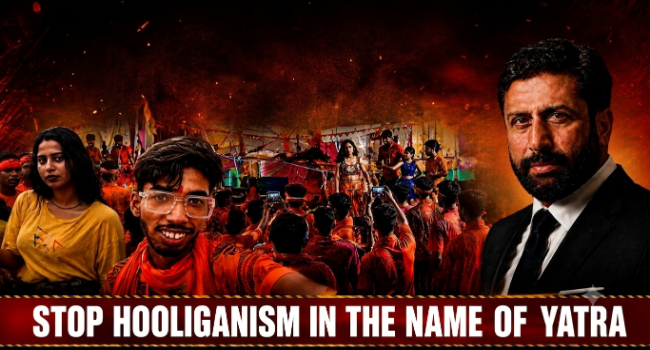
However, over the past few days, a series of videos have gone viral on social media that raise troubling questions. One shows a Bhojpuri dance performance, with hundreds of Kanwariyas dancing, many filming the performance on their phones, and others cheering along. The question that arises is straightforward: what does this have to do with the Kanwar Yatra? What does it have to do with devotion, or with Lord Shiva himself?
To be clear, this is not a question directed against the Kanwar Yatra, against Lord Shiva, or against the faith of the lakhs of devotees who undertake this pilgrimage. The question concerns those few individuals who, in the name of religion, are undermining the very honor of that religion. When lakhs of devotees carry out a sacred pilgrimage with devotion and discipline, and a handful turn it into what resembles a public entertainment event, the actions of that small group end up shaping the perception of the entire pilgrimage — affecting not just public opinion, but the reputation of the lakhs of genuine devotees who undertake the journey in earnest faith.
Why These Videos Demand Scrutiny
There is an additional reason these videos warrant discussion: they are emerging from Uttar Pradesh, a state whose Chief Minister describes himself as a “Yogi.” In such a state, the public naturally expects that so sacred a pilgrimage be conducted with discipline, dignity, and reverence. The question, therefore, is not whether the Kanwar Yatra should take place — it must, without question. The real question is: who is responsible for safeguarding its honor?
In another video, those seen dancing are themselves dressed in saffron robes, with hundreds of Kanwar pilgrims standing before the stage — many dancing, many filming, others cheering. This raises a pointed question: is this what saffron represents? For centuries, saffron has stood for sacrifice, renunciation, discipline, and spirituality. It is not merely a color — it carries emotional and symbolic weight, and with it, a sense of responsibility.
This is illustrated by a precedent: a few years ago, when a film actress wore saffron-colored clothing in a movie song, it triggered a nationwide controversy, complete with protests, television debates, and statements from political leaders — all insisting that saffron’s sanctity be respected. If that standard applied there, an equally valid question is whether the same respect should not be expected within a religious pilgrimage itself. Or do standards shift depending on who is wearing the color?
To be unambiguous, this is not a criticism of the young people in these videos, nor of the Kanwar Yatra itself. It is a question directed at those turning a sacred pilgrimage into a public spectacle — and, by extension, at the administrative authorities. Who granted permission for these events? These are not clandestine occurrences: the stages are set up in public spaces, with hundreds of people present and everything unfolding in plain view, suggesting that some form of official permission must have been granted.
When Devotion Becomes Content
In yet another video, a young man is seen laughing and filming himself, seemingly intent on preserving the moment as a lasting memory, with a dance performance playing out behind him. This raises a deeper question: is this truly the purpose of the Kanwar Yatra? When such videos are uploaded to Instagram, Facebook, or X, what message do they send — not just domestically, but globally? Will viewers around the world see this as one of the largest spiritual pilgrimages on earth, or merely another entertainment festival? Therein lies the real tragedy: the actions of a few can alter global perception of an event undertaken with genuine devotion by lakhs of people.
Every year, lakhs of Kanwar pilgrims walk for days, sleep by the roadside, and carry sacred water with great discipline, chanting “Har Har Mahadev.” They cause no disturbance, damage no property, attack no one, and seek no attention. Yet these devotees rarely go viral — it is the videos involving violence, threats, destruction, and inappropriate conduct that circulate widely. Gradually, social media appears to be reshaping the very purpose of this sacred pilgrimage, turning it, for some, into a pursuit of viral content, likes, and views rather than devotion.
In one further video, an apparently intoxicated Kanwar pilgrim is seen climbing onto a stage and dancing alongside a performer. This prompts a pointed question: is this individual undertaking the Kanwar Yatra out of devotion, or for entertainment? Once again, this should not be misread as an indictment of the pilgrimage itself — lakhs of pilgrims undertake this journey with genuine devotion, walking hundreds of kilometers with discipline and treating the pilgrimage as an act of service to God, and they deserve respect. But if such videos come to define the public image of the Kanwar Yatra, the damage extends beyond any one individual to the reputation of the pilgrimage as a whole, doing a disservice to its genuinely devout participants. The real question, then, is not whether the Kanwar Yatra should continue — it must — but who will safeguard its honor, given that devotion appears increasingly to be receding while spectacle advances, and prayer is giving way to performance.
From Cultural Concerns to Questions of Law and Order
Beyond questions of decorum, a separate and more serious set of videos raises concerns not about culture, but about violence — concerns that, whenever violence occurs in the name of religion, responsible citizens are obligated to examine.
One such video reportedly shows an individual who, according to available information, accidentally touched a kanwar and was subsequently attacked by a group of people. Complete details of the incident remain unknown, and the actual sequence of events will need to be established through police investigation. What is evident, however, is that a group of individuals is seen assaulting a person while a police constable stands nearby. This raises a fundamental question — one that concerns not religion or politics, but the Constitution itself: who holds the authority to punish a citizen — a mob, or the law? If a wrong has been committed, police may act, and it is for a court to determine whether a crime occurred. But a mob cannot assume the role of judge, deliver a verdict, and administer punishment. If mobs are permitted to take the law into their own hands, no citizen — regardless of who they are — can remain safe, and public trust in the rule of law, along with democratic institutions, is correspondingly weakened.
Another video shows a police officer running, pursued by a crowd. This image raises questions that extend beyond the specific incident to matters of governance and law and order more broadly. The Uttar Pradesh government under Chief Minister Yogi Adityanath has repeatedly emphasized a policy of “zero tolerance” toward crime and lawlessness; if that principle is to be applied consistently, it should be visible here as well. The relevant issue is not the identity of the crowd, but whether the law is applied equally to all — whether the response to road blockades, property destruction, or assaults on individuals follows a single, consistent standard, irrespective of who is involved or who stands behind them.
Questions of Accountability and Compliance
A further video raises the question of whether religious identity can be used as a license to disregard the law. It shows a vehicle entirely painted in saffron, inscribed with “Om Namah Shivaya,” and topped with a large idol of Lord Shiva — but with no visible registration number plate. This question, it should be emphasized, has nothing to do with Lord Shiva or with religion; it concerns whether the law — which mandates registration numbers for every vehicle in the country — applies equally, or whether vehicles bearing religious symbols are effectively exempt. These may be uncomfortable questions, but they are ones that must be asked, since respect for the law should apply as consistently as respect for religion, regardless of faith.
A separate video, unrelated to social media dynamics, illustrates a climate of fear: it shows a car being vandalized on a national highway, its windows smashed. While the circumstances preceding the incident remain unclear and must be established through investigation, one principle is unambiguous — no individual, group, religion, or organization has the right to destroy another’s property. Wrongdoing should be met with legal consequences; when punishment is instead meted out on the streets, ordinary citizens are left to live in fear.
A Positive Counterexample
Not all viral content from this year’s pilgrimage has raised concerns. One video, shared by the Ghaziabad Police themselves, shows a Muslim police officer serving as ACP providing drinking water to Shiva devotees — an image that reflects precisely what is expected of law enforcement. Whether during the Kanwar Yatra, the Kumbh Mela, Muharram, Eid, Christmas, or Gurpurab, ensuring that citizens of all faiths can practice their beliefs peacefully and safely is a core responsibility of the state, and police personnel fulfilling that duty deserve recognition.
A Concluding Question
The government demonstrates its capacity to arrange drinking water, deploy thousands of police personnel for security, and even organize flower petal showers for the Kanwar Yatra. The question that remains is why it appears unable to maintain discipline, or to prevent the actions of a few from tarnishing the reputation of lakhs of devotees. It is worth remembering that the overwhelming majority of Kanwar pilgrims are ordinary devotees who walk for days, chant “Har Har Mahadev,” carry sacred water with devotion, cause no harm, damage no property, and engage in no confrontation — yet it is not they who go viral. Instead, it is videos involving violence, threats, destruction, and indecorous conduct that circulate widely, unfairly tarnishing the reputation of both the pilgrimage and its genuinely devout participants.
To reiterate, none of this reflects opposition to the Kanwar Yatra, to Lord Shiva, or to the faith of the lakhs of Hindus who undertake this pilgrimage — quite the opposite: it stems from a wish to honor that faith. Genuine respect for a religion requires safeguarding its honor; remaining silent when a few commit wrongs in its name does no service to that religion and instead damages its reputation. The loss here is not borne by any political party or government, but by the Kanwar Yatra itself — by the devotion, faith, and discipline of lakhs of people, which risk being overshadowed by the conduct of a few. The essential question, then, is not whether the Kanwar Yatra should continue — it must — but whether devotion and discipline can be preserved as its defining identity, since true respect for any religion lies not in celebration, but in the responsibility with which it is practiced.
Har Har Mahadev.