





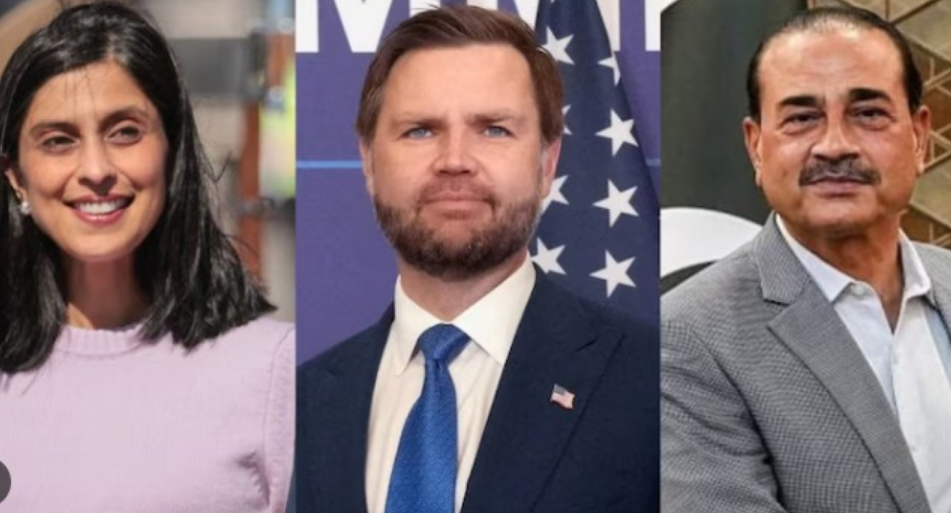
Pakistan and Qatar are currently serving as intermediaries in efforts to broker a peace agreement between the United States and Iran. However, remarks made by US Vice President JD Vance at the recent Switzerland talks have ignited a fierce political controversy back home, with senators from his own Republican Party openly challenging his effusive praise for Islamabad and its military leadership.
At the centre of the dispute are comments Vance made during the Switzerland negotiations, in which he declared that the United States “loves Pakistan” and described Pakistani Army Chief Field Marshal Asim Munir as one of the most important people in his life. Vance revealed that two individuals had been particularly significant to him — one Indian and one Pakistani — identifying them as his wife Usha Chilukuri and Field Marshal Munir respectively. He further disclosed that he had spoken more with Munir than with almost anyone else over the past three months, a revelation that immediately drew fierce criticism from Republican lawmakers.
#WATCH : US Vice President JD Vance joked that the two most important people in his life are "an Indian and a Pakistani," referring to his wife, Usha Vance, and Pakistan's Army Chief Field Marshal Asim Munir.
Vance added that he has spoken with Munir more than almost anyone else… pic.twitter.com/iGuIv9s8bu— upuknews (@upuknews1) June 21, 2026
Republican Senators Rick Scott and Tim Sheehy moved swiftly to condemn Vance’s remarks, arguing that Pakistan and Qatar have decades-long histories of harbouring terrorist organisations and cannot be regarded as neutral or trustworthy mediators. Senator Sheehy, a former US Navy SEAL, was particularly pointed in his criticism, noting that Pakistan had sheltered Osama bin Laden — the world’s most wanted terrorist — for a decade, and accusing its intelligence agency, the ISI, of funding attacks against American interests and channelling money to Iran. He questioned how such a nation could credibly be treated as an impartial broker in sensitive diplomatic negotiations. Qatar, too, was accused of facilitating money laundering for terrorist organisations over several decades.
The Republican senators further argued that restricting the peace process to Pakistan and Qatar as mediators was a strategic miscalculation. They called on the administration to bring in the UAE, Israel, and Saudi Arabia — nations they described as America’s genuinely reliable partners in the Middle East — as active participants in the negotiations. Above all, the senators stressed that preventing Iran from developing nuclear weapons must remain the United States’ overriding priority, regardless of the diplomatic framework being pursued.