





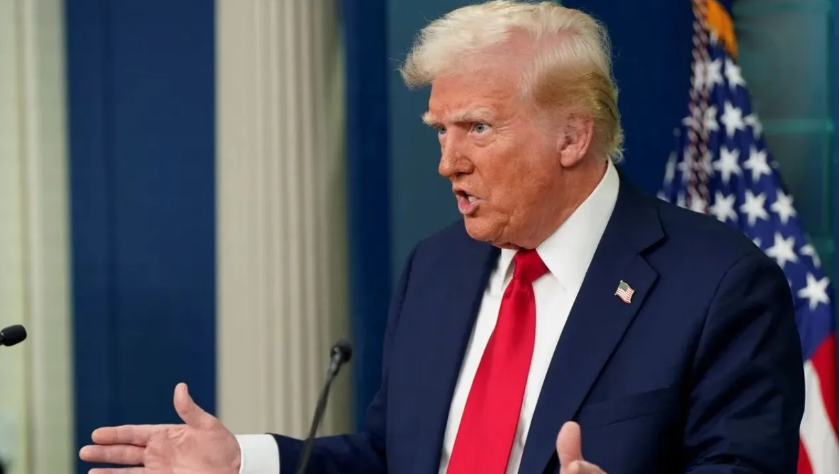
United States President Donald Trump launched a scathing broadside against Iran, declaring that the country had been comprehensively devastated by the recent conflict and that its story was, for all practical purposes, over. Speaking with characteristic bluntness, Trump asserted that Iran no longer possesses an air force, a navy, or even basic anti-aircraft defence systems and radar capabilities, describing the country’s military strength as having been reduced to zero. He made categorically clear that Iran should harbour no expectations of financial assistance from Washington, stating that not a single penny would be forthcoming under any circumstances.
Trump also turned his fire on his domestic political rivals, lashing out at Democrats on his Truth Social platform after they claimed Iran had emerged stronger from the conflict than it was four months ago. Responding with characteristic contempt, Trump ridiculed the assertion, questioning whether there could be anything more foolish and asking rhetorically whether people had lost their senses. He flatly rejected suggestions that his administration had been eager to negotiate, insisting instead that it was Iran that had come to the table in a state of desperation and panic following the conflict. Trump reaffirmed that his administration would proceed within the existing 60-day timeline framework but reiterated with finality that no financial support of any kind would be extended to Tehran.
The remarks came a day after Iran’s Supreme Leader Mojtaba Khamenei made his first public statements since the signing of the US-Iran agreement, offering a sharply contrasting account of how the deal came about. Khamenei accused Trump of having been the one desperately seeking a deal with Iran and of having employed every form of pressure available to bring it about. He also disclosed that he had initially opposed the agreement on principle, revealing that he only relented after receiving assurances from Iranian President Masoud Pezeshkian and members of the Supreme National Security Council that the deal would not compromise Iran’s national interests or damage the Resistance Front.
The duelling narratives from Washington and Tehran lay bare the deep mistrust that continues to define the relationship between the two nations even as a formal agreement sits on the table. With Trump refusing any financial concessions and Khamenei framing his acceptance of the deal as a reluctant concession extracted under pressure, the fragile diplomatic architecture faces significant headwinds — and the 60-day window Trump referenced may prove as contentious as the conflict that preceded it.