





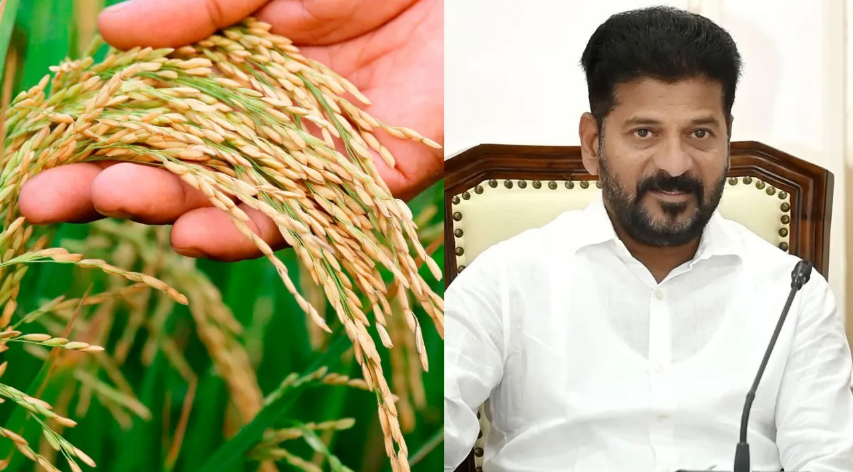
The Telangana government has taken a significant policy decision affecting the state’s paddy farming community, restricting its election-promised bonus of Rs. 500 per quintal for fine grain paddy to only seven officially recognised varieties. The Agriculture Department, after a scientific analysis of domestic and international market demand, has released the list of eligible seed varieties and submitted a detailed report to the Cabinet for approval.
The seven varieties eligible for the bonus are BPT-5204 (Samba Masuri), RNR-15048 (Telangana Sona), HMT Sona, Jai Shriram, KNM-1638 (Kunaram Sannalu), WGL-44 (Siddi), and KNM-7715. Farmers cultivating any of these approved varieties will receive the additional incentive of Rs. 500 per quintal.
The government stated that the rationale behind the restriction is to prevent farmers from suffering losses by growing varieties that lack market demand. Agricultural scientists identified approximately 33 fine grain paddy varieties being cultivated in the state at the time the election promise was made. However, the remaining 26 varieties were found to have larger grain size and higher bran content after milling, making them unsuitable for export and unattractive to consumers. With millers reluctant to procure them and farmers unable to obtain minimum support prices, the Civil Supplies Department and rice millers recommended their exclusion from the bonus list.
Research from Professor Jayashankar Telangana State Agricultural University confirms that the seven selected varieties are well suited to the state’s climate and diverse soil types. Notably, RNR-15048 (Telangana Sona) has a shorter cultivation period, requires less water, and carries a low glycaemic index, driving strong market demand. Kunaram Sannalu and Siddi, developed at research stations in Warangal and Kunaram, demonstrate strong resistance to pests and diseases, particularly blast disease.
The decision has, however, generated mixed reactions among farming communities. Farmers in the erstwhile Nalgonda district’s Miryalaguda belt, who have cultivated a traditional local variety called Chittu (Chitti Muthyalu) for decades, find themselves excluded from the bonus despite the variety’s strong local market reputation, due to the absence of certified genetic documentation and seed certification records. Similarly, private varieties such as Kaveri, Giant BPT, and Nellore Sannalu are also ineligible. The policy effectively compels farmers to shift away from familiar traditional varieties toward the seven government-approved ones.
On the cultivation front, the Agriculture Department projects total sowing across 1.34 crore acres statewide in the upcoming Kharif season, with paddy expected to cover 69 lakh acres. Within that, the government has set a target of cultivating the seven approved fine grain varieties across 38.19 lakh acres — up from 27.88 lakh acres last season, representing an increase of 10.31 lakh acres.
For subsidised seeds, the government has introduced a new verification process. Farmers must first pay the full price at designated seed sale centres, retain their purchase bills until the end of the crop cycle, and undergo field verification by the Agriculture Extension Officer, who will confirm that only authorised seeds were used. Seed subsidy amounts will then be credited directly to farmers’ bank accounts after verification is complete.
Officials estimate that 9.55 lakh quintals of seeds are required to meet the 38.19 lakh acre cultivation target. The Agriculture Department has confirmed that 15.64 lakh quintals are currently available in the state — well above the requirement — with 38,000 quintals held by the State Seeds Development Corporation, 5,000 quintals with the National Seeds Corporation, and 15.21 lakh quintals available with private companies. Seed shortage is therefore not anticipated.
To ensure transparent distribution, District Agriculture Officers will identify Rythu Vedika centres and seed sale points with the approval of the respective District Collectors. Daily stock availability and variety details are to be displayed on boards at each centre. Farmers presenting their Pattadar Passbook, Aadhaar card, and bank passbook will be served through the Rythu Bharosa server. The government has warned of strict action against private companies or dealers who attempt to push unauthorised varieties on farmers.
The Agriculture Department has submitted three financial proposals to the government regarding seed subsidies. A 100 percent subsidy would cost the exchequer Rs. 439.20 crore, a 50 percent subsidy would amount to Rs. 219.60 crore, and a 25 percent subsidy is estimated at Rs. 109.80 crore. The Cabinet is expected to take a final decision on the subsidy level shortly.