





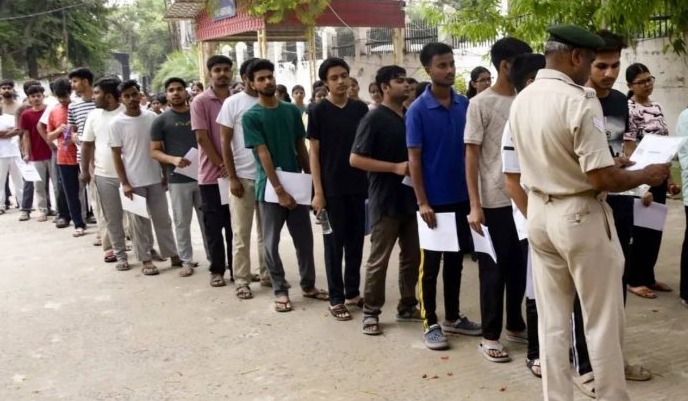
Even the most heavily secured NEET re-examination in recent memory could not keep cheaters out. Elaborate, almost cinematic schemes were hatched by candidates across the country — and every single one of them was caught. The very day after the exam, police in Lakhisarai district of Bihar cracked open a massive impersonation network, arresting 30 people in total, including 14 employees of the biometric verification company that was specifically deployed to prevent exactly this kind of fraud. The gang had disguised themselves in the uniforms of biometric staff and infiltrated exam centres to write the test on behalf of real candidates — a brazen operation that left investigators and the public alike speechless.
The entire Bihar racket unravelled because of one man. Mayank Kashyap, a third-year MBBS student at Patna Medical College and Hospital, had sneaked into the Hasanpur High School exam centre disguised as a biometric company employee. His suspicious movements caught the attention of police officers on duty, and when they pulled him aside for questioning, the full scale of the conspiracy began to surface. Acting on his disclosures, police launched simultaneous raids on three major exam centres across the district, pulling out impersonators one after another. In total, nine fake candidates and 21 accomplices were arrested — among them the 14 biometric verification employees who had been bribed to look the other way and wave the imposters through.
The cheating was not limited to Bihar. In Uttar Pradesh, a candidate named Prince Dubey from Ballia district was caught with a SIM card and an old NEET question paper hidden inside his undergarments, leading to his immediate arrest. Meanwhile, in Hyderabad, officials were left stunned by the audacity of a plan devised by a candidate from Achampet in Nagarkurnool district. He arrived at the Ragannaguda ZPHS exam centre as early as 7 in the morning, well before anyone else, and quietly slipped a mobile phone inside a ziplock cover which he then hid inside the flush tank of the bathroom. When the exam was underway, he complained of a stomach ache and sought permission to use the restroom.
When he failed to return for an unusually long time, suspicious invigilators went in to check — and caught him red-handed, phone in hand, searching for answers he had retrieved from the flush tank. The school management filed a complaint and police from Adibhatla station registered a case against him under the Cheating and Public Examinations Act, arresting him and seizing the mobile phone on the spot. Taken together, the incidents from Bihar, Uttar Pradesh, and Hyderabad paint a deeply troubling picture — that no amount of security infrastructure can fully substitute for the integrity that this examination system has clearly lost.