





- Ravi Prakash
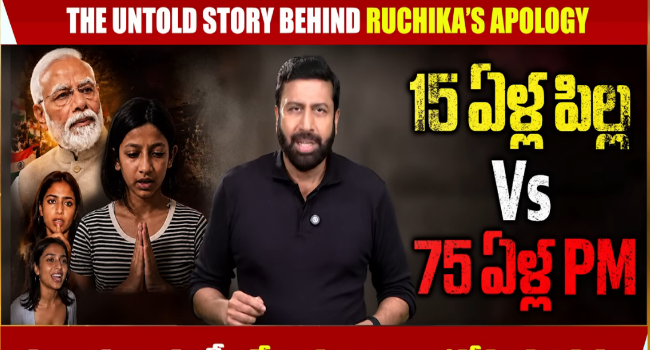
Ruchika Singh is just 15 years old — the same teenager who went viral nationwide over a video in which she used abusive language against Prime Minister Narendra Modi. An FIR has since been registered against her, and the case has dominated television news, turned into a flashpoint on social media, and abruptly become the centerpiece of national political discourse.
In a video apology, Ruchika bowed her head, folded her hands, and sought forgiveness. She admitted to making a mistake, claiming she had been influenced by certain individuals, and pleaded to be pardoned. Three questions arise from this episode: Did the 15-year-old appear frightened? Did she appear distressed? Did she seem like a child shouldering a burden beyond her years? For millions across the country who answer “yes,” these questions carry weight — particularly because the FIR against Ruchika was filed even before her apology video surfaced, her video went viral nationally, television studios ran shows targeting her, politicians and activists entered the debate, and social media transformed her into the face of a national controversy. Whether the apology was entirely voluntary or the result of external pressure remains unanswered. What is clear, however, is that a 15-year-old girl has become central to one of the country’s most significant political controversies.
The story took a new turn after Ruchika’s apology video was released. At 11:06 pm, Prime Minister Modi posted a selfie video on Instagram. While he did not name Ruchika directly, he referenced the abuse directed at him by young people, including inappropriate remarks about his late mother, before stating: “We must forgive children.”
The call for forgiveness was, in itself, welcomed broadly — no one disputes that Ruchika Singh’s language was inappropriate, and there is no ambiguity on that point. However, the sequencing of the Prime Minister’s remarks has raised two questions. First, if the Prime Minister himself refers to the protesters as “children,” is it not the government’s foremost responsibility to protect them before legal action is initiated? Second, can a 15-year-old student and a 75-year-old Prime Minister reasonably be held to the same standard — one still learning how to navigate society, the other having led the nation for over a decade? The expectations placed on each cannot be equivalent.
Observers note that the Prime Minister had an alternative path available — for instance, stating that cases against the children would be withdrawn and that matters of conduct would be left to parents and teachers. Had he taken that approach, the controversy might have concluded there. Instead, he first referenced the abuse directed at himself and his mother before extending forgiveness — a sequencing that has itself become the subject of nationwide debate: was this a call for civility, or an assertion of having been wronged followed by conditional forgiveness? Given that the Prime Minister explicitly used the word “children,” critics argue his responsibility extends beyond forgiveness to protection — with correction, not punishment, and guidance, not fear, being the appropriate response to a minor’s error.
Ruchika Singh is not the only individual to have become a focal point in this controversy. As the political debate intensified, several other young women involved in the protest were similarly drawn into national discourse — among them, Urvashi Palandurkar, a professional dancer from Maharashtra who took part in the student protest.
The BJP’s official Chhattisgarh X (formerly Twitter) handle shared a video of Palandurkar’s participation, describing her as “a Gen Z woman celebrating Babar’s legacy through dance.” The post went viral within minutes. Palandurkar responded with her own video, addressing the allegations and referencing the BJP post satirically. She rejected the political framing entirely, stating she had participated in the protest solely as a citizen, and questioned why participation in a democratic protest should invite political targeting. Her response also went viral, and Congress leader Rahul Gandhi subsequently shared her video on his Instagram story — extending the controversy to the highest levels of national politics.
Whether one supports or opposes the student protests is a matter of individual right. The larger question raised by these events is whether participation in a protest should expose a young person to a nationwide political campaign. This is no longer a question of ideology but of democratic principle.
Within days of the Jantar Mantar protest concluding, an FIR was filed against one participant, and another appeared on an official party social media handle. Television studios delivered swift verdicts, social media saw an exchange of accusations, and political leaders across parties weighed in. Yet the central question remains unanswered: if, as the Prime Minister stated, these individuals are “children,” who bears responsibility for ensuring they are not turned into symbols of political conflict?
Respectfully, this raises a point of disagreement with the Prime Minister’s framing — describing protesters as “children” arguably increases, rather than diminishes, the responsibility to protect them, not merely forgive them. Children make mistakes, sometimes serious ones; parents correct them, teachers guide them, and society shapes their conduct. Governments, in turn, bear responsibility for ensuring that punishment does not exceed the offense — a principle that carries added weight when the individual involved is a 15-year-old girl. This is not an argument in defense of inappropriate language, which remains indefensible, but a question every democracy must ask itself: is a criminal case the appropriate response to a child’s error, or is correction the more suitable path? The answer bears on more than Ruchika Singh’s individual future — it speaks to the kind of democracy being built.
Following the Prime Minister’s video, public debate shifted toward a different question: do criminal procedures apply uniformly to all citizens? Reactions poured in from across the political spectrum — Congress, AAP, journalists, and analysts alike raised not whether Ruchika’s conduct was justified, but whether political leaders themselves adhere to the standards of civility they demand from youth.
Congress spokesperson Supriya cited a history of controversial political remarks, questioning whether a standard against inappropriate language, if genuine, should apply equally to all — noting that political leaders “did not appear from nowhere.” AAP MP Sanjay Singh raised a similar point regarding the treatment of women in political discourse, referencing years of contentious remarks in Indian politics and questioning whether current officeholders themselves meet the standard of conduct expected of the public. CJP founder Abhijit Deepke echoed this, citing past political controversies and arguing that leaders should hold themselves to the same conduct expected of ordinary citizens. These remain individual opinions from various commentators, but their underlying argument converges: if inappropriate language has become normalized in Indian politics, responsibility cannot rest solely with teenagers.
Children do not originate political rhetoric — they absorb it through observation: election campaigns, televised debates, social media, and parliamentary proceedings. As political discourse grows more aggressive, public language shifts accordingly, and it should not be surprising when that language surfaces among youth. This debate, therefore, extends beyond Ruchika Singh to the broader question of political culture. Today it is Ruchika; tomorrow it could be another student or young person. If meaningful change in public conduct is the goal, it must begin not on the streets but at the top — among political parties, governments, opposition leaders, television anchors, and influencers alike, since leadership entails demonstrating standards, not merely prescribing them.
This is not a story solely about an FIR or a single inappropriate remark — it concerns what is being modeled for the next generation, and who bears responsibility for teaching young citizens how to engage within a democracy: parents, teachers, schools, or political leaders. Children learn not from textbooks but from observing leaders daily — in Parliament, campaigns, debates, and increasingly, social media. While there is broad consensus that young people should not use inappropriate language, it bears noting that such language is not created by children — it is learned from adults, from politics, from television, and from social media. A genuine shift toward civility among younger generations would require a corresponding shift among adults first.
Referencing the principle that “charity begins at home,” commentators argue that if the Prime Minister genuinely intends this message to serve as a national example, that change must be visible in action, not only rhetoric, starting from the highest office. Critics have long scrutinized certain social media accounts — some allegedly followed at various points by the Prime Minister’s official account — for targeting women journalists, activists, and political opponents with abusive language and threats of violence. Whether following such accounts constitutes endorsement remains a matter of debate, but observers argue that a concrete step — such as unfollowing accounts associated with abuse, misogyny, threats, or hate speech — would send a stronger message than further speeches.
This call for consistency is directed at all political parties — BJP, Congress, AAP, Trinamool Congress, and Left parties alike — on the basis that moral standards regarding civility cannot shift according to political convenience, and inconsistency undermines any subsequent appeal to decorum.
Ruchika Singh has acknowledged her error and apologized. The responsibility now shifts to adults — not only to extend forgiveness, but to reflect on the political culture being cultivated, the language being normalized, and the example being set for the next generation. As this case illustrates, democratic institutions are strengthened not by lecturing children on conduct, but by those in positions of power holding themselves to the same standard they demand of others.