





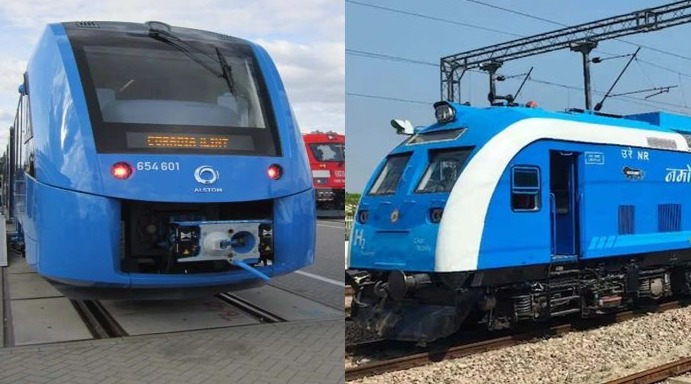
With India’s first hydrogen train successfully running, it has marked the beginning of a new revolution in the country’s domestic transport sector. Against this backdrop, here is a comprehensive report explaining exactly how hydrogen train technology works and how this fuel sector is set to evolve in the future.
As the search for pollution-free transport systems intensifies worldwide, “hydrogen trains” are emerging as one of the most promising alternatives. With India’s first hydrogen train hitting the tracks, the country has taken another major step in eco-friendly transportation. By replacing conventional diesel engines with this new fuel source, it becomes possible to completely curb coal and carbon emissions. This has sparked interesting discussions among the general public about exactly how this train works and how the fuel is stored in it.
Contrary to what many assume, hydrogen trains do not generate their own fuel while traveling. Before the journey begins, hydrogen fuel is filled into extremely safe, high-pressure-resistant gas tanks. These tanks are connected to the train’s “fuel cell” system. The hydrogen that enters the fuel cell undergoes a chemical reaction with the oxygen naturally present in the air, generating large amounts of electrical energy. This electricity powers the electric motors in the train, which in turn drive the wheels forward.
Ordinary trains, while running, release harmful smoke such as nitrogen oxides and carbon monoxide that damage the environment. But in hydrogen fuel cell technology, no combustion (burning) process takes place at all. Since only a chemical reaction occurs, the only by-products released are pure water (in the form of vapor) and some heat — instead of smoke. This is precisely why scientists consider these trains to be 100 percent eco-friendly.
Since hydrogen is also used as fuel in space rockets, it’s natural to wonder why the same method isn’t used in trains. However, in rockets, liquid hydrogen and liquid oxygen are stored at extremely low cryogenic temperatures (minus 183 degrees Celsius) and burned directly. This produces intense heat and uncontrollable energy. Such extreme temperatures are not safe for train travel. Moreover, if a train were to meet with an accident, a rocket-style combustion system could risk massive explosions. That is why the fuel cell method is the safest approach for trains.
Rocket engines are designed for the extreme acceleration needed to launch into space for just a few minutes. Trains, however, are different — they need to travel steadily at a constant speed for hours at a time. Rocket-style thrust technology is not at all suited for continuous travel. The electricity generated through fuel cells is supplied steadily, making it excellent for running a train over long durations without any interruption.
Theoretically, it would be possible to generate hydrogen during the journey itself using a regenerative braking system, solar panels mounted on the train’s roof, or small electrolyzers that split water molecules. However, this is not currently commercially viable. The process of electrolysis — separating hydrogen from water — requires an enormous amount of electricity, far more than a moving train can generate on its own. Even if such systems were installed on the train, the added weight would drastically reduce the train’s mileage and speed.
Scientists around the world are currently focused on developing advanced carbon-fiber tanks capable of storing more hydrogen at lower weight. Research is also intensifying on reducing the production cost of “green hydrogen” — hydrogen produced using only water and solar power, without any harm to the environment. If technology advances further in the future, it would not be surprising to see trains generating hydrogen on board using safer electrochemical methods.
Based on currently available technology, there is no alternative that surpasses hydrogen trains in terms of both environmental protection and fuel efficiency. Leading nations such as Germany, China, and Japan have already adopted this technology, and India has now joined this club, showcasing its own capabilities. There is no doubt that if technology costs come down and the availability of green hydrogen increases in the coming days, hydrogen trains will become the backbone of the transport sector worldwide.