





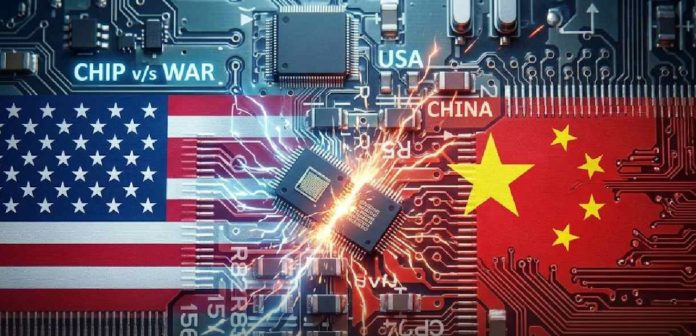
The United States has widened its export controls on advanced artificial intelligence chips to cover foreign data centers that supply computing power to China, escalating a technology contest that increasingly resembles the arms races of earlier eras. The Commerce Department announced the new rules on November 16, and they took effect on November 19.
Under the rules, foreign data centers that offer large-scale computing capacity to countries facing US restrictions, including China, now fall under US licensing requirements. Facilities above a set performance threshold must obtain a US export license to serve Chinese companies. The threshold, 12 million in total processing performance, is estimated to equal the maximum capacity of about 750 Nvidia H100 or H200 chips. Data centers already providing such services must also secure licenses within a specified deadline.
Washington has also tightened licensing for certain advanced AI chips shipped to Malaysia, Singapore, Indonesia, Thailand and Brazil, amid concern that chips could be diverted from those countries to China. The measures are not a blanket ban. Licensing requirements apply according to the specific chips, their capability and their intended use.
US officials regard advanced AI chips as strategic technology tied to national security, not merely commercial products. AI-driven military systems, intelligence networks, autonomous weapons and cyber operations are expected to depend heavily on them. Washington’s concern is that if China gains such technology at scale, it could challenge the US in AI and strengthen its military capabilities. The US has imposed export controls in phases since 2022 to keep advanced semiconductor technology out of China. Nvidia’s H100 and H200 accelerators are central to the issue, since AI models require parallel processing across thousands of powerful processors, which is the role GPUs play. The more capable the chip, the faster larger models can be trained.
US officials also suspect Chinese firms have been sidestepping the direct export ban by renting computing capacity from overseas providers. A company does not need to own an AI chip to benefit from it. Leasing computing power from a data center that hosts the chips is enough to train AI models. A Chinese AI company unable to obtain H100 or H200 chips directly could, for example, lease resources from a data center in Singapore or Malaysia that houses them. The chips never enter China, yet the company can use their output. This indirect route is the practice the new rules are designed to target.
A report released on November 19 by the US investment firm Jefferies, titled “Greed and Fear,” put numbers on the concern. It estimated that about 240,000 Nvidia chips may have reached China through illicit channels since restrictions took effect in 2024. It also said Singapore-based Megaspeed is leasing about 86,000 GPUs to Chinese customers, including Alibaba. The figures are estimates, not official data confirming that every chip was illegally diverted. Washington’s broader worry is that if US-made chips supply computing power to Chinese firms through third-country data centers, its export restrictions lose their effect. Officials are therefore stepping up scrutiny of where chips go, who buys them and who ultimately uses them. Under the new regime, foreign operators will need to carry out stricter verification of customers, end users, ownership details and computing usage.
The rules could affect the fast-growing data center industry in Southeast Asia, where countries such as Singapore and Malaysia are drawing heavy investment in AI infrastructure. Companies may face higher compliance costs, new data center projects could be delayed, and foreign investors may need to review their plans. Third countries are thus being drawn into the US-China contest.
Beijing’s response has been to accelerate efforts to build its own semiconductor ecosystem. Reliance on the US and its allies for advanced technology is seen as a long-term risk, since Washington can impose curbs at will. China is investing across chip design, manufacturing, manufacturing equipment, raw materials and memory technology. Huawei, SMIC, Cambricon and Alibaba are playing key roles. Huawei is seeking to develop an alternative to Nvidia through its Ascend series of AI processors, SMIC is working to expand manufacturing capacity, and Cambricon is advancing in AI accelerators.
The government is also committing large sums. Through the National Integrated Circuit Industry Investment Fund, it is financing domestic chipmakers, and in 2024 the fund announced about 344 billion yuan for its third phase. Beijing is also trying to source chipmaking equipment from domestic suppliers wherever possible, with the goal of a system that does not depend on foreign technology. China has not yet matched the most advanced chip technology of the US, Taiwan or South Korea. Challenges remain in advanced lithography, high-bandwidth memory, manufacturing yield and chip efficiency. Still, its rapid progress in domestic technology is a long-term concern for Washington.
The chip war has entered a new phase. Washington first blocked direct sales of advanced AI chips to China and is now trying to prevent Beijing from expanding its computing power through foreign data centers and cloud services. China is responding by strengthening its own semiconductor base. The central question is whether US export curbs can hold back China’s AI development, or whether they will push China to build its own chip manufacturing faster. If China achieves self-sufficiency in advanced AI chips, the technological dominance the US has long enjoyed would face a serious challenge.