





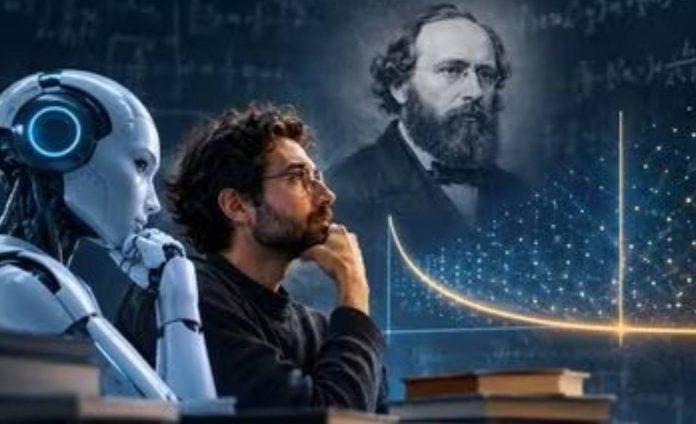
Levent Alpoge says the AI tool overtook him in the final stretch of work on the 160-year-old problem, while the Clay Mathematics Institute still treats it as unsolved
Has artificial intelligence found the solution to a complex problem that has remained a mystery in the world of mathematics for decades? Levent Alpoge, a mathematician working at the leading AI company Anthropic, says it has. On Friday he made a sensational announcement: he has found a proof of the Riemann Hypothesis, the celebrated problem that dates back 160 years.
Alpoge said he achieved this with the help of Claude, the AI tool built by Anthropic. He posted a four-page explanatory note on his website describing the work. “For the past few months, Claude and I have worked intensively on this problem,” he said. “But in the final stage, Claude overtook me and found the solution.”
The Riemann Hypothesis was proposed in 1859 and is among the most important unsolved problems in pure mathematics. It describes the pattern in which prime numbers (2, 3, 5, 7, 11 and so on) spread out as they grow toward infinity. In 2000, the Clay Mathematics Institute announced a prize of $1 million, more than Rs 9 crore in Indian currency, for anyone who solves the mystery.
Anthropic has not yet officially responded to Alpoge’s announcement. The Clay Institute, which announced the prize, has not accepted the claim immediately either. It said it currently continues to regard the problem as unsolved. However, the institute’s president, Martin Bridson, acknowledged that Alpoge’s announcement is historic. He made clear that it will take more time for mathematical experts to fully verify whether the proof is actually correct.
Whatever the outcome, the development has undoubtedly taken the capability of AI to another level. If the proof is confirmed, it would stand among the most significant achievements in the history of mathematics. Until experts complete their review, however, it remains a claim and not an established result.