





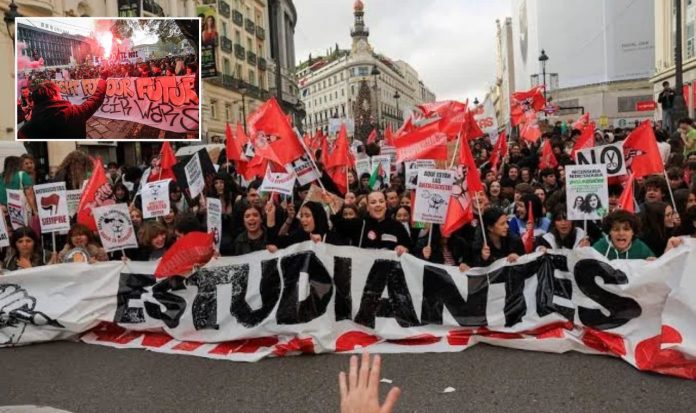
Young people across Europe staged coordinated protests on Friday, November 20, accusing governments of prioritizing military spending over education, employment and affordable living. Organizers said demonstrations were called in nearly 400 cities across more than 25 countries, including Britain, France, Germany, Italy and Spain. Under the slogan “Fight for Our Future, Not Their Wars,” students boycotted classes and held rallies and marches. Although conditions differ from country to country, organizers said a shared sense of economic insecurity united the protesters. In some countries unemployment is the main grievance; in others it is rising house prices and rents, or cuts to education funding.
Unemployment and underemployment are among the most pressing concerns. Many graduates say that even after paying heavily for higher education, they cannot find work that matches their qualifications. Those who do find jobs say salaries have not kept pace with the rising cost of living. Cuts to university funding, inadequate facilities in public institutions and higher tuition fees add to the burden on students, many of whom must borrow to study without any guarantee of employment afterward. In Britain, nearly one million people aged 16 to 24 are reportedly not in education, employment or training. Students protested in London, Manchester and other cities, and organizers called on pupils from more than 350 schools, colleges and universities to take part.
Housing costs are another major flashpoint, particularly in Spain, where sharply rising rents and property prices have made independent living difficult for many young people. Protesters said most of their income goes to rent, leaving little room for savings. “We believed a good education and a good job would mean a good life,” demonstrators said. “Now, even with a job, living independently is becoming impossible.” Housing shortages and high living costs are also affecting young people in several other major European cities.
The most contentious issue, however, is public spending priorities. Since Russia’s invasion of Ukraine, European security concerns have grown, and NATO members have significantly increased allocations for weapons, military infrastructure and defense production. Protesters argue that education, healthcare and social welfare have not received comparable investment. “Governments have billions for wars but no budget for our education, healthcare and future,” they said.
In Germany, debate over reintroducing compulsory military service has heightened anxiety among young people, who said they want quality education, better jobs and social security rather than military training. In Italy, workers joined students in the demonstrations, with major unions such as the CGIL organizing protests in more than 100 locations and demanding higher wages, lower living costs and more funding for public services. In France, students raised concerns over inadequate facilities in public schools and teacher vacancies, while in Serbia, student-led protests against corruption and perceived government negligence are already under way.
Young protesters also cited fears about artificial intelligence, particularly its potential impact on entry-level jobs. They are calling for skills training, new employment opportunities and government support for those displaced by technological change. Climate change was another concern, with demonstrators warning that global warming and extreme weather will have serious consequences for future generations. Social media platforms including TikTok, Instagram and Telegram have played a key role in spreading the movement across borders and connecting students in different countries.
The protests are adding political pressure on European governments, with young people demanding more funding for education, employment, housing, healthcare and social security. Governments face budget constraints, including slowing economic growth, rising public debt and competing demands from defense and welfare spending. Analysts warn, however, that ignoring youth concerns could deepen political discontent, which may influence the outcome of upcoming elections. Jobs, rents, education and the cost of living could become central campaign issues.
Whether the protests prove a one-day event or grow into a broader movement capable of reshaping European politics and policy remains to be seen. For now, the demonstrators’ message is clear: “Invest in our future; don’t gamble our lives for wars.