





- Ravi Prakash

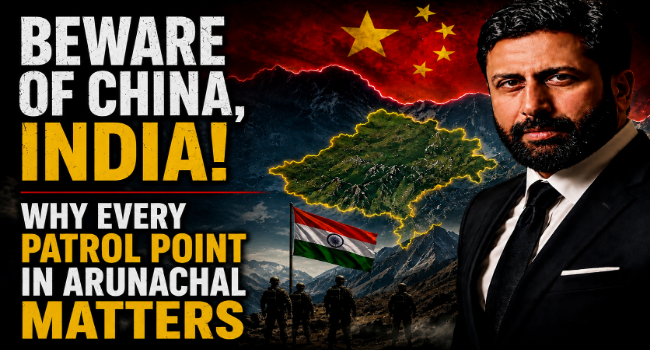
A voice message from a young man belonging to Arunachal Pradesh has gone viral on social media, in which he explains why he is leaving India. He alleges that China is occupying certain areas of Arunachal Pradesh and warns that a day may come when the state disappears from India’s map altogether. How much truth lies in his claims remains a matter that requires verification.
On the same issue, former Union Minister, former MP, and former Union Home Secretary R.K. Singh has raised pointed questions regarding India’s patrolling positions along the Line of Actual Control (LAC). Singh has asked the Prime Minister and the Defence Minister how many patrolling points India has given up since 2014, arguing that if India abandons a patrolling point and China subsequently moves in, it could have implications for India’s territorial claims. These, however, remain allegations made by Singh and are yet to be independently verified. The Indian government, meanwhile, has strongly denied allegations that China is engaged in “slow encroachment” in Arunachal Pradesh.
Understanding R.K. Singh’s Argument
To understand Singh’s argument, it is necessary to first understand a basic fact about the India-China border: it remains undemarcated, with both countries holding differing views on where exactly it lies. China does not accept the McMahon Line in Arunachal Pradesh as the border and continues to claim the state as part of “Southern Tibet.” India, on the other hand, maintains that Arunachal Pradesh is an integral part of the country. This is precisely why patrolling along the LAC assumes such significance.
According to Singh, Indian and Chinese soldiers patrol up to the points their respective countries consider to be the border, and these patrolling points serve to demonstrate a country’s presence in territory it claims as its own. He argues that when India stops visiting a particular patrolling point, it does not merely mean ceasing to visit that location — it makes it more difficult, in the future, to assert that the area belongs to India. Singh contends that if India regularly patrolled a certain area in the past and later stopped, while Chinese forces subsequently moved in and expanded their presence there, the ground reality in that area could gradually shift.
The Shera 5 Case
Singh cites Shera 5, located near Taksing in the Upper Subansiri district of Arunachal Pradesh, as an example. According to a fact-finding team dispatched by the People’s Party of Arunachal, Chinese People’s Liberation Army (PLA) personnel arrived at the Shera 5 patrolling point and brought the area under their control, allegedly blocking the Indian Army from accessing it. The team further alleged that Chinese forces are gradually extending control even into grazing and hunting areas near the LAC traditionally used by local residents. It must be noted, however, that these remain claims made by the fact-finding team and have not been officially confirmed.
According to reports cited by the team, a physical confrontation took place between Indian and Chinese soldiers near Shera 5 in 2023, following which Indian forces reportedly withdrew from the location and did not return. The team alleges that PLA personnel subsequently arrived and removed the remaining Indian markers in the area. If these claims are accurate, they raise a serious question — one that Singh has directly posed to the Prime Minister and Defence Minister: why has the Indian Army, which previously patrolled the area, stopped doing so, and how many other patrolling points nationwide have witnessed a similar pattern since 2014? Singh maintains that the country deserves clarity on whether Shera 5 is an isolated case or part of a broader trend.
Government’s Response
The Indian government has firmly rejected the broader allegation of Chinese “slow encroachment” in Arunachal Pradesh, stating clearly that claims of China gradually moving into Indian territory are untrue. The government has, however, provided historical context on the matter. China has long claimed Arunachal Pradesh as “South Tibet,” and according to the government, during India-China border talks in 1960, China claimed approximately 69,000 square kilometres of territory within Arunachal Pradesh as its own — indicating that the dispute has a history spanning decades.
In 1959, Chinese forces attacked the Assam Rifles post at Longju and took control of the area, which the Indian government says has remained under Chinese control since, with reports periodically emerging of Chinese infrastructure development there. The 1962 India-China war followed, during which Chinese forces carried out large-scale operations across the Kameng, Subansiri, Siyom, Siang, and Lohit regions. After the ceasefire, however, Chinese forces withdrew to the north of the area India considers to be the LAC.
The government further notes that Arunachal Pradesh shares a long and difficult border with Tibet along the Great Himalayan range, and that India has significantly expanded infrastructure in the region in recent years, correspondingly increasing patrolling and surveillance along the border. Since the border remains undemarcated, the government acknowledges that Indian and Chinese patrols occasionally come face to face, and states that such situations are handled according to existing protocols and mechanisms. It maintains that the Army and the Indo-Tibetan Border Police (ITBP) remain fully prepared to monitor the border, track Chinese activity, and respond as necessary. The government has further characterised sensational allegations of Chinese encroachment made without specific evidence as attempts to attract attention.
Two Competing Narratives
Two distinct narratives currently stand before the public. On one side is Singh’s question regarding how many patrolling points India has relinquished since 2014; on the other is the government’s position that China is not engaged in slow encroachment in Arunachal Pradesh. Determining which argument holds true requires moving beyond political statements to examine facts, with the Shera 5 location now at the centre of the controversy.
Key questions remain unanswered: Was Shera 5 genuinely an Indian patrolling point? Did a confrontation occur there between Indian and Chinese soldiers in 2023? Did Indian forces subsequently withdraw, followed by the PLA moving in and removing Indian markers? And most critically, does the Indian Army continue to patrol the area today? The fact-finding team’s claims extend beyond a military position alone, referencing areas traditionally used by local residents for grazing and hunting, and alleging that increased restrictions on local movement have enabled PLA forces to advance further — a broader narrative of Chinese advancement that the Indian government does not accept.
Historical Context and Wider Implications
China continues to refer to Arunachal Pradesh as “Zangnan” or “Southern Tibet” and has not accepted the name given to the state by India. Since 2017, China has assigned its own names to locations within the region, with the latest available information indicating that names have been announced for 112 locations across six phases, the most recent occurring in April 2026. With the border between the two countries still unsettled and both nations holding differing positions on the LAC, every patrolling point, Indian patrol, territorial marker, road, bridge, military post, and surveillance system in the region carries significance.
A viral video alone cannot establish that China has occupied the area in question, just as a single allegation from Singh does not constitute proof, and a fact-finding report is not equivalent to an official military assessment. Equally, a government denial does not close the matter. What remains necessary is evidence — clarity on what occurred at Shera 5, how far the Indian Army patrolled prior to 2023, when that patrolling ceased, whether the Army can still access the area today, what became of Indian markers there, and above all, how many patrolling points India has relinquished since 2014. Journalist Aarti Tikoo has also spoken of the security challenges India could face as a result, describing the potential for a “360-degree” challenge to the country.
The Need for Facts, Not Rhetoric
Regardless of differing assessments, the security situation surrounding India remains complex, underscoring the need for the Arunachal Pradesh issue to be addressed through facts rather than political rhetoric. It would be premature to declare outright that China is occupying Indian territory, just as it would be dismissive to reject the allegations entirely as attempts to seek publicity. The truth must be established through ground-level evidence — satellite imagery, patrol records, military reports, maps, coordinates, and, crucially, information provided transparently by the government. This is not a matter of political parties contesting one another, but a question concerning the border India claims, the LAC, and ultimately, India’s territorial integrity and national security.
The central question that the entire matter returns to remains R.K. Singh’s original query: how many patrolling points has India given up since 2014? Should the answer be none, the government must state so unambiguously; should changes have occurred due to agreements, protocols, infrastructure development, or operational considerations, these too warrant clear explanation to the public. Should the allegations concerning Shera 5 prove unfounded, evidence to that effect should be presented. The concerns voiced by a young man from Arunachal Pradesh on social media cannot be easily dismissed, even as a national debate built on fear and misinformation must also be avoided. What is required, ultimately, are facts — clarity from the government, clarification from the Army where possible, and independent evidence establishing the true situation on the ground, given that Arunachal Pradesh represents not merely a line on a map, but Indian territory whose access, if genuinely under threat, warrants serious investigation rather than political dismissal.