





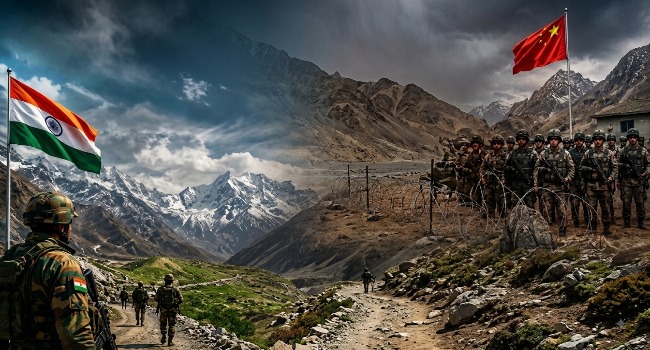
Tensions have flared once again along the India-China border in Arunachal Pradesh. A fact-finding team formed to assess the ground situation in Arunachal Pradesh has alleged that Chinese People’s Liberation Army personnel have effectively denied Indian forces access to key patrolling points in the Taksing area of Upper Subansiri district, and are steadily expanding control over Indian grazing and hunting grounds along the Line of Actual Control. The People’s Party of Arunachal (PPA) constituted a four-member fact-finding committee, comprised of former minister Kahfa Bengia, PPA vice-president Kaling Jerang, and secretaries Sorang Kiokam and Narah Jimmy. However, the Indian Army subsequently rejected the allegations, saying reports claiming recent Chinese encroachment and the setting up of camps in Arunachal Pradesh were “incorrect and without any basis,” with Arunachal Pradesh Chief Minister Pema Khandu also rejecting the reports, bringing the long-simmering dispute back into the spotlight.
The primary source of the India-China border dispute traces back to the McMahon Line. China has historically laid claim to Arunachal Pradesh, referring to the region as “South Tibet.” The claim was articulated during the India-China border talks in 1960, when China reportedly claimed around 69,000 square kilometres of territory in the present-day state. China has never accepted this boundary, viewing it as a line imposed unilaterally by the British.
The situation shifted decisively when China annexed Tibet by force. What had previously been the boundary between India and Tibet subsequently became the shared boundary between India and China, laying the groundwork for repeated friction, including the 1962 war between the two countries.
Even after the war ended, no mutually agreed boundary line was ever formally established between the two countries. As a result, troops from both sides patrol up to what each considers its own boundary — an arrangement referred to as the Line of Actual Control (LAC). This lack of a clearly demarcated border has been a recurring source of face-offs and skirmishes between soldiers on both sides.
The fact-finding committee, led by former minister and PPA chief adviser Kahfa Bengia, visited Taksing on July 10, 2026. Itanagar-based The Arunachal Times reported on August 10 that the four-member PPA panel found that PLA troops were effectively preventing Indian forces from reaching designated patrolling points and that alleged Chinese “incremental intrusions” were being consolidated on the ground. The PPA claimed that the PLA had been restricting access to one of the patrolling points since 2023 — an apparent reference to the Shera 5 patrol point, the site of a 2023 face-off between Indian and Chinese troops. Locals have stated that these areas were earlier used as hunting grounds for the local community of Arunachal and were cattle grazing areas as well, with activities of the Chinese government and the PLA having increased particularly over the past 10-15 years in the border areas of the Taksing circle.
The PPA has called for a rapid expansion of Indian military presence, along with infrastructure such as roads, helipads, and network connectivity, in the border areas. However, responding to the report, government sources dismissed social media claims of a “slow encroachment” by China in Arunachal Pradesh, asserting that the Indian Army and the Indo-Tibetan Border Police are “geared up to dominate the border, monitor and check Chinese activities”. Sources also cautioned against broad or sensational claims regarding developments along the Arunachal Pradesh border, saying that such assertions should be assessed against specific locations and verifiable facts rather than generalised allegations. The PPA’s findings also come shortly after India rejected China’s objection to New Delhi formally marking 27 locations in Arunachal Pradesh on its official maps, with India maintaining that the northeastern state is an “inalienable and integral part of India”.