





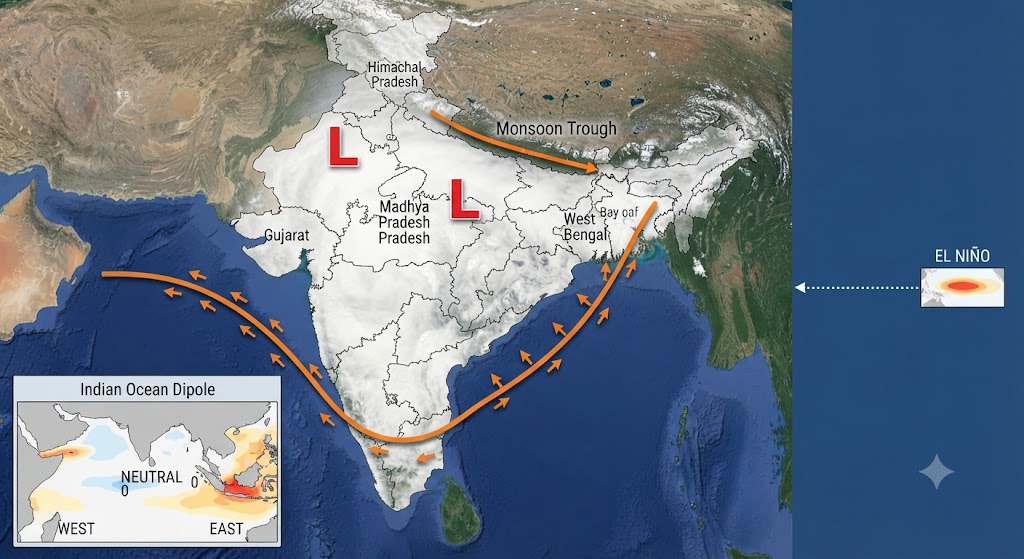
Meteorological experts initially predicted that El Niño would have a severe impact on the Indian monsoon and that rainfall would decrease significantly. Typically, when strong El Niño conditions develop, a decline in rainfall across India is common. However, the weather conditions currently being observed in the country are completely contrary to these predictions. Nearly 95 percent of the country’s landmass being covered with dense clouds, along with torrential rains being recorded in several states, has been generating intense interest and excitement among the public.
El Niño is a global-scale weather phenomenon that occurs due to an abnormal rise in sea surface temperatures in the central and eastern regions of the Pacific Ocean. It alters weather patterns internationally and turns unfavorable for the southwest monsoon in India. However, El Niño is not a force that controls day-to-day weather. Scientists clarify that it does not stop rains that fall over a span of a few days or a week at a time, and that it only affects the average rainfall estimates for the entire monsoon season.
It appears that the current widespread rainfall in the country is mainly due to local weather changes rather than the distant Pacific El Niño. At present, strong surface circulations (low-pressure systems) have formed around Haryana and northeastern Madhya Pradesh. In addition, a moisture-laden trough extending from the Arabian Sea to the Bay of Bengal has become highly active, causing large amounts of moisture from both seas to enter the country’s interior. It is this combination of local winds and moisture that is allowing dense clouds to form and rains to occur at such intensity, overcoming the influence of an El Niño thousands of kilometers away. On the other hand, the fact that the Monsoon Trough, which had earlier shifted northward for some time, has returned to its normal position has further boosted the rains. With the continuous increase in moisture supply from the Bay of Bengal, the monsoon has once again gained rapid momentum. As a result, heavy to extremely heavy rainfall has been recorded in several states including West Bengal, Himachal Pradesh, Uttarakhand, and Gujarat. The India Meteorological Department has indicated that, due to the effect of this trough, rains are likely to spread to other regions in the coming days as well.
The role of the ‘Indian Ocean Dipole’ (IOD) is also extremely crucial in determining the performance of the Indian monsoon. The IOD refers to the difference between sea surface temperatures in the western and eastern regions of the Indian Ocean. When it is in a ‘positive’ phase, it pushes additional moisture towards the Indian landmass and greatly increases rainfall. Historically, in 1997, even though there was an extremely strong El Niño worldwide, India was protected from severe drought because of a positive IOD at the time.
Looking at current conditions, the IOD in the Indian Ocean continues to remain in a neutral state. This means that the rains currently occurring are not receiving any additional positive boost from the IOD. Weather analysts clarify that even without strong IOD support to counter the effect of El Niño, this level of rainfall is being recorded purely because of local surface circulations and favorable monsoon trough conditions.
The main question on everyone’s mind now is whether these rains mean the threat of El Niño has been eliminated. The answer coming from meteorological experts is no. The overall picture of the entire monsoon season cannot be assessed based on rain that falls over a week or two. Experts point out that certain specific local weather systems can temporarily overcome the adverse effects of El Niño, but they cannot permanently cancel out its influence.
Overall, while the current cloudy weather and abundant rainfall are providing short-term relief, the threat of El Niño has not yet been completely eliminated. This year’s domestic agriculture and availability of water resources will depend on how the monsoon behaves in the coming months and how rainfall is recorded. Therefore, instead of assuming that the rainfall deficit has been made up based on this temporary rain, it is most crucial to closely monitor the rainfall trends that will be recorded in the coming days.