





- Ravi Prakash
Mamata Banerjee and the CPM — together? Just imagine that for a moment. Leaders who have waged political war against each other in Bengal for years are now set to sit together over the same issue: the Election Commission and the Special Intensive Revision. This is the story now drawing everyone’s attention in national politics.
The Left parties ruled Bengal for 34 years before Mamata Banerjee defeated them and came to power, and the rivalry between the TMC and the CPM continues to this day. Yet now, on the issue of the Election Commission and the Special Intensive Revision, leaders of Mamata Banerjee’s party and the CPM are talking to each other and coordinating. They are set to sit together at an opposition meeting in Delhi on September 30. This is not a TMC-CPM alliance — but the very fact that it is happening is what makes it so striking, because two parties that have confronted each other for decades have now found common ground on a single issue.
So what exactly is set to happen on September 30? A meeting of opposition parties is to be held that day at the Constitution Club in Delhi. Rahul Gandhi, Sonia Gandhi, Mallikarjun Kharge, Mamata Banerjee, Abhishek Banerjee, Akhilesh Yadav, Uddhav Thackeray, CPM leader M.A. Baby, and several other opposition leaders are expected to attend. One key item on the agenda is a renewed attempt to initiate removal proceedings against Chief Election Commissioner Gyanesh Kumar. But this is not just about Gyanesh Kumar alone — opposition objections to the Special Intensive Revision, demands for an independent inquiry into the Election Commission’s decisions, nationwide protests, and proposed changes to the selection process for the Chief Election Commissioner and Election Commissioners are all set to come up for discussion.
There is also debate over a proposal to include the Chief Justice of India in the panel that selects the Chief Election Commissioner. The Left parties, for their part, have also said they want to meet President Droupadi Murmu. In other words, this is not a fight against a single individual — it is an attempt to launch a larger political battle over the functioning of the Election Commission itself.
But there is another twist here — the DMK. While opposition parties are coming together on one front, sharp divisions are visible within the opposition on another, and chief among them involves the DMK. Why is the DMK staying away from this meeting? The reason lies in Tamil Nadu politics. The decades-old alliance between the Congress and the DMK has now come apart, after Congress joined hands with TVK, the party of actor-turned-politician Vijay — a move that has pushed the DMK away from Congress. The DMK has also demanded separate seating for itself in Parliament. Its relations with the India bloc, and with Congress in particular, have been badly strained as a result. So even as Congress, the TMC, the Left parties, sections of the Samajwadi Party and Shiv Sena, and some other opposition parties come together over the Election Commission issue, the DMK — once a longtime Congress ally — now stands apart. This is the central contradiction within opposition unity at the moment: Mamata and the CPM coming together on one side, even as Congress and the DMK drift apart on the other. This is the new picture now emerging in national politics — old alliances are shifting, new combinations are forming, and while not everyone shares the same political goal, there is a visible willingness to stand together when it comes to one particular issue.
September 29 is also a significant date in this sequence. A day before the September 30 opposition meeting, the Congress Working Committee is set to meet on September 29 to discuss the party’s strategy on the Election Commission issue and what political course of action to take. In effect, September 29 will settle Congress’s strategy, while September 30 will be a test of opposition unity.
So why has the Election Commission become such a major issue in the first place? This story did not begin on September 30 — it has been building for months. An investigation by journalist Ritika Chhabra for The Indian Express reported that Election Commissioners Sukhbir Singh Sandhu and Vivek Joshi formally raised objections at least 14 times over roughly 10 months. According to the report, the two commissioners questioned certain decisions taken in the name of the Election Commission of which they said they had not been informed. The investigation states that they raised questions on several matters, including the ECINet software, the centralisation of voter lists, changes to Form 6, voter appeals in West Bengal, and the Election Commission’s information technology systems. The report also says that in some instances, they sought inspections and clarity. The Election Commission, for its part, has said such internal differences are normal, that its decisions have full legal backing, and that even the final decisions on the Special Intensive Revision were taken unanimously.
This is where the real political battle began — and it is not a new one. Back in June, 23 opposition parties, along with an independent MP, had already approached the Chief Justice of India on matters relating to the Special Intensive Revision and the broader election process. The September 30 meeting now marks another major step in that ongoing political battle. The Left parties are also holding nationwide protests from September 26 to October 2. CPI(ML) Liberation leader Dipankar Bhattacharya has said that the September 30 meeting should be attended not just by the India bloc but by all opposition parties, civil society, concerned citizens and public intellectuals — an attempt, in effect, to turn this into a larger national conversation rather than a fight confined to political parties alone.
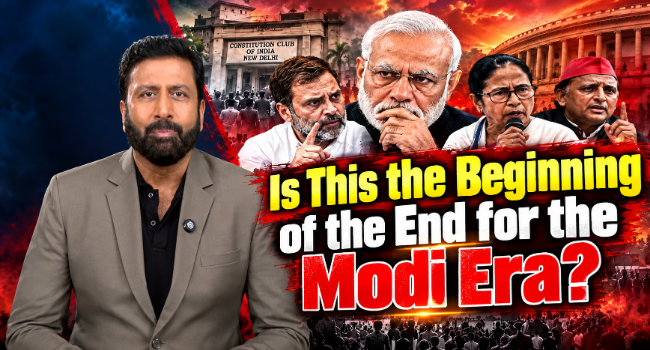
But the bigger question remains: is this the beginning of the end of the Modi era? It is too early to say. A single meeting will not bring down a government, nor will it change an election result. What is genuinely interesting, however, is that so many different political forces are attempting to come together over one single issue. Mamata Banerjee and the CPM, political rivals for decades, are now speaking on the same platform over the same issue. Congress and the DMK, allies for years, have now parted ways. Even the Aam Aadmi Party’s relationship with Congress and the India bloc has grown complicated. And yet, when it comes to the Election Commission and the Special Intensive Revision, different opposition parties are once again trying to find common ground. That is the real story here.
Will something dramatic happen on September 30? There is no basis to claim that. The real test is how long this opposition unity holds together. Opposition meetings are not new in India; joint statements are not new; attempts at unity are not new. But Mamata and the CPM standing together on the same issue is, without question, a striking political development — two forces that once fought to defeat each other in Bengal are now visible in the same battle. It is not an alliance, and it is not a partnership — but it is a shared platform of struggle, nonetheless.
Which brings us to the final question: is September 30 the beginning of the end of the Modi era? There is no answer to that yet. But September 30 will test one thing regardless — no matter how many disputes exist among them, how far will the opposition as a whole go for a shared cause? And if political rivals as entrenched as Mamata Banerjee and the CPM can stand side by side on a single issue, the real question that follows is this: will this temporary unity become tomorrow’s new political reality?