





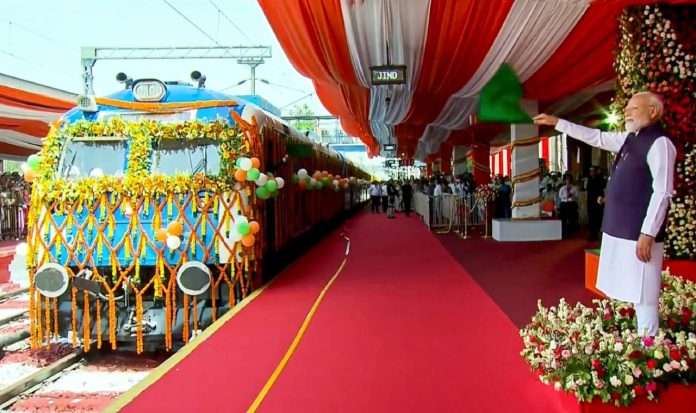
India’s railway sector has entered a new era with Prime Minister Narendra Modi flagging off the country’s first hydrogen-powered train. Developed by the Integral Coach Factory in Chennai, the state-of-the-art train will operate on the 89-kilometer stretch between Jind and Sonipat in Haryana, falling under the Delhi Division of Northern Railway. To support the train’s operations, an indigenously developed hydrogen storage and refueling facility has been set up at Jind.
Turning to the train’s specifications, it is a 10-coach train powered entirely by hydrogen fuel cells, running on a 1,200 kW fuel cell propulsion system. While capable of reaching a maximum speed of 110 kilometers per hour, its permitted operating speed is 75 kilometers per hour. The train has the capacity to carry approximately 2,600 passengers at a time. Running between Jind Junction, Gohana Junction, and Sonipat, it will make stops at several stations along the route, including Jind City, Pandu Pindara Junction, Lalit Khera, Bhambewa, Isapur Kheri, Butana, Khandrai, Rabra, Lath, Mohana, and Barwasni.
Positioned as an alternative to diesel-run trains, the hydrogen train operates on pollution-free technology that causes no harm to the environment, generating electricity through hydrogen fuel cells. The project, aimed at promoting environmentally sustainable rail travel, is expected to serve as a model for the introduction of hydrogen trains on additional routes across the country in the future.
With this launch, India joins a small group of nations currently deploying hydrogen train technology, including Germany, Japan, China, and the United States. Germany introduced the world’s first hydrogen-powered passenger train in 2022, while the United States rolled out its own hydrogen train, named “Zemu,” in California in 2024. Japan, meanwhile, is preparing to launch its first hydrogen-hybrid train by 2027.
With the Jind-Sonipat corridor now operational, India’s entry into hydrogen rail technology marks a significant step in the country’s broader push toward cleaner, more sustainable modes of public transportation — and one that officials hope will pave the way for wider adoption across the national rail network in the years ahead.