





-Ravi Prakash

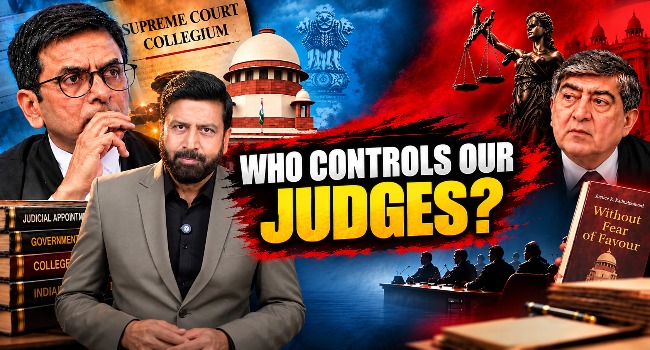
Who selects the judges of India’s Supreme Court: the government, the Prime Minister, the President, or the judges themselves? The question is not easy to answer. Under the Constitution, judges are appointed by the President, but the Collegium plays a key role in examining and recommending the names. How much of a role should the government have in this system? At what stage should its opinion be taken into account? How can transparency in appointments be ensured while protecting the independence of the judiciary? The issues now being discussed between former Supreme Court judge Justice Sanjay Kishan Kaul and former Chief Justice D.Y. Chandrachud have brought these questions to the forefront once again.
Remarks made by Justice Kaul in his book “Without Fear or Favour” are at the centre of the controversy. Kaul alleges that Chandrachud, as Chief Justice, showed more leniency towards the government than necessary in matters of judicial appointments. He refers to three incidents in the book: discussions in Collegium meetings and the idea of ascertaining the government’s view on a candidate in advance; objections raised over the appointment of a judge belonging to a minority religion; and the transfer of a Prevention of Money Laundering Act case to another bench. The real issues become clear only when the allegations and Chandrachud’s responses are examined separately.
The First Incident: Consulting the Government in Advance
Kaul first recalls an occasion when the Collegium had to decide on six names to fill vacancies in the Supreme Court. He states that consensus had already been reached on five names, and that on the day of the meeting Chandrachud proposed a sixth. Other Collegium members objected to that name, and Kaul says he suspected the candidate’s name may have come from the government. His own account, however, makes clear that there appears to be no publicly disclosed evidence confirming that the government suggested the name.
Kaul alleges that Chandrachud subsequently took him aside and asked whether he should make a phone call to ascertain the government’s view on the candidate. Kaul says he objected, arguing that the Collegium should first deliberate independently and reach its own decision, and only then take the government’s opinion into account. In the end, he says, the five names on which consensus had been reached went ahead, while the sixth was not approved.
The issue goes beyond the selection of one candidate. Is it proper to ascertain the government’s view before the Collegium has deliberated independently on a name? Consulting the government is one thing; finding out in advance what it thinks and only then discussing the candidate is another. The difference between the two lies at the heart of Kaul’s objection. His concern is that, if this practice becomes a convention, the government’s influence over the selection of judges could grow. Sufficient evidence is needed, however, before the details of the incident and the suspicions about the government’s role can be treated as established facts.
The Second Incident: Questions on Religion and Caste
The second incident is more sensitive. Kaul states in his book that, when the appointment of a judge belonging to a minority religion was under discussion, the government questioned why another minority judge was needed when judges from other minority communities were already on the court. He adds that the government also asked which caste the candidate’s family belonged to. Kaul says he objected, asking how the caste of a family that has remained in the same religion for generations could be determined, and what relevance it had to the appointment of a judge.
Kaul also states that Chandrachud told him of another point raised by the government during the discussion, which he is not disclosing in the book. Deeply upset, he says, he closed the file and walked out of the meeting. According to his account, the meeting was adjourned and no further meeting on the matter was held for some time. Eventually, the government withdrew its objections and accepted the candidate’s appointment.
The candidate’s name has not been disclosed publicly, and the full context of the government’s questions is not clearly known. There should therefore be no room for speculation about who the candidate is or what the government intended. Yet the questions Kaul has raised cannot be set aside. How justifiable is it to use religious identity against the appointment of a judge? How necessary is it to ask about a candidate’s family caste in assessing judicial qualifications? How should the Collegium treat such objections when the government raises them? Answering these questions requires examining the context and official details along with the account of the person making the allegations.
The Third Incident: Allocation of Cases
The third incident concerns not judicial appointments but the allocation of cases. In 2022, the Supreme Court upheld several provisions relating to the powers of the Enforcement Directorate under the Prevention of Money Laundering Act (PMLA). A three-judge bench headed by Justice Kaul had to consider whether certain aspects of that judgment needed to be re-examined. Kaul states that the case was subsequently sent to another bench and that he was given no clear explanation for the change. He suspects the case may have been moved on the assumption that his bench might take a strict stance.
However, the fact that a case went before another bench does not confirm that the government was behind it. Kaul’s suspicion alone does not prove government pressure. To know what actually happened, the case listing records, the official orders relating to the change of bench and the administrative decisions would have to be examined. Even so, the incident raises an important question: how is the decision taken on which bench should hear sensitive cases, and should the reasons be transparent? If cases were shifted on the basis of assumptions about how a particular judge might rule, public trust in the judiciary could be damaged. Along with whether the allegation is true, the transparency of the case allocation system is also an important matter.
How Supreme Court Judges Are Appointed
To understand these incidents, the appointment system must be examined. Under Article 124 of the Constitution, Supreme Court judges are appointed by the President, while the Collegium plays a key role in examining and recommending candidates. The Supreme Court Collegium consists of the Chief Justice and four other senior judges. It examines candidates and recommends names, after which the Union Government considers the proposals. The government may communicate objections and, in some cases, names can be sent back for reconsideration. The Collegium then takes its decision according to the applicable procedure, and finally the President formally announces the appointment.
The main purpose behind this system is that the government should not have complete control over judicial appointments, because courts also bear the responsibility of questioning government decisions. If the government selected judges entirely at its discretion, doubts could arise about their independence in delivering verdicts against it. This is why the Collegium system came to acquire importance. Yet it too faces criticism. What are the criteria for selecting candidates? Why is a particular person selected? How are differences of opinion within the Collegium resolved? The public never fully knows these details.
On one hand, government interference should not grow; on the other, the entire power of appointment should not be concentrated in the hands of a few judges. Striking a balance between the two is the real challenge. While there is a right to criticise the Collegium, any alternative must not compromise judicial independence. At the same time, it cannot be said that, in the name of independence, transparency and accountability are not needed in the appointment process.
The NJAC Experiment
The attempt to replace the Collegium with the National Judicial Appointments Commission (NJAC) is another important chapter in this debate. The commission included three senior judges, the Union Law Minister and two eminent persons, and under it two members had the power to block the appointment of a candidate. In October 2015, however, the Supreme Court, by a four-to-one majority, declared the NJAC unconstitutional, the main concern being the danger to the judiciary’s independence.
Justice Kaul’s opinion is different: he feels the NJAC should have been given a chance to function. Giving the government greater power could damage judicial independence, but if judges select judges without adequate transparency, questions can arise about accountability. It would therefore not be right to limit the discussion to the allegations against Chandrachud; how to enhance transparency while protecting independence in judicial appointments must also be discussed.
Chandrachud’s Response
Chandrachud’s response must also be taken into account. In his response to The Indian Express, he said he had not yet read Kaul’s book and would speak in detail only after going through it. He said respectful discussions were held in Collegium meetings, where members shared their views, and that he does not recall Kaul walking out of a meeting. He also pointed out that Kaul’s differences of opinion were not recorded in the Collegium’s official resolutions. He stated that discussions between the government and the Chief Justice in the appointment process are natural, and that the appointment is finally made formally by the President.
However, the absence of a recorded difference of opinion in official resolutions does not prove that no informal discussions took place. At the same time, allegations made by a former judge in a book cannot be treated as established facts. It is necessary to examine the full book, obtain clear answers from the persons concerned and compare the claims against official records. According to available information, a full, point-by-point response from Chandrachud on each of the three incidents is yet to emerge, and more clarity is needed before reaching a final conclusion.
The Larger Question
One thing must be clearly understood. The judiciary is not an institution meant to work against the government, nor one that must bow to everything the government says. It is the responsibility of the courts to protect the Constitution, safeguard citizens’ rights and examine whether government decisions are lawful. To discharge this responsibility, the judiciary must remain independent and not yield to political pressure. At the same time, in the name of independence, judicial appointments and administrative decisions cannot be placed beyond questioning.
Justice Kaul’s allegations raise questions about the relationship between the Collegium and the government, while Chandrachud’s response suggests that conclusions should not be drawn without examining the full context. What actually happened in the three incidents must be established with evidence. On the basis of current information, it cannot be concluded that the government dictated judicial appointments or influenced court verdicts. But the real question remains: what kind of system should India build, one that does not yield to government pressure while ensuring transparency and accountability in appointments? That is the subject on which a debate is still due.
This is not merely a dispute between two former judges; it is a question about the balance of powers in a democracy. If, tomorrow, an ordinary citizen has to knock on the court’s door seeking justice against the government, can that court deliver its verdict without fear and without bias? That is what judicial independence means, and how transparent the system that protects that independence is remains the real question to be asked.