





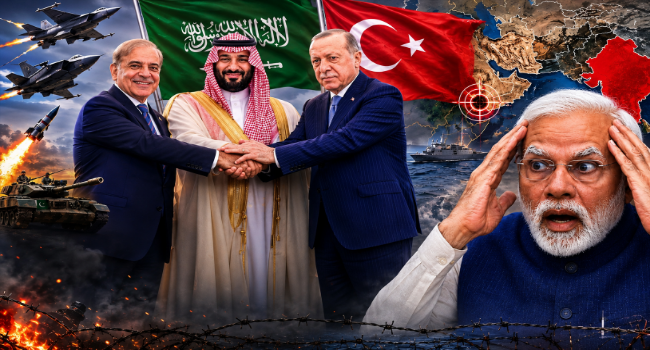
Pakistan has the nuclear bomb. Turkiye has NATO-level military strength. Saudi Arabia has one of the largest defence budgets in the world. These three countries have now come together under a single umbrella, declaring that an attack on any one of them will be treated as an attack on all three. So why exactly have these three countries joined hands? Is this really turning into a “Muslim NATO”? Egypt too is expected to join this alliance. So how is the power equation in West Asia set to change as a result? And notably, why is this alignment taking shape precisely at a time when a war involving Iran is underway? Is this aimed at targeting Iran, or is it an attempt by these nations to handle their own security without depending on the United States? And what effect would this grouping of three have on India? Let’s understand this story in detail.
A key meeting held in Mecca, Saudi Arabia, on August 7 is now sending ripples through global politics. Saudi Crown Prince Mohammed bin Salman, Pakistan’s Prime Minister Shehbaz Sharif, and Turkiye’s President Recep Tayyip Erdogan came together to sign the “Mecca Joint Defence Agreement.” The most crucial element of this agreement is that if any one of these three countries comes under armed attack, it will be treated as an attack on the other two as well. In other words, they have set up a collective defence system under which if danger comes to one, the other two are obligated to respond.
Turkiye’s Foreign Minister Hakan Fidan explained this point in greater detail, saying that this mutual defence clause is technically very close to Article 5 of NATO. However, he also clarified that, unlike NATO, it does not necessarily mean that any single attack would automatically require full-scale war. If one country seeks assistance, the others can, depending on the situation, share intelligence, provide logistical support, supply defence equipment, and if necessary, even send military units. In other words, the response under this agreement can be multi-layered.
Turning to Saudi Arabia — unlike Pakistan, Saudi Arabia does not have a large active-duty military, nor does it have a vast military-industrial complex like Turkiye. But Saudi Arabia has a different kind of strength: money power. In 2025, Saudi Arabia’s military expenditure reached approximately 83.2 billion dollars, making it the eighth-largest defence-spending country in the world. This means Saudi Arabia has substantial financial capacity to acquire advanced fighter jets, missile defence systems, radar networks, air defence systems, and naval equipment as needed.
As for Pakistan’s strength — the country has a large standing army. According to Global Firepower 2026 estimates, Pakistan has around 6.6 lakh active-duty personnel, 5.5 lakh reserve personnel, and roughly 5 lakh paramilitary personnel. Its air force reportedly has around 1,397 aircraft. Importantly, Pakistan is the only country among the three that possesses nuclear weapons — which is why Saudi Arabia’s defence partnership with Pakistan also carries a nuclear-strategic dimension. However, there is no publicly available detail on how or when nuclear weapons would come into play under this new Mecca agreement.
Putting the strengths of the three countries in a single line: Pakistan brings nuclear weapons and a massive army; Turkiye brings technology, a defence industry, and NATO experience; Saudi Arabia brings money, energy capability, and regional influence. Combined, the capabilities that each country lacks individually are filled in by the others. That’s why, even though this alliance is small, its strategic significance is considerable. Egypt too is now expected to join this grouping — Turkiye’s Foreign Minister Hakan Fidan himself described Egypt as a “natural partner,” saying they hope Egypt will join in the next phase. In other words, Egypt is not yet an official member, but it is the most important candidate for future expansion.
Should Egypt join, the alliance would also take on a far more strategically significant geographical shape. Pakistan is located in South Asia, Saudi Arabia in the Gulf, and Turkiye between Europe and Asia. Egypt would connect North Africa and the Red Sea region. If all four countries were to work together, it could result in the formation of a powerful security network. However, the question of whether this alliance is aimed at targeting Iran remains unanswered by the member countries so far. Turkiye’s Foreign Minister has stated clearly that they have not identified any single country as a common enemy, and that they are not viewing any country that has not attacked them as a target. Pakistan’s Foreign Minister too described the agreement as “purely defensive” in nature. In other words, there is officially no basis to claim that this alliance was formed against Iran. But in geopolitics, it is important to look not just at what an alliance claims its intent to be, but also at when it was formed and what the strategic interests of its member countries are.
That’s because Saudi Arabia has long-standing regional rivalry with Iran, and its suspicions about Iran on Gulf security matters have not fully disappeared. Pakistan, meanwhile, shares a border with Iran, so Saudi Arabia would certainly not want a direct confrontation involving Pakistan and Iran. Even though the interests of these three countries are not identical, there is a shared understanding that mutual cooperation is necessary when it comes to regional security.
Now, turning to India — as soon as this alliance was formed, some began viewing it as a “new threat to India.” But arriving at such a conclusion immediately would not be right. India has very strong strategic, economic, and energy ties with Saudi Arabia. Lakhs of Indians work within the Saudi economy, and India-Saudi relations across sectors such as oil, trade, investment, and security cooperation have strengthened considerably over the past several years. So it cannot be said that India-Saudi relations will suddenly change merely because Saudi Arabia is now part of an alliance that includes Pakistan.
That said, since both Pakistan and Turkiye are countries that pose a threat to India, our country will certainly not ignore this alliance. In particular, if Egypt, Qatar, or other countries join in the future, this alliance would gain even greater power. This is why two things become important for India: first, further strengthening its ties with Gulf countries; and second, carefully monitoring the extent to which defence cooperation between Turkiye and Pakistan develops.
One point about India’s own military strength also needs to be stated clearly. Statements like “India has the power to completely destroy any country that attacks it” may sound politically appealing, but making such absolute claims is not appropriate in a serious military analysis. In reality, India is indeed one of the world’s leading military powers. Global Firepower placed India fourth in the world for 2026. India has around 14.31 lakh active-duty personnel, 10 lakh reserve personnel, a large air force and navy, aircraft carriers, submarines, long-range missiles, nuclear weapons, and numerous other strategic capabilities. India’s military expenditure in 2025 is estimated at around 92.1 billion dollars. So India’s strength here is also considerable, and on top of that, India has the backing of Russia and Israel, with the possibility of US support as well if required.
Another point worth noting is that this Mecca alliance faces certain challenges too. The first is geography — there is a vast distance between Pakistan, Saudi Arabia, and Turkiye, and how quickly one country could respond if another urgently needed military assistance remains a big question. The second is political will — even though the agreement states that an attack on one is an attack on all, how much actual military force is sent in any given crisis remains a political decision each time. The third is differing threat perceptions — Saudi Arabia’s concerns centre on Iran and Yemen; Turkiye’s concerns involve Syria, Iraq, the Kurdish issue, and Black Sea matters; while Pakistan has its own separate concerns involving India, Afghanistan, and internal security.
Even so, this alliance cannot be dismissed as a minor development, because it sends a new strategic signal within West Asia. Instead of the old approach of relying on an outside power to come and provide security, the idea that regional powers should build their own security architecture together is gaining strength. While the United States remains the most powerful external military force in the Gulf, countries like Saudi Arabia are diversifying their security options — and strengthening ties with countries like Pakistan and Turkiye can be seen as part of that broader, more comprehensive strategy.
So how does Iran view this? Iran has criticised the Mecca alliance, saying it poses no new threat to its own security and is not a major solution for Saudi security either. But one thing is clear — at a time when a war between the US and Iran is underway, the announcement of a collective defence mechanism by Saudi Arabia, Turkiye, and Pakistan in the Gulf is not something entirely irrelevant to Iran. In particular, there is widespread interest in how this alliance would function if attacks were to target Saudi Arabia’s energy infrastructure, military bases, or shipping routes in the future. The future of this alliance also depends significantly on whether Egypt eventually joins — if Egypt formally becomes a member, the agreement would gain a considerably larger military presence.
As for India, it cannot be said that this alliance poses an immediate military threat to us. But the growing defence cooperation between Pakistan and Turkiye, Pakistan’s new strategic partnership with Saudi Arabia, and the possibility of Egypt joining are all developments India must certainly keep track of. At the same time, it remains crucial for India to further strengthen its energy, trade, diaspora, and defence ties with Saudi Arabia. How many more countries will join this alliance in the coming days? Will this alliance genuinely grow into a NATO-style force, or will it remain merely a political statement? Share your thoughts in the comments.