





- Ravi Prakash

At a time when petrol and diesel prices are already burdening the common man’s pocket, the government now appears set to reach into UPI as well. Critics argue that the Prime Minister’s priorities remain money and political image rather than the welfare of the people. If this charge is not meant to be visible to the public, why is it being imposed at all — and more importantly, where will this money ultimately go?
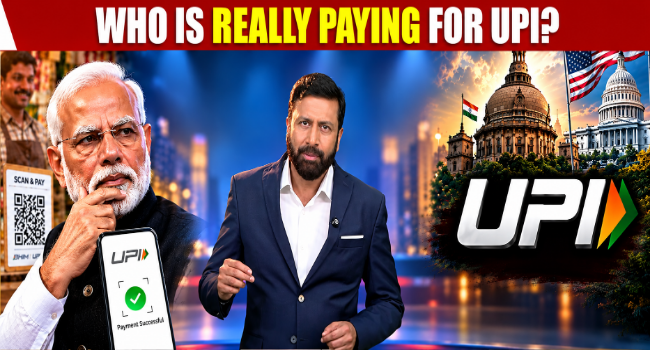
For years, UPI has run on a simple promise: scan the QR code, pay, and the transaction is complete — with no additional charge, regardless of whether the amount is small or large. This simplicity made UPI the largest digital payment system in the world. But now, a new number has entered the conversation: ₹2,000. The question being asked is why this particular threshold, why now, and who is really expected to bear the cost. At the centre of the debate is a pointed question: is UPI genuinely on its way to becoming chargeable, or is there a larger story behind this move? Congress leader Rahul Gandhi has alleged that the Modi government is quietly opening the door to impose fees on UPI transactions.
Understanding MDR
According to available data, only about 5% of UPI transactions each month exceed ₹2,000. To understand the charge being discussed, it is necessary to understand what is called MDR — the Merchant Discount Rate. In simple terms, this is the processing fee a merchant pays for accepting a digital payment. For instance, if a customer pays a merchant ₹10,000 and the MDR is fixed at 0.4%, the merchant would incur a cost of ₹40.
The critical question that follows is who absorbs that ₹40 — does the merchant treat it as a loss, cut into his own profit margin, or pass it on by raising the price of his goods or services? When prices are raised, the cost is indirectly transferred to a large number of customers. This is precisely the basis of Rahul Gandhi’s argument, and it is not without merit. However, the claim that the government plans to directly collect UPI fees from ordinary customers does not appear to be entirely accurate.
Why UPI Isn’t Actually Free to Run
Because of zero MDR, small kirana store owners, street vendors and large retailers alike have adopted the UPI ecosystem without having to think about transaction charges — whether the payment is ₹100, ₹500 or ₹1,000. But there is a catch: UPI may be free for the end user, but running the UPI network itself is not free.
Banks, servers, cybersecurity systems, fraud-prevention mechanisms, payment infrastructure, settlement systems and customer support all require continuous investment. As UPI’s scale has grown, so has the cost of operating it. This raises a fundamental question: the entire ecosystem currently runs on government subsidies and incentives. High-value transactions make up only a small percentage of total UPI transactions, but they represent a disproportionately large share of the total money moving through the system. The underlying logic, therefore, is that everyday small-value payments should remain exempt from MDR, while high-value merchant transactions may not.
The Political Charge: “The Modi Heist”
The Prime Minister first urged citizens repeatedly to adopt UPI — “do UPI, do UPI, do UPI” — and once people embraced it en masse, the government is now said to be looking to recover costs from the very system it promoted. If that recovery does not happen through other means, critics argue, it will happen through UPI charges. Until now, UPI has been free of charge, and the government maintains that there is still no charge on transactions below ₹2,000.
Citing transaction data, nearly ₹314 lakh crore worth of value was transferred through UPI. Of the total transaction volume, only about 4% — roughly 906 crore transactions — were valued above ₹2,000, yet these accounted for nearly ₹207 lakh crore out of the total ₹314 lakh crore in value. It is this concentration of value in high-ticket transactions that critics say has led the government to see an opportunity for recovery — a move labeled “the Modi heist” and “the UPI robbery,” with sharp sarcasm suggesting that soon even bathing might be taxed.
Under the proposed framework, a ₹2,000 charge would apply to certain UPI transactions as part of what is described as a blanket government fee, while at the same time high-value merchant transactions would remain protected and free of charge. Reports suggest discussions around a 0.4% MDR are underway, but no final decision has been made — which is why UPI continues to run free of charge for now, even as concerns mount over what may follow.
The US Pressure Angle
A separate and more contentious question is why the UPI fee structure is being reconsidered at all. Rahul Gandhi has sought to link this development to alleged pressure from American payment companies.
The reasoning offered is that UPI’s rapid growth has enabled a large number of households to access digital payments, expanding the platform far beyond a mere payment option into what is described as the backbone of India’s digital payments infrastructure. International payment companies are said to have been closely monitoring this growth, and the United States has reportedly expressed concerns regarding India’s digital payments ecosystem. It has further been alleged that when the US imposed tariffs on India as part of trade negotiations, questions arose over whether this was connected to the Adani-related files or the Epstein files — with claims that names of political leaders appearing in such files have opened the door to blackmail, which in turn is said to be driving pressure on policy decisions.
Beyond the political charges, there is a human cost to this dispute: it is not the government, the leaders, the ministers or the Prime Minister who bear the brunt, but the ordinary Indian citizen — who is already grappling with inflation and unemployment and is directly affected by these decisions in real time. This, critics argue, is not merely a matter of assembled facts but of policy itself. Rahul Gandhi has alleged that due to American pressure, the Modi government will have no option but to walk back its position on UPI charges.
However, the claim of direct American pressure shaping India’s domestic decisions currently lacks public evidence. What is clear is that the government provides subsidies and incentives to sustain the UPI ecosystem, and that cost must be borne at some level — whether by the government, the banks, the payment companies, or the merchants themselves.
Impact on Small Businesses
Consider the example of a restaurant where a customer pays ₹10,000 via UPI. If a 0.4% MDR is applied in future, the merchant’s cost on that single transaction would be ₹40 — seemingly a small amount. But for a business processing lakhs of transactions daily, this becomes a meaningful recurring cost. Merchants would then face a choice: absorb the cost themselves, cut into their profit margins, or raise the price of their products or services.
Just as the ruling party has not spared ordinary people accused of petty theft, critics argue it is unlikely to spare common citizens from bearing this cost either. They recall that the Prime Minister first encouraged citizens to move onto UPI on the promise that it was free, and now that adoption has become widespread, charges are reportedly being considered — raising fears that an even larger burden could follow. The sentiment being expressed is that the public does not feel seen or heard by the government in this matter.
A Second Concern: System Simplicity
Beyond the fee debate lies a second concern — the risk to UPI’s core strength: its simplicity. Scan, pay, done — this ease of use was what moved India away from cash dependency, eliminating the need for card machines and the friction of additional charges. Different transaction values already carry different rules, and the system risks becoming more complex going forward. UPI’s popularity spread even to small roadside vendors who began accepting payments via QR codes, sparing customers the hassle of handling cash — a convenience made possible simply by a phone, UPI, and a payment point.
The Core Question
Until now there have been no charges at all on UPI — so why are these charges now being considered? A parallel is drawn with GST and the heavy taxation already levied on diesel and petrol, with many people remaining unaware of the extent of taxes and charges already in place. The central question that follows is where this money will ultimately go, and how much impact it will have on small businesses in particular. For a large retailer, a small MDR may be manageable; but for small shopkeepers operating on thin margins, even a modest charge could become a heavy burden. The final rules — including merchant value thresholds, transaction value slabs, and whether MDR is passed on to customers — remain critical details that need far greater clarity.
It would be premature to declare UPI charges as a settled fact — but it would be equally incorrect to claim that nothing is going to change. Until the final MDR rate and fee structure are formally decided, no conclusion can be drawn, and the claim that American pressure alone derailed or shaped this policy has not been proven either. Amid the noise, one point should not be lost: charges on UPI are not a trivial matter. At its heart, this is a story about the success of India’s largest digital payment system — and the unresolved question of who should ultimately pay to sustain it: the government, the banks, the payment companies, the merchants, or the consumer.
As it stands — UPI itself may remain free for the user, but running UPI is not free. The genuine question underlying the entire debate is simple: someone has always been paying the bill — who will it be going forward?