





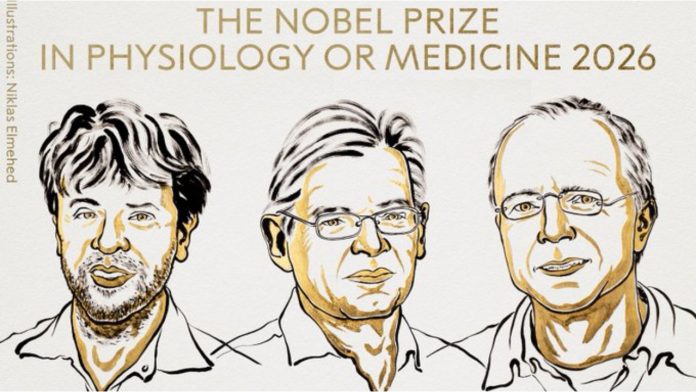
The Nobel Prize in Physiology or Medicine for 2026, one of the most prestigious honors in science, has been awarded to three scientists for unraveling the complex workings of the brain’s neural network and developing a groundbreaking technology to control nerve cells using light. The Nobel Assembly at the Karolinska Institute in Stockholm, Sweden, announced the award for Karl Deisseroth of the United States and Peter Hegemann and Georg Nagel of Germany. The three laureates will jointly share a cash prize of approximately Rs 11.55 crore (1.2 million dollars).
The human brain functions as the central system governing the body, thought processes, and emotions, with billions of neurons continuously exchanging signals to enable cognition and action. However, fundamental questions, including when individual neurons become active, why certain cells suddenly weaken, and what transpires in the brain during conditions such as severe depression, Alzheimer’s disease, or paralysis, had remained poorly understood for decades.
The laureates’ discovery, a technology known as optogenetics, has provided critical answers to this long-standing scientific puzzle. The research traces its origins not to direct studies of the human brain, but to investigations into a species of green algae found in water. Peter Hegemann initially examined how the algae was able to swim toward sunlight. Working in collaboration with Georg Nagel, he discovered that exposure to blue light caused a protein within the algae’s cells to open like a gate, generating electrical signals.
Building on this discovery, Stanford University professor Karl Deisseroth advanced the research to a transformative stage. By integrating principles of optics and genetics, he introduced light-sensitive proteins into specific neurons in the brains of laboratory mice. When a targeted laser beam was directed at that region of the brain, the corresponding neurons became immediately active, and switching off the light returned them to their normal state, demonstrating for the first time that brain cells could be precisely switched on and off using light.
The implications of this discovery extend well beyond laboratory research, offering considerable promise for the field of human health. The technology allows for the precise identification of damaged neurons in severe neurological disorders such as Parkinson’s disease, Alzheimer’s disease, and epilepsy. It has also enabled researchers to pinpoint which regions of the brain are implicated in depression and anxiety, opening avenues for more targeted treatment approaches. It is in recognition of this landmark scientific achievement that the Nobel Prize was awarded to the three researchers.