





-Ravi Prakash

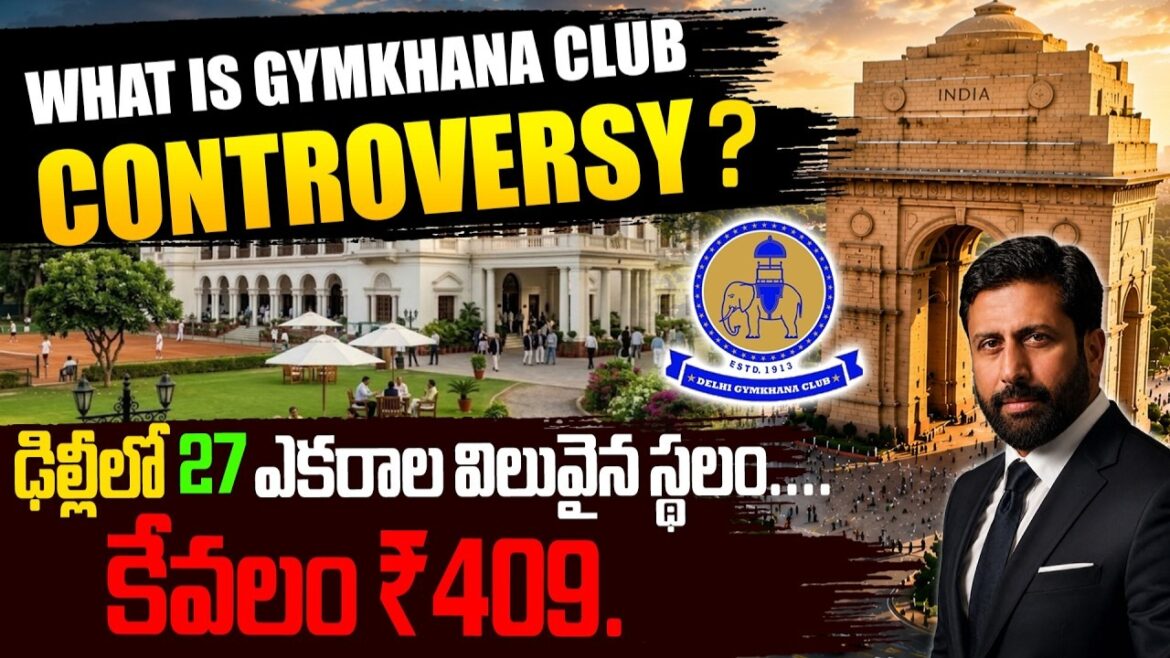
In the heart of the national capital lies nearly 27 acres of prime land worth hundreds of crores — an address long associated with power, prestige, and influence in Lutyens’ Delhi: the Delhi Gymkhana Club. For decades, the elite institution symbolized the remnants of British-era exclusivity, operating as a highly restricted social circle inaccessible to ordinary citizens. However, the iconic club has now landed at the center of a massive political, legal, and ideological controversy that is rapidly escalating into a nationwide debate.
Established by the British in 1913 as the Imperial Delhi Gymkhana Club, the institution was later renamed the Delhi Gymkhana Club after Independence. Over the years, it evolved into one of India’s most exclusive clubs, with memberships dominated by senior IAS and IPS officers, judges, military generals, politicians, corporate elites, and influential families. Membership at the club has historically been considered extremely difficult to obtain, with waiting periods reportedly stretching close to 30 years. Critics argue that the system largely favored legacy admissions, with preference often going to the children and relatives of existing members, effectively turning the club into a closed elite network.
The controversy erupted after the Central government directed the club to vacate the land by June 5, citing public purpose, infrastructure development needs, and security concerns. The property itself is located in Lutyens’ Delhi and is considered one of the most expensive government-owned land parcels in the country. However, the issue took a dramatic turn after details of the lease agreement entered the public domain. According to the colonial-era lease arrangement, the annual ground rent being paid by the Delhi Gymkhana Club for the 27-acre property was reportedly just Rs. 409 per year. The revelation triggered widespread outrage, with critics questioning how land worth hundreds of crores could continue to be occupied at such a nominal rent for decades.
Following a reassessment based on present-day market rates, the government revised the annual rent from Rs. 409 to nearly Rs. 4 crore. Notices were subsequently issued demanding payment of approximately Rs. 48 crore in alleged pending dues. At the same time, the Ministry of Corporate Affairs (MCA) intensified scrutiny of the club’s operations. Through proceedings before the National Company Law Tribunal (NCLT), the Centre moved to take control of the club’s management, arguing that the institution was operating in violation of public interest principles.
The government has alleged that membership privileges within the club remained concentrated among a limited circle of influential families and individuals, effectively turning a public asset into a private preserve for elites. It further argued that despite collecting massive sums through membership-related revenues, the club was not functioning in accordance with regulatory norms. According to the Centre’s position, public land was allegedly being used for the benefit of a select few under a structure resembling a private limited entity rather than a genuinely public institution.
The dispute has also evolved into a larger ideological battle. Supporters of the government view the move as part of Prime Minister Narendra Modi’s broader campaign against what he describes as “Ghulami Mansikta,” or colonial-era mindsets. Over the past few years, the Modi government has undertaken several symbolic changes, including renaming Rajpath as Kartavya Path and replacing multiple British-era laws. In this context, many supporters argue that the Delhi Gymkhana Club represents the arrogance and exclusivity of the old colonial elite culture embedded within Lutyens’ Delhi, and that the government’s intervention is intended to dismantle that entrenched privilege system.
However, political commentators and critics interpret the development differently. Many argue that the move reflects a larger struggle for institutional control within Delhi’s power ecosystem. According to this view, even as governments change, networks involving senior bureaucrats, retired officials, influential lawyers, and old power circles continue to wield influence behind the scenes, often described informally as a “deep state.” Critics allege that the Gymkhana Club functioned as a hub for these networks and that the Centre’s current actions are aimed at breaking the influence of the old establishment while consolidating its own control.
The matter has now reached the judiciary. The Delhi Gymkhana Club approached the Delhi High Court challenging the Centre’s eviction order. During proceedings, the government clarified that it would not forcibly take possession of the premises until due legal procedures were completed. Nevertheless, the issue has sparked intense debate across political and media circles.
Veteran journalist Vir Sanghvi added further fuel to the controversy through a sharply worded post on X. He criticized what he described as exaggerated portrayals of the Gymkhana Club as the “headquarters of the Khan Market Gang.” In a satirical tone, he remarked that social media narratives were creating the impression that opposition leaders such as Rahul Gandhi and Sonia Gandhi were conducting anti-Modi conspiracies from the club premises. Sanghvi also raised a provocative question: whether the BJP was still fighting the establishment or had itself become the new establishment. His remarks triggered a major social media storm.
Senior journalist Rajdeep Sardesai invoked Italian sociologist Vilfredo Pareto’s “Circulation of Elites” theory while analyzing the controversy. He argued that elites in society never truly disappear; instead, one elite structure simply replaces another. According to Sardesai, the British elite was followed by a Congress-Lutyens elite, and now a BJP-linked power structure appears to be emerging in its place.
Historian Irfan Habib questioned the government’s security-related arguments, asking why similar concerns were never raised when former Prime Minister Indira Gandhi resided in the same area. Retired IPS officer Yashovardhan Azad similarly questioned why the Gymkhana Club alone appeared to be under scrutiny.
Former Army officer Deeptangshu Chowdhury criticized the broader direction of the debate itself. He argued that if privilege and misuse of taxpayer resources were genuinely the concern, then similar scrutiny should also extend to political luxuries such as VIP convoys, ministerial bungalows, and other state-funded privileges enjoyed by elected leaders. He questioned why retired civil servants and military veterans were being disproportionately targeted while political excesses remained largely unaddressed.
Lawyer Sanya Talwar mocked sections of the old elite establishment, remarking sarcastically that elites were now “crying over subsidized kebabs.” She argued that the issue was not a crisis of democracy but rather a reflection of anxiety among old power circles fearful of losing influence.
Meanwhile, television anchor Rahul Shivshankar — often viewed as ideologically sympathetic to the BJP — offered a notably critical perspective. He argued that if the government genuinely viewed the Gymkhana Club as a symbol of entrenched elite privilege, it should openly state so rather than relying solely on security-related explanations. Shivshankar pointed out that the Modi government had consistently politically targeted the so-called Lutyens ecosystem, Khan Market Gang, dynastic politics, and colonial-era elite networks over the years. He further questioned why the Gymkhana issue had suddenly become urgent nearly a decade after Prime Minister Modi shifted to 7 Lok Kalyan Marg.
He also highlighted that several other prominent institutions — including Ashok Hotel, Samrat Hotel, the Race Course, the Air Force Golf Club, and the Flying Club — are located within the same zone. Shivshankar questioned why only the Delhi Gymkhana Club appeared to be specifically targeted. He asserted that if the objective was genuinely to dismantle the old elite order, the government should publicly acknowledge that intention and apply the law uniformly across all similar institutions.
As the legal and political battle intensifies, the future of the Delhi Gymkhana Club remains uncertain. The controversy has exposed not only the extraordinary Rs. 409 lease arrangement but also the deeper tensions surrounding privilege, power, institutional control, and the changing nature of India’s political establishment. Whether the club eventually transforms into a more open institution accessible to ordinary citizens, undergoes structural changes under government-appointed administrators, or simply becomes another flashpoint in India’s ongoing political polarization remains to be seen.