





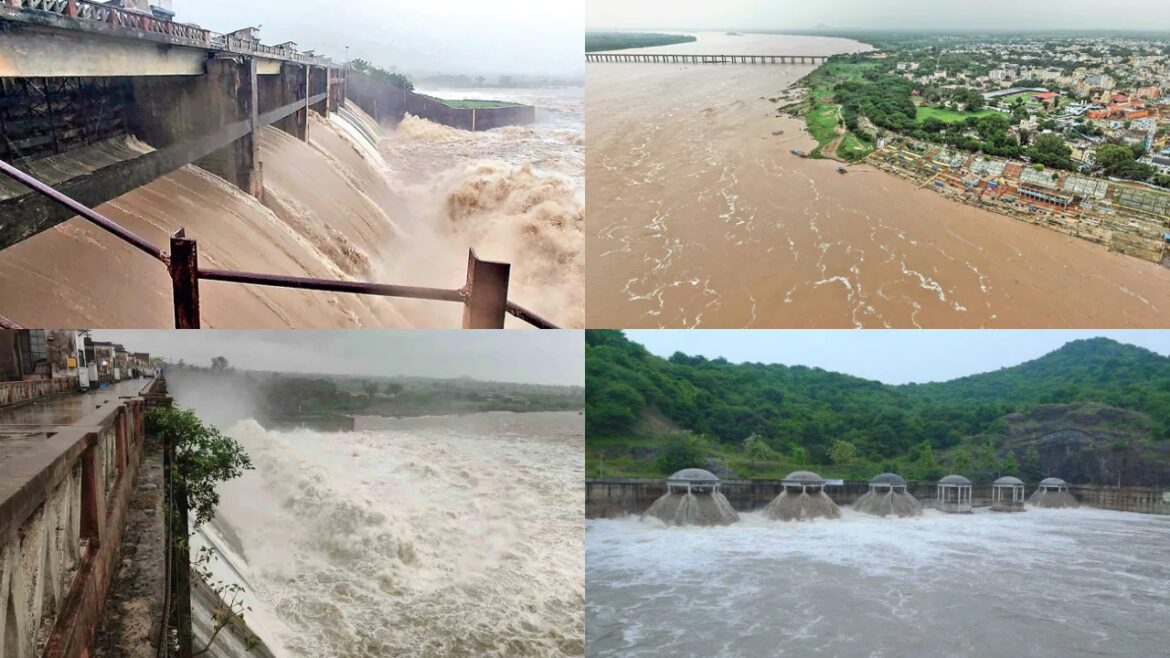
Due to incessant rainfall in the border areas of Maharashtra and Telangana, inflows into the Sriramsagar Project (SRSP) on the Godavari River in Nizamabad district are rising sharply. This project, critical to the erstwhile Nizamabad district and northern Telangana districts, is currently receiving an inflow of 75,432 cusecs. Against a full storage capacity of 80.5 TMC, water storage reached 21.2 TMC by Thursday evening, sparking celebrations among ayacut farmers. The filling up of SRSP is set to bring major relief to Telangana’s agriculture sector, as the project supports an extensive ayacut across two stages — approximately 9.68 lakh acres under Stage-1 and 4.80 lakh acres under Stage-2, totaling 14.50 lakh acres of irrigated land. The recent floods are expected not only to address irrigation water shortages for Kharif crops but also to significantly boost groundwater levels.
Flood risk has also increased at major reservoirs downstream of SRSP. Following heavy rains in the erstwhile Adilabad district, the Kadem Project filled to capacity, prompting officials to open its gates and release 1.90 lakh cusecs into the Godavari. Combined with this surge and local rainwater runoff, inflow at the Sripada Yellampalli Project in Peddapalli district reached 4.65 lakh cusecs. With Yellampalli’s storage capacity at 20.18 TMC already at 19.70 TMC, officials are releasing incoming water downstream to the Medigadda barrage as it arrives.
With floodwaters surging into Yellampalli, the lift irrigation process transferring water to the Mid Manair reservoir via Rajarajeshwara continues uninterrupted. On Wednesday, officials lifted 12,600 cusecs of water using four motors each at the Nandi and Gayatri pump houses; as water flow increased on Thursday, they activated a fifth motor at the Nandi pump house, raising inflow into the Nandi reservoir to 15,750 cusecs. From there, water is being channeled through tunnels to the Gayatri pump house at Lakshmipur in Ramadugu mandal, and then lifted via five motors through the flood canal into the Mid Manair reservoir.
In Jayashankar Bhupalpally and Mulugu districts, the Godavari tributaries Pranahita and Indravati are flowing in spate. Due to the surge in Pranahita, 3.31 lakh cusecs of water are being released downstream from the Medigadda (Lakshmi) barrage. With floodwaters from the Indravati river originating in Chhattisgarh combining with local stream flows into the Godavari, an inflow of a massive 9.36 lakh cusecs was recorded at the Sammakka barrage (Tupakulagudem), underscoring the severity of the situation.
The rising flood levels are severely disrupting infrastructure. Near Regumakugandi, close to Tekulagudem on the Telangana-Chhattisgarh border in Mulugu district, floodwaters have risen significantly onto the roadway. As a result, vehicular movement on National Highway 163 connecting Hyderabad and Bhupalpatnam has come to a complete halt. With connectivity between the two states cut off, passengers and cargo vehicles have been stranded for kilometers, facing severe hardship.
With all the Godavari tributaries converging, water levels at Bhadrachalam are rising rapidly. As of 8 pm on Thursday, the water level at Bhadrachalam reached 28.70 feet, with flow recorded at 3.97 lakh cusecs. Based on the pace of flow coming from the upstream Pranahita and Indravati rivers, irrigation officials estimate that the water level at Bhadrachalam could soon reach the first flood warning level (43 feet). Authorities have alerted residents of riverside areas.
Meanwhile, flood levels are also gradually rising in the Krishna river basin. At the upstream Krishna projects in Karnataka, Almatti is receiving an inflow of 83,000 cusecs while releasing 97,000 cusecs downstream. Similarly, with an inflow of 95,000 cusecs into the Narayanpur reservoir, officials are releasing 1.09 lakh cusecs downstream. With this water flowing in from upstream, the Krishna river is entering Telangana with vigor.
Owing to releases from upstream projects, Jurala — the first project on the Krishna river in Telangana — received a flood inflow of 1.04 lakh cusecs by Thursday night. While generating power there, officials have opened the gates and are releasing 1.09 lakh cusecs downstream. As a result, inflow into the Srisailam reservoir rose to 1.12 lakh cusecs. Against a full storage capacity of 215.81 TMC, Srisailam’s water level reached 46.82 TMC by Thursday evening.
With backwaters sufficiently built up at Srisailam and Jurala, the Telangana government has begun operating ayacut-based lift irrigation schemes. At the Mahatma Gandhi Kalwakurthy Lift Irrigation Scheme in Nagarkurnool district, 1,600 cusecs of water are being lifted from the first-stage pump house into the Yelluru reservoir. Officials have also accelerated water-lifting operations through the Bhima and Nettempadu lift irrigation schemes, which draw on the backwaters of Jurala.