





-Ravi Prakash

I have seen many disturbing incidents in journalism. But the video that surfaced now is, without exaggeration, one of the most shameful visuals in recent years. Because this is not just a celebration video. It feels like a direct slap on the face of the justice system itself.
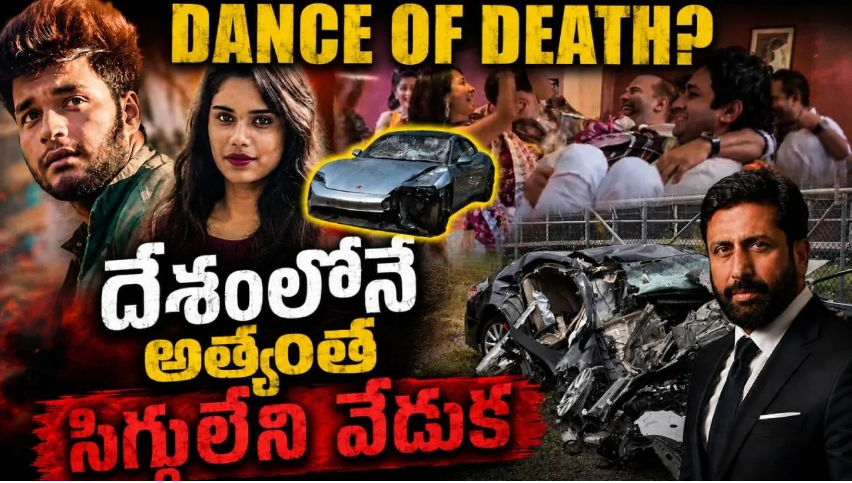
The case involves the tragic death of Anish Awadhiya and Ashwini Koshta, two young tech professionals who were killed in a Porsche accident in Pune. Two families have been pushed into irreversible grief and darkness. Parents who lost their children are living through unbearable pain.
At the same time, a video allegedly connected to the accused family shows celebrations after bail was granted. The visuals reportedly show people dancing and celebrating, including garlanding themselves with currency notes. This raises a simple but painful question: were they elected in an election? Were they declared innocent by a court? And most importantly, is there even a trace of remorse?
Watching this video leads to one disturbing thought—has money in our country not only influenced people, but also weakened the idea of justice itself? The confidence shown in the celebrations forces us to ask what condition the victims’ parents must be in while such visuals circulate.
Is this really a celebration, or is it the burial of accountability in this country? On one side, grieving parents are suffering unimaginable pain, while on the other side, celebrations continue. This is no longer being seen as a simple road accident case. It has become a symbol of privilege, power, status, and the dangerous belief that justice can be negotiated.
The incident took place in May 2024, when a speeding Porsche car hit two young tech professionals riding a bike. Both Anish Awadhiya and Ashwini Koshta died on the spot. The car was allegedly driven by a minor returning from a party under the influence of alcohol.
What shocked the nation was not only the accident, but the bail decision. The Juvenile Justice Board granted bail to the minor with conditions such as writing an essay, assisting traffic police, and attending counselling. This triggered massive public outrage, with many questioning whether such conditions are appropriate for a case involving the loss of two lives.
Following the backlash, the system reacted again. The minor was sent to an observation home, and the investigation was reopened. From there, multiple twists emerged in the case. Allegations surfaced regarding tampering of evidence, and even blood sample manipulation, leading to arrests of medical professionals involved in the process.
The case also saw political attention, including controversy around NCP leader Sunil Tingre’s visit to a police station, which critics alleged was an attempt to influence the proceedings. The case soon raised a deeper question—does influence decide outcomes in such cases?
But perhaps the most disturbing aspect today is no longer only the accident or the legal process. It is these celebrations. Because celebrations like these expose mindset. They reveal the real psychology behind power and privilege.
This raises uncomfortable questions being asked by the public: if the accused belonged to a poor family, would top lawyers have appeared so quickly? Would bail have been granted so fast? Would there have been political access? Would the narrative have been controlled so effectively?
This is why the case is emotionally shaking the country. Because this is not just about law. It is about whether law applies equally to everyone.
Every year, thousands of lives are lost in India due to drunk driving incidents. Families are destroyed. Children lose parents. Parents lose children. In many such cases, punishment remains minimal compared to the loss caused.
In contrast, in countries like the United States, drunk driving cases resulting in fatalities often lead to decades of imprisonment. In the Mackenzie Shirilla case, a court found her guilty of speeding and killing two people and sentenced her to life imprisonment, with the judge clearly stating that neither age, privilege, nor money could protect the accused.
But the question being raised now is—what is happening here? The painful reality many people are thinking about is that influence often slows down the system, softens outrage, and weakens accountability, while victims are left only with grief.
Anish Awadhiya. Ashwini Koshta. These two names must not be forgotten. Because in such cases, society often shifts focus to law, bail, and politics, but forgets the two lives that never returned.
Somewhere, their parents are still crying, still trying to survive, still trying to forget. And at the same time, somewhere else, celebrations continue.
And these celebrations, to many, appear not just insensitive—but as a reflection of the deeper crisis facing the justice system itself.