





China’s robot race has now moved to a whole new level. Robots have started performing tasks like humans — from household chores to running, long jump, and shuttle events. So why is China focusing so heavily on humanoid robots? What exactly is their goal? And just how safe are these robots? Let’s find out clearly in this story.
Robot testing in China has now entered a new phase. Until now, robots were assigned a specific task in advance and made to perform only that task. But now, they are being tested for their ability to adapt their own actions in response to changing conditions. At the second World Humanoid Robot Games being held in Beijing from August 22 to 26, 666 teams comprising 2,056 robots from 16 countries are participating. Competitions range from household chores to running, long jump, and shuttle events. Household tasks include assignments such as tidying up a living room, folding clothes, washing and hanging clothes to dry, and even handling an interruption — such as receiving a parcel mid-task — before resuming the paused activity.
However, these tests are not limited to household chores alone. They are also assessing whether the robot can move like a human, maintain balance, and respond immediately if the situation suddenly changes. That’s why robots are being tested in sports events as part of the games as well — how fast they can run, how far they can jump in the long jump, and how well they play in shuttle events. China isn’t simply aiming to build a robot that merely looks human — it’s aiming to build a robot that can actually work like a human. Because whether at home or in a factory, conditions are never exactly the same every time. That’s why robots are being trained not just to stick to pre-programmed tasks, but to understand the situation they encounter and make decisions accordingly.
The main reason behind China’s aggressive push in this direction is its shifting demographics. The number of elderly people in China is steadily increasing, while the working-age population is expected to decline in the future. As a result, there is a looming shortage of human labor in factories, warehouses, logistics, and certain service sectors. China is proactively seeking a technological solution to this problem, which is why it is preparing robots now to take over some of the tasks currently performed by humans.
In addition to this, robots are also expected to be highly useful for China’s massive manufacturing sector. China is one of the largest manufacturing hubs in the world, with thousands of factories, massive warehouses, and millions of different products — all of which require the same tasks to be repeated over and over. Tasks such as lifting boxes, arranging goods, packing, and transporting materials from one location to another are areas where robots, if deployed effectively, could reduce dependence on human labor, lower production costs, and increase the speed of work. In particular, if robots can be made to work 24 hours a day, it would become a major advantage for China’s large-scale manufacturing factories.
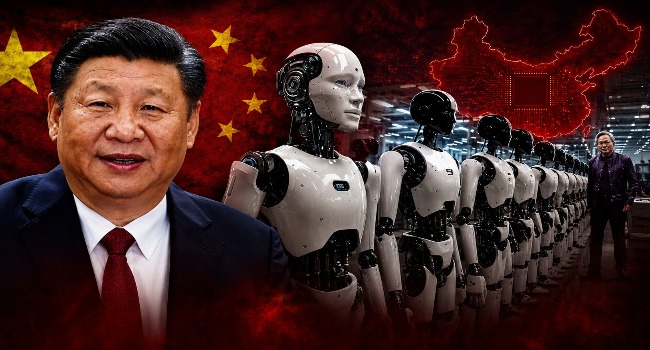
China’s Humanoid Robots Are Learning to Think, Not Just Perform
160