





-Ravi Prakash

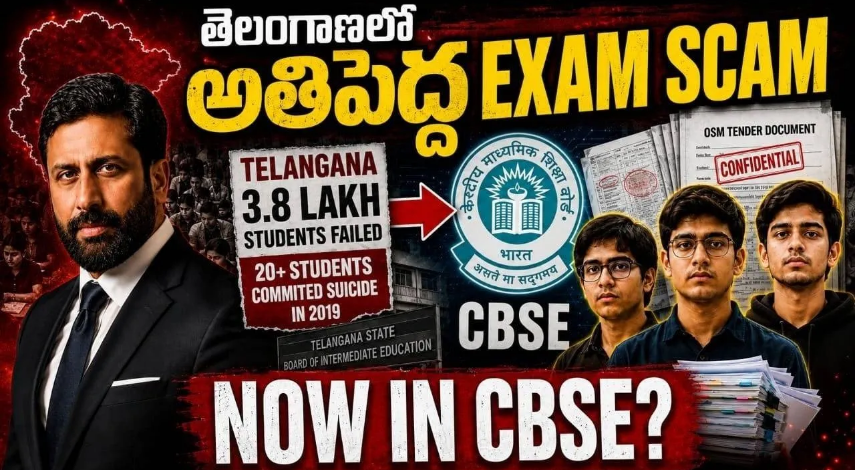
In 2019, Telangana witnessed one of the most controversial episodes in its education sector when 3.8 lakh Intermediate students were reportedly failed due to large-scale evaluation and result-processing errors, leading to the deaths of more than 20 students. At the center of the controversy was Globarena Technologies, the company entrusted with handling the examination process. Critics allege that the company later rebranded itself as Coempt Edutech in an attempt to distance itself from the fallout. The controversy has resurfaced after Coempt Edutech was awarded a major CBSE contract, prompting questions over how a company linked to such a contentious history was once again entrusted with responsibilities affecting millions of students. Critics argue that changing a company’s name does not erase its past record and have questioned the decision to award it another contract involving the future of students across the country.
The latest controversy did not emerge from a parliamentary committee, government audit, or media investigation. Instead, it was sparked by three teenagers who independently scrutinized CBSE’s On-Screen Marking (OSM) system, a digital evaluation mechanism introduced to modernize the assessment process. The system was designed to replace manual paper evaluation with digital marking, promising greater accuracy and efficiency. However, concerns over mark discrepancies, data leaks, and cybersecurity vulnerabilities soon emerged. Student researcher Vedant Srivastava questioned alleged flaws in the marking system, while another teenager, Nisarg Adhikari, publicly highlighted what he described as vulnerabilities in CBSE’s data-security infrastructure. Their findings raised concerns about the privacy and security of information belonging to millions of students.
The most detailed investigation was carried out by Class 12 student Sarthak Siddhant, who examined hundreds of pages of CBSE tender documents line by line. According to his analysis, several tender conditions appeared to have been modified over time in ways that allegedly benefited a particular company. Sarthak reviewed multiple versions of CBSE tenders and raised questions about whether the eligibility criteria, technical standards, and evaluation mechanisms had been altered to favor Coempt Edutech, formerly known as Globarena Technologies. He questioned why the original tender process, which reportedly included major technology firms such as TCS, was cancelled and replaced with a revised tender containing significantly different conditions.
According to Sarthak’s findings, several key clauses were modified between tender versions. He pointed to changes in provisions related to company reputation, blacklisting history, software maturity standards, data-center ownership requirements, source-code ownership, and cooling-off periods for retired officials joining private firms. He questioned why companies with adverse track records could no longer be disqualified solely based on past controversies and why blacklisting provisions were revised to apply only to firms currently under blacklisting. He also raised concerns over the reduction of CMMI maturity requirements, relaxation of infrastructure norms, removal of source-code ownership provisions, and the shortening of mandatory cooling-off periods from two years to one year.
The controversy has now entered the political arena. Congress leader Rahul Gandhi publicly praised Sarthak Siddhant’s investigation, stating that the student had exposed critical issues using CBSE’s own documents. Senior Congress leader Jairam Ramesh demanded a judicial inquiry into the matter and questioned the circumstances under which the tender conditions were altered. Both leaders called for greater transparency regarding the tender process and accountability for any irregularities that may have occurred.
Sarthak’s investigation further alleged that significant changes were made to the tender’s scoring and evaluation framework. Earlier tender models reportedly emphasized experience in handling large-scale projects, project value, operational scale, and proven track records. However, the revised framework appeared to reduce the importance of large-project experience and permit smaller assignments to qualify more easily. He argued that these modifications potentially expanded eligibility for vendors with limited experience in handling large-scale educational digitization projects.
Questions were also raised regarding technical manpower requirements. According to the analysis, earlier tender frameworks gave greater weightage to companies with large teams of experienced software professionals. The revised framework reportedly reduced these requirements despite the project involving massive digitization efforts, answer-sheet processing, software management, cybersecurity systems, and monitoring operations affecting millions of students. Critics have questioned why technical standards were lowered for a project of such scale and significance.
Another major point of contention relates to quality-control mechanisms and penalties. Earlier tender provisions reportedly imposed strict penalties for errors such as incorrect scanning, missing pages, partial scanning, and failure to digitize answer books. However, Sarthak’s research suggested that newer tender versions shifted emphasis toward meeting deadlines while reducing accountability for quality-related failures. He claimed that error thresholds and mathematical quality benchmarks that existed in earlier frameworks were removed from later versions. Furthermore, a corrigendum issued after the tender release allegedly softened blacklisting provisions, reducing the consequences for vendors involved in serious errors or contractual violations.
As the controversy evolved, attention shifted from procurement issues to cybersecurity concerns. Nisarg Adhikari alleged that infrastructure associated with the OSM ecosystem contained significant security vulnerabilities. He claimed that an examination-related cloud-storage bucket was left publicly accessible without proper authentication controls. According to his allegations, the exposed material potentially included answer sheets, question papers, student personal information, and records from multiple institutions. Although cybersecurity experts have yet to publicly verify these claims in a formal capacity, the allegations triggered widespread concern over the protection of student data and examination records.
The alleged exposure of educational records has raised several unanswered questions. Observers have sought clarification regarding the volume of information that may have been accessible, the duration of any potential exposure, the number of users who may have accessed the data, the timeline for identifying and addressing the issue, and whether affected students, schools, or parents were informed. The absence of detailed public explanations has contributed to growing demands for transparency and accountability.
The security allegations have also reignited scrutiny of the tender changes highlighted by Sarthak Siddhant. Critics argue that if security failures occurred, they raise broader questions about whether technical standards, security audits, and compliance mechanisms were sufficiently robust. In a widely discussed social-media post, Sarthak expressed concern that public trust in educational institutions had been undermined, arguing that students and parents rely on examination boards to protect both academic integrity and personal information.
The issue has now expanded beyond software and procurement matters to become a debate about institutional responsibility. Since students have no ability to audit cloud systems, verify cybersecurity controls, or review procurement decisions, they are entirely dependent on educational authorities to maintain trust and transparency. This growing concern has intensified calls for independent investigations into both the tender process and the alleged security vulnerabilities.
Jairam Ramesh has further expanded the scope of scrutiny by questioning not only the tender process and cybersecurity framework but also the answer-sheet digitization methodology, scanning quality standards, and equipment specifications used during implementation. These concerns gained momentum after answer-sheet images began circulating on social media, prompting fresh questions about whether the scanning process complied with the standards outlined in tender documents.
A new controversy emerged when Sarthak Siddhant publicly questioned the quality of digitized answer-sheet images. CBSE had repeatedly stated that high-end professional scanners were used for answer-sheet digitization. However, Sarthak pointed to visible shadows, fold marks, and other image characteristics that he argued resembled photographs rather than industrial scanner outputs. He questioned whether answer sheets were actually scanned using professional equipment or whether alternative methods had been employed.
The issue attracted further attention after an X user identified as Datavorus reportedly analyzed 2,944 answer-sheet pages. According to observations shared online, similar shadows, folds, and extraneous visual elements appeared across thousands of images. Critics argued that such characteristics were inconsistent with the outputs expected from industrial document-scanning systems. Tender documents reportedly referred to duplex scanners, automatic book scanners, and robotic scanning technologies, leading observers to question whether the actual digitization process matched the technical specifications outlined in procurement records.
Sarthak also argued that earlier tender versions contained stricter scanner specifications and technical requirements, which were later relaxed through subsequent revisions. He questioned whether these changes were made to accommodate alternative digitization methods and whether the modifications had been planned in advance. The controversy, he maintained, is not merely about shadows or fold marks but about transparency, compliance, quality control, and the integrity of a system handling the academic future of millions of students.
The investigations carried out by Vedant Srivastava, Nisarg Adhikari, and Sarthak Siddhant have attracted significant public attention. Vedant focused on alleged flaws within the evaluation system, Nisarg examined cybersecurity concerns, and Sarthak conducted a detailed review of tender documents and procurement practices. While the accuracy of their allegations remains subject to independent verification and official scrutiny, their work has prompted nationwide discussion about accountability within India’s educational infrastructure.
The controversy has now reached political circles and Parliament, transforming what began as a social-media discussion into a broader national debate. Questions continue to be raised regarding why tender conditions were modified, who benefited from the changes, whether comprehensive security audits were conducted, where the audit reports are, how student data was protected, and why such extensive public concern has emerged if all procedures were followed correctly.
At its core, the issue extends beyond a software platform, a cloud-storage system, or a single contractor. It concerns the transparency, security, and integrity of examination systems relied upon by millions of students and families every year. Students devote years of effort to their education, while parents make significant financial sacrifices to support them. In return, they expect fairness, security, transparency, and justice from the institutions responsible for evaluating their academic performance.
The controversy has also sparked criticism of mainstream media organizations. Some observers argue that issues of such significance should have been subjected to greater investigative scrutiny by established news outlets. They contend that questions involving the future of millions of students should not have relied solely on the efforts of three teenagers. Nevertheless, the investigations conducted by Vedant Srivastava, Nisarg Adhikari, and Sarthak Siddhant have succeeded in bringing national attention to questions of accountability, transparency, and institutional responsibility. Their work has highlighted the role citizens can play in questioning public systems and has reignited debate over the safeguards governing one of the country’s most important educational institutions.