




-Ravi Prakash
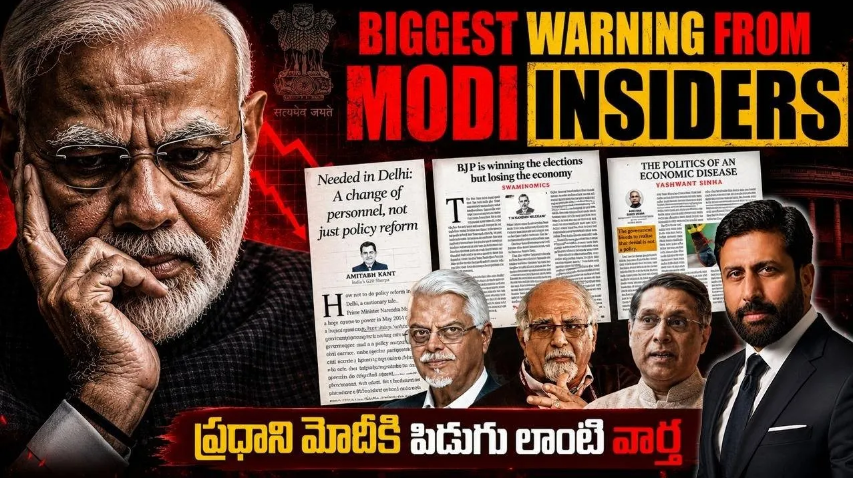
India’s political landscape continues to project the Bharatiya Janata Party (BJP) as a dominant force, with Prime Minister Narendra Modi’s image remaining strong and the party consistently securing electoral victories. However, three prominent personalities have now issued serious warnings regarding the Modi government and the Indian economy. Notably, these individuals are neither opposition leaders nor critics from the Congress or Left parties. Instead, they are figures who themselves played influential roles during the Modi era and are now expressing deep concerns about the country’s economic direction.
Among them is former Chief Economic Adviser Arvind Subramanian, another is economist Surjit Bhalla, who was appointed by the Modi government as India’s Executive Director at the International Monetary Fund (IMF), and the third is political commentator Sanjaya Baru, who had earlier strengthened the narrative portraying former Prime Minister Manmohan Singh as a weak leader and Narendra Modi as a decisive one. All three are now raising similar concerns, warning that something serious is going wrong within the Indian economy. Their comments have triggered a nationwide debate on whether India is heading toward an economic crisis, why the rupee continues to weaken, why investors are becoming increasingly nervous, and why a politically powerful government appears to be facing growing economic vulnerabilities.
The debate, according to analysts, is not merely about the stock market but about investor trust, governance, policy stability, and the silent fear allegedly growing within India’s economic system. Arvind Subramanian, who served as Chief Economic Adviser to the Modi government from 2014 to 2018, is internationally respected for his work with institutions such as the IMF and the Peterson Institute. He is not generally viewed as anti-government. Surjit Bhalla, meanwhile, has long been known as a supporter of market reforms and was officially nominated by the Modi government to represent India at the IMF.
Sanjaya Baru, former media adviser to Manmohan Singh and author of “The Accidental Prime Minister,” is the third major voice in this debate. BJP supporters had used Baru’s book for years to strengthen the narrative that Manmohan Singh lacked decisiveness while Modi represented strong leadership. However, Baru too is now expressing concern over India’s economic direction.
Surjit Bhalla, in a recent article, questioned whether the BJP was winning elections while simultaneously losing the economy. The observation is being viewed as a significant political comment suggesting that electoral success is not translating into meaningful economic transformation. Bhalla argued that India should not judge economic strength solely based on GDP numbers. According to him, the country is failing to perform according to its actual potential. He described the current approach as “band-aid instead of surgery,” implying that temporary fixes are replacing deep structural reforms.
Bhalla further argued that investor confidence has become the core issue. According to him, businesses are now seeking long-term certainty regarding policy stability. Concerns are reportedly growing within business circles over whether taxation policies could suddenly change, regulations could be altered unexpectedly, or the government could take abrupt policy decisions. His comments suggest that confidence in the Modi government is gradually weakening among sections of the business community.
Arvind Subramanian’s article has drawn even sharper attention due to its direct criticism. The headline itself — “Needed in Delhi: Change of Personnel, Not Just Policy” — has generated significant discussion. Subramanian argued that merely changing policies would not be enough and that the mindset of individuals managing the system also needs transformation. He claimed that India currently lacks clear financial direction and identified drift, uncertainty, and absence of direction as major structural problems.
Subramanian also argued that international developments alone are not responsible for the rupee’s decline. According to him, investors are increasingly expressing doubts over India’s medium-term growth prospects while simultaneously losing confidence in the broader economic system. Economists consider the statement highly significant because it comes from a former Chief Economic Adviser closely associated with the Modi government.
He further identified weak private investment as one of India’s biggest economic challenges. According to Subramanian, private companies are increasingly reluctant to make large-scale investments, posing long-term risks to manufacturing, employment generation, industrial expansion, and sustained economic growth. He warned that if industrialists continue to operate under fear and uncertainty, investment activity could decline further.
Sanjaya Baru, meanwhile, focused not only on economic policy but also on political psychology. He argued that fear, uncertainty, and excessive centralisation are adversely affecting economic sentiment. According to Baru, events such as demonetisation, the COVID-19 lockdown, unexpected policy shocks, and concentration of power have created unprecedented anxiety within business communities.
Baru stated that businesses are increasingly worried about unpredictable governance, including fears regarding sudden policy announcements, abrupt regulatory changes, and uncertainty over which companies could face official targeting in the future. In such an environment, he argued, companies become reluctant to take financial risks or commit to major investments.
Economists say investor confidence remains the foundation of economic growth. When businesses trust governance systems, investments increase, boosting industrial activity and employment. However, when uncertainty and fear dominate, investments slow down. Analysts warn that under such conditions, an economy may appear strong externally while weakening internally.
Another major concern highlighted by economists is the global shift away from dependence on China. As international supply chains continue to diversify, many countries are searching for an alternative manufacturing hub. India, with its large population, youthful workforce, massive domestic market, and geopolitical importance, has emerged as a natural candidate. However, economists argue that India has not fully capitalised on this opportunity.
Manufacturing growth, according to experts, has not expanded at the expected pace, while large-scale job creation remains limited. These challenges are now increasing pressure on the Modi government. Analysts describe the situation as India’s “greatest paradox” — a politically strong government facing growing economic concerns from within its own establishment.
The three articles, observers note, are not merely about economic indicators but about India’s future trajectory. Financial experts argue that without investor confidence, sustained business growth becomes impossible. They question whether India’s economic foundations are genuinely strengthening or whether the country merely appears politically powerful.
Economic analysts also point out that history has repeatedly shown how political popularity can temporarily conceal economic weaknesses. However, once investor confidence weakens, investment flows decline sharply, making long-term economic growth difficult to sustain. That is why the warnings issued within a single week by three individuals closely associated with India’s economic and political establishment are being viewed as extraordinary.
Experts clarify that these warnings do not necessarily mean India is heading toward collapse. Instead, they reflect growing fears that the country may fail to achieve its full economic potential unless deeper reforms, greater policy consistency, and stronger investor confidence are restored.