





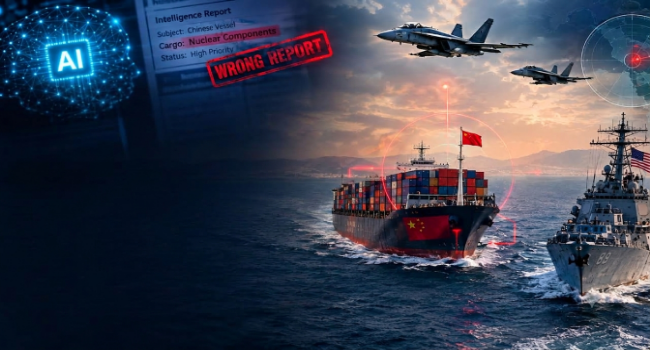
WASHINGTON: A false intelligence report produced with the help of artificial intelligence nearly pushed the US military into intercepting a Chinese ship in the Middle East, according to a CNN report published Friday citing sources familiar with the episode.
The report circulated across the US military this spring, during the war with Iran, and claimed that a Chinese vessel was transporting components of a nuclear weapons program. Four sources told CNN the military moved to intercept the ship. Two of them said armed personnel were preparing to board it, and military aircraft were already in the air.
Officials discovered the problem only shortly before the planned operation, when they examined the report more closely. They found that a Special Operations Command analyst had prepared it with the help of an AI chatbot, and that the chatbot had inaccurately identified the material aboard the ship. The operation was called off. CNN said it could not determine what the vessel was actually carrying.
According to the reporting, the analyst had asked the chatbot about intelligence on the ship’s manifest that originated with US Special Operations Command Pacific, based in Hawaii. Rolling Stone, summarizing the CNN account, said the tool combined open-source information with classified intelligence and arrived at a faulty conclusion. It is unclear which chatbot was used, or whether it was a commercially available product or a government-only system.
One source described the report as entirely false and said it “almost started a war,” warning that a US operation against a Chinese vessel could have escalated into an armed confrontation between Washington and Beijing.
The episode highlights the military’s expanding use of AI, which now ranges from processing large volumes of intelligence and identifying potential strike targets to managing budgets, logistics and supply chains. The push is driven in part by competition with rivals such as China and Russia. A former senior US official told CNN that the military’s internal AI tools are largely commercial products with cosmetic changes.
Analysts have long feared that AI could contribute to a catastrophic miscalculation if governments rely on poor or corrupted data, such as one leading the United States to fire on a Chinese ship based on inaccurate information. Critics argue that without rigorous human review, similar errors could recur with far graver consequences.
A Defense Department spokesperson told Mediaite that the US military assesses hundreds of potential threats around the world every day. The portion of the statement reviewed does not address the incident directly.