





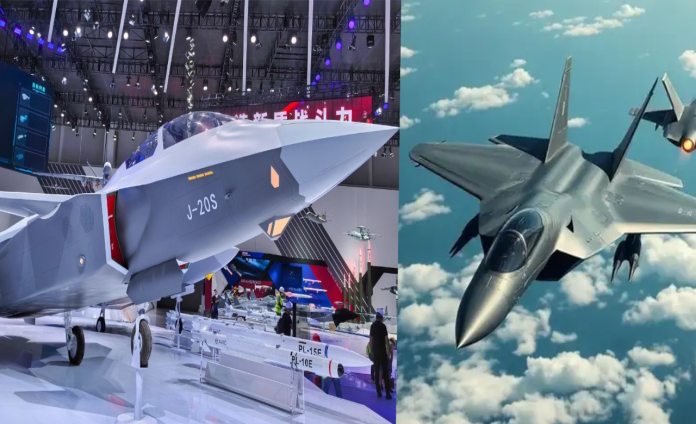
BEIJING: China’s air force has disclosed key details on the development of its fifth-generation J-20 stealth fighter, state media reported, citing upgrades that include domestically built engines, a refined aerodynamic design, improved sensor systems and a newly introduced two-seat variant, the J-20S. The enhancements are intended to prepare the aircraft for future combat requirements.
The adoption of indigenous engines, first shown publicly at the 2021 Zhuhai Airshow, is regarded as a major milestone for the program. Military analyst Wang Mingliang said the new powerplants allow the jet to reach higher top speeds, sustain supersonic cruise and perform complex maneuvers under high G-loads. He said engine self-reliance gives China a strong foundation for future fighter projects.
The upgraded single-seat J-20A incorporates two principal changes. The junction between the rear cockpit and the fuselage has been reshaped into a smoother, more curved profile, reducing drag and improving speed. The number of optical lenses beneath the nose has also risen from six to eight, which analysts say enhances the aircraft’s ability to detect enemy planes, particularly other stealth fighters.
The two-seat J-20S is designed to overcome the limitations of single-seat fighters in network-centric warfare. The front-seat pilot flies the aircraft and focuses on air combat, while the rear-seat operator acts as a “mission coordinator,” controlling drone swarms, analyzing radar data and planning strikes on ground or maritime targets.
Reports describe the J-20 as no longer solely an air-superiority fighter but a command-and-communications platform within an integrated combat system. Its use, initially limited, now extends beyond routine training to joint exercises with multiple units, combat-oriented tasks and continuous patrol missions. With these upgrades, the J-20 family is expected to pose a significant challenge to adversaries in the air.