





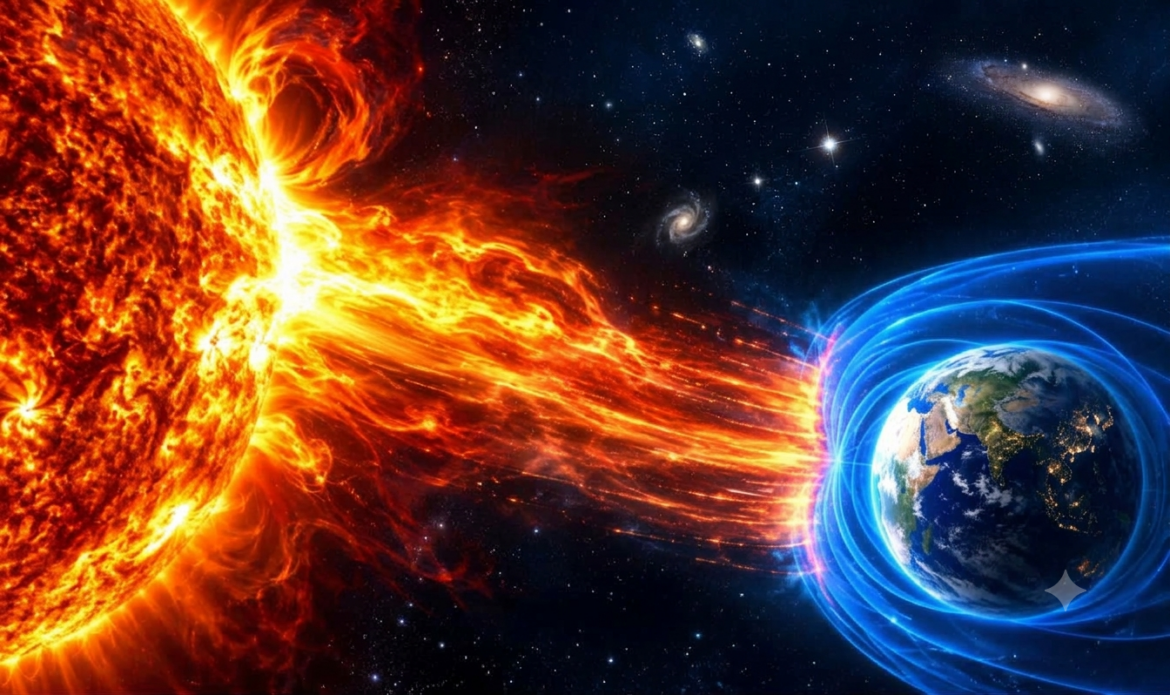
A powerful solar storm, triggered by two massive eruptions on the Sun’s surface, is set to strike Earth on Sunday, scientists have warned. The development is likely to affect technological systems on Earth, particularly in the communication and navigation sectors.
According to NOAA, the US space agency, two solar flares were released from the Sun on the 7th and 8th of this month and have been travelling towards Earth. The flare from the second eruption is moving faster than the first, and scientists expect it to overtake and merge with the earlier one in space, making the storm more powerful. NOAA said the storm could cause a G2-level geomagnetic storm on Earth, which is considered moderate in intensity.
Such storms occur when a coronal mass ejection hurls massive amounts of plasma and magnetic fields from the Sun’s outer layer, the corona, into space. When these charged particles approach Earth, they collide with the planet’s protective magnetic field, causing severe disturbance known as a geomagnetic storm. Scientists classify the intensity of such storms from G1 to G5.
The storm poses no direct danger to life on Earth, as the atmosphere and magnetic field protect against harmful solar radiation. However, the ionosphere may be disturbed, weakening high-frequency radio signals and potentially disrupting radio communications used by aircraft, ships, and the military. GPS signals may also be delayed or misdirected, causing variations in positioning accuracy.
Satellites in Earth’s orbit may face risks, as fluctuations in the magnetic field can damage their electronic systems, and some may drift from their orbits, requiring satellite control agencies to adjust operations as a precaution. Countries at high latitudes near the polar regions may see voltage fluctuations in power grid transformers, although the current G2 storm is not expected to cause major damage. Charged particles colliding with oxygen and nitrogen in the atmosphere may also produce auroras, which could extend beyond polar regions.
Scientists say India, being close to the equator, will see very little impact, as the magnetic field offers stronger protection there than in polar regions. Major power supply disruptions are unlikely, and the chance of auroras being visible is almost nil. Only minor interruptions to some radio signals and slight variations in GPS accuracy may be seen.