





- Ravi Prakash
What is happening in the country right now? On one side, Delhi. On the other, Mumbai. Students, youth, activists and opposition parties are all raising a single demand: Gyanesh Kumar must resign.
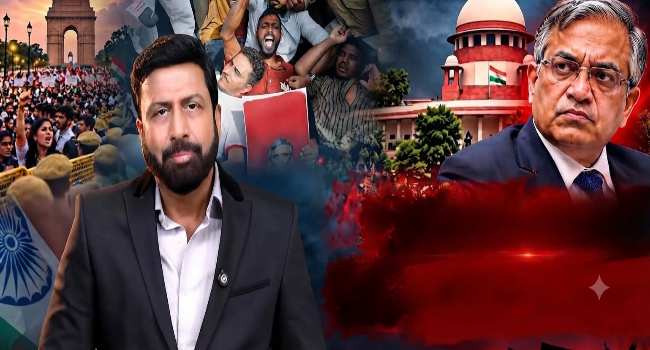
In Delhi, protests have continued for three days in a row. Police detained hundreds of people who tried to reach Jantar Mantar, among them AISA National President Neha Bora. Yogendra Yadav and Prashant Bhushan were also taken into custody. A massive protest followed in Mumbai, where Uddhav Thackeray and Raj Thackeray shared the same stage with the same demand: Gyanesh Kumar must resign.
The agitation is not stopping there. The Cockroach Janta Party has called for a major protest in Delhi on October 10 and announced that, if Gyanesh Kumar does not resign, it will demonstrate at Jantar Mantar once again. The real question now is whether street pressure on Gyanesh Kumar is growing, how far that pressure will go, and whether he will actually resign.
The protests began on October 2, Gandhi Jayanti, at Jantar Mantar. Police did not grant permission for the demonstrations, but the protesters did not retreat. Barricades were put up and police were deployed in large numbers. Those who tried to move toward Jantar Mantar were detained, and hundreds were taken into custody, including AISA National President Neha Bora. She had tried to cross the barricades, and police stopped and detained her. But Neha came back, and the protesters came back with her.
The agitation continued the next day, and police again detained around 150 people, among them Neha Bora, Yogendra Yadav and Prashant Bhushan. This was not a one-day agitation. An effort is under way to turn it into a larger movement.
The visuals emerging from Delhi tell the story: police barricades, police vehicles, protesters, and confrontations with officers. One young woman leader appears in them repeatedly, Neha Bora, the AISA National President, who has been detained several times during these protests.
One point is especially important. This movement is not being run by political parties alone. Student organisations, youth groups and activists are playing a key role today. Their question is not only “Why SIR?” Their demand is accountability, and the demand now being raised most forcefully is that Gyanesh Kumar resign.
While students, activists and opposition leaders agitated in Delhi, an interesting political scene unfolded in Mumbai. Raj Thackeray and Uddhav Thackeray came together on one stage at the Virat Garjana Morcha held on October 4. Another notable detail is that they asked for no party flags and no party symbols. Only the tricolour was flown.
There were two main demands. The first was that Gyanesh Kumar resign. The second was that SIR be stopped in Maharashtra. This no longer looks like the agitation of a single party. The parties, groups and political ideologies are different, but the common demand is the same: questions over the way the Election Commission is functioning.
Another interesting group in this story is the Cockroach Janta Party (CJP). Its name was heard widely earlier this year during student protests. The group has now made Gyanesh Kumar’s resignation its main demand. As far back as September, it gave Gyanesh Kumar 48 hours, demanded his resignation and warned that otherwise it would launch protests across the country.
Now there is another announcement. On October 10, at Jantar Mantar, CJP says it will march to Delhi if Gyanesh Kumar does not resign. The agitation, in other words, is no longer limited to Delhi. It has reached Mumbai and is spreading to other regions. What will happen on October 10? That is what remains to be seen.
A flashback to July is important here. A few months ago, this same youth movement staged massive protests in Delhi over the exam crisis and allegations of a paper leak. The protests grew and the pressure mounted. Finally, on July 25, Union Education Minister Dharmendra Pradhan resigned. His resignation had been one of the main demands of the protesting students.
That is why July is being recalled now. July answered one question: is a high-profile resignation possible through street pressure? To the protesters, July looks like a precedent, and an attempt is now being made to build the same pressure on Gyanesh Kumar.
But there is one crucial difference. Dharmendra Pradhan was a Union Minister, whereas Gyanesh Kumar is the Chief Election Commissioner, a holder of a constitutional post. The process for removing him is therefore entirely different.
Another significant factor behind the protests is an Indian Express investigation. The report said there are differences within the Election Commission itself over decisions. In particular, it reported that Election Commissioners Sukhbir Singh Sandhu and Vivek Joshi raised objections to certain procedures. These reports have now become central to the protesters’ arguments. Their questions are whether everything was done according to the rules, and whether the required procedure was followed.
It must be stated clearly, however, that these are reported allegations and internal differences. No court has yet delivered a final verdict that Gyanesh Kumar acted unlawfully. That is why all eyes are now on the Supreme Court.
The Supreme Court has entered the picture. It is hearing the dispute over the Election Commission’s actions, including SIR and Form 6, and has sought responses and records from the Centre and the Election Commission. One thing is very clear: the Supreme Court has not suspended Gyanesh Kumar, has not removed him and has not directed him to resign. The petitioners sought interim action, but the court did not grant that relief.
The court is now examining the records. It is looking at whether procedure was followed in the Election Commission’s decisions and whether the Commission acted in accordance with the law. This is a very important distinction. If an ECI decision is found to be contrary to the law or to required procedure, the Supreme Court can review it. If necessary, it can set the decision aside or impose restrictions. But that is not the same as removing the CEC.
Another key issue is Form 6, the form used by people who want their names added to the electoral roll. A controversy arose over the use of an additional declaration connected to it during SIR. The Supreme Court has offered some clarity here, stating that it has not approved the change in Form 6. But questions remain. Who authorised that additional declaration? Under what procedure was it done? Was it a decision of the Election Commission? All of these are now open questions.
Is Gyanesh Kumar the only issue? This is where the story grows bigger, because it is not only about Gyanesh Kumar. The fundamental question is who controls India’s electoral rolls, and how. Whose name should be added to the voter list? Whose name should be removed? How should that decision be made? What should be done when Election Commissioners differ in opinion? How transparent is the process?
Above all, do people trust the institution that conducts India’s elections? An election is not just polling day. The foundation of an election is the voter list. If doubts arise about that very list, the entire electoral process is affected.
So will Gyanesh Kumar resign? He has not resigned so far. The Supreme Court has not removed him and has not directed him to resign. Moreover, under Article 324(5), the removal of a CEC is nothing like an ordinary political resignation. There is a constitutional process equivalent to the one for removing a Supreme Court judge.
Three kinds of pressure are now visible. The first is street pressure: Delhi, Mumbai, students, activists, opposition parties, the CJP and more protests. The second is political pressure: the opposition’s demand that Gyanesh Kumar resign. The third is judicial scrutiny: the Supreme Court’s examination of the Election Commission’s decisions, their procedure and their legality.
So are these Gyanesh Kumar’s last days? That cannot be said at this stage. Pressure does not mean resignation. Protest does not mean removal. A Supreme Court notice does not mean a verdict. Likewise, an allegation does not mean guilt has been proven.
But one thing is clear. This controversy has now crossed the walls of the Election Commission’s office. It has come to Delhi and to Mumbai. It has reached students and activists, and it has reached political parties. A call has now been issued for another massive protest in Delhi on October 10. The memory of July is also still fresh, because in July, after street pressure, Education Minister Dharmendra Pradhan resigned.
That is why the real question now is how far this movement will go. Will it remain only a street protest? Will it go all the way to the courts? Will political pressure increase further? Or will some political decision eventually become unavoidable?
This is now not only Gyanesh Kumar’s story. It is the story of the Election Commission, of the voter list, and of the public’s trust in India’s electoral process. Is October 10 about to become another key day in this story? We shall see.