





- Ravi Prakash
What if a world leader suddenly collapsed during a summit in India? What if, within hours, he was placed on a special aircraft and flown home, and word then spread that he had suffered a serious stroke and been taken to Beijing’s 301 Hospital? That is the story now going viral on social media about Chinese President Xi Jinping. Another claim has since emerged. A Polymarket account on X with 1.9 million followers posted: “Just in: Multiple world leaders have reportedly fallen ill after attending the BRICS Summit in India.” Did several leaders who attended the summit really fall ill? Who are these “multiple world leaders”? What happened to whom? What has been confirmed, and what is only a claim? This report separates the facts from the claims and sets out the questions that remain open.
Posts circulating on social media allege that Xi suffered a medical emergency during the New Delhi BRICS Summit and fainted at the event. They say his accompanying medical team treated him immediately, that he left India early on a special aircraft, and that on reaching Beijing he was taken to 301 Hospital, one of China’s best-known military hospitals. The claims go further. Some allege that doctors found he had suffered a serious form of stroke, that treatment was delayed, and that this could lead to severe complications. All of these medical details remain unverified. Among those who amplified the story is the Chinese dissident Wanjun Xi, who claimed in a post that Xi lost consciousness during the summit and was taken to China for treatment. Neither Beijing nor New Delhi has officially confirmed any of it. That leaves the first question: did Xi really leave India in a hurry because of a medical emergency?
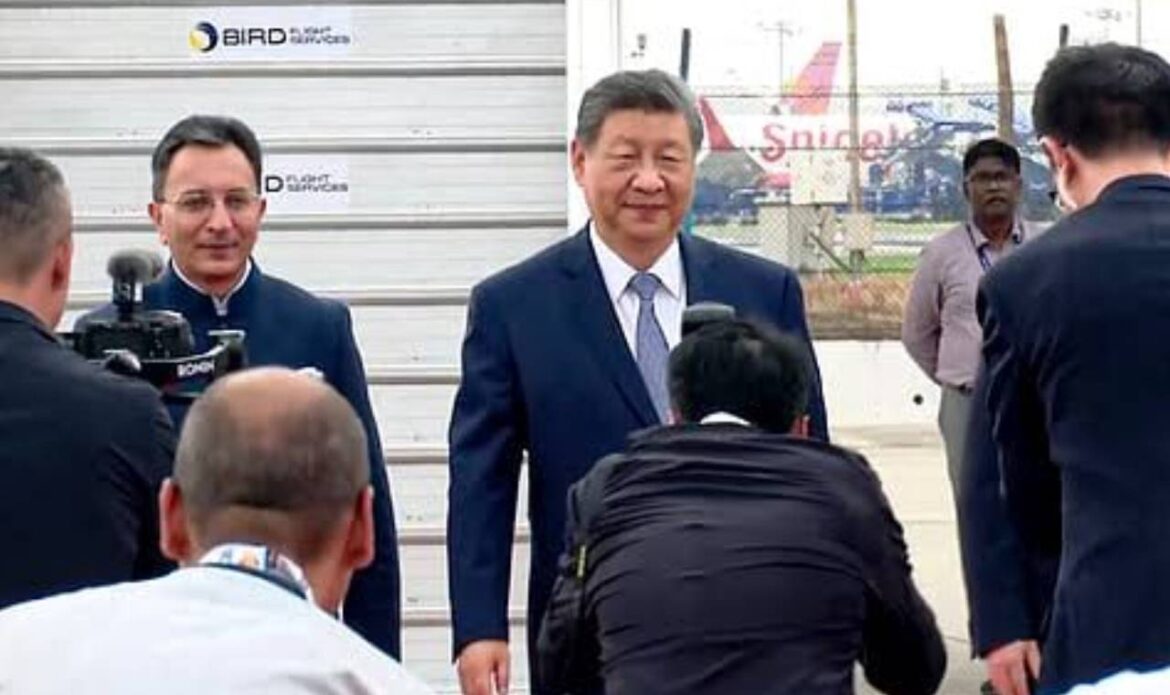
What is known is this. Xi travelled to New Delhi for the summit and, according to China’s official account, arrived in India on September 12. He took part in the proceedings and held a bilateral meeting with Prime Minister Narendra Modi. The meeting was significant. India and China have had considerable differences for some time, yet both countries are now trying to increase communication and manage them. After that, one development drew attention: Xi did not attend the gala dinner hosted by Modi.
According to reports citing sources, Xi returned to his hotel and rested after the day’s summit proceedings. Nowhere, however, has it been officially stated that he suffered a stroke or a medical emergency, and no official explanation has been given for why he skipped the dinner. It is therefore true that he did not attend, but the reason has still not been officially confirmed. That is where speculation on the internet began. First came the claim that Xi has a health problem, then that he collapsed, then that he had a stroke, and finally that he was taken to 301 Hospital. These four assertions are not the same thing.
Beijing’s official account matters here. According to a statement from China’s Foreign Ministry, Xi successfully completed his engagements at the 18th BRICS Summit and returned to Beijing on September 13. China also says senior Indian government officials bade him farewell. The official version contains no suggestion that Xi was rushed out of India because of a medical emergency. It says only that the visit was successfully completed and that he then returned to Beijing. There are now two competing narratives. In the first, Xi came to the summit, completed his engagements and returned to Beijing. In the second, he suffered a medical emergency, which was the reason he left India, and was then taken to a military hospital. As things stand, the second narrative has no independent verification.
The story becomes more complicated because one BRICS leader’s illness has been confirmed. South African President Cyril Ramaphosa travelled to New Delhi for the summit and met Modi on September 13, the final day. He returned to South Africa on Monday. On September 16, the South African Presidency issued an official statement saying Ramaphosa was staying away from public engagements because of ill health. His medical team had advised that he needed rest and recovery. That much is confirmed, but there is an important distinction. The Presidency did not say what illness Ramaphosa has. It did not say he had a stroke, or that he fell ill because of the summit, or that his illness had any connection to the rumours about Xi’s health. Precision is essential. It is confirmed that Ramaphosa fell ill, but the cause is not publicly known. The timeline shows he fell ill after returning from India, yet to say he fell ill because of the summit would be speculation.
The wording of the Polymarket post is also significant. The account did not say “multiple world leaders have fallen ill.” It said they had “reportedly fallen ill,” presenting the claim as a report rather than an established fact. That distinction matters. Based on what can be independently verified so far, it is confirmed that one BRICS leader, Ramaphosa, fell ill. That Xi had a stroke is unverified, and no credible reporting has been found showing that multiple BRICS leaders fell ill after the summit. The real questions follow. Who are the “multiple world leaders” Polymarket referred to? Who are the other leaders, and what happened to them? Who first reported the news? Do those incidents have any connection to the summit? So far, none of these questions has a clear answer.
Another point needs clearing up. Brazil is part of the BRICS grouping, but Brazilian President Luiz Inácio Lula da Silva did not travel to New Delhi. Lula remained in Brazil, and Foreign Minister Mauro Vieira attended the summit on his behalf. Readers who see social media posts or images claiming Lula attended should be cautious. Brazil took part in the summit, but Lula did not attend in person. This matters for the “multiple world leaders” story, because it requires checking who actually came to India and who did not. A BRICS country’s participation and its president’s personal attendance are not the same thing.
Perhaps the most sensational element of the viral story is the claim that Xi was taken to 301 Hospital in Beijing. So far, there is no official confirmation that he was admitted there because of a stroke. The appearance of “stroke” and “301 Hospital” together on social media does not make the story true, and it remains an unverified claim. A further sensational claim is circulating: that there is a critical treatment window in such cases, that Xi’s treatment was not delivered in time, and that he suffered severe neurological consequences. But asserting something like this about any person’s health requires credible medical evidence or official confirmation. So far, there is no such evidence.
Several things, however, are true. Xi did not attend the gala dinner. He returned to Beijing afterward. Ramaphosa fell ill, as the South African Presidency has officially confirmed. Speculation about Xi’s health on social media is real, and Polymarket amplified a major claim that multiple world leaders had fallen ill. Together, these elements have made the rumour bigger. When a powerful leader suddenly changes his public schedule, people naturally ask questions. But questions are not evidence, and speculation is not confirmation.
The biggest question in the story is whether these developments are related: the Xi health claim, Ramaphosa’s confirmed illness and Polymarket’s “multiple leaders” claim. Are they three separate developments, or is there a connection between them? At present, there is no verified evidence that they share a common cause. This is where responsible reporting must stop. It can state what is known, the timing, the confirmed illness, the viral claim and what Polymarket posted. It must not turn a coincidence of timing into proof of a connection.
The story is also drawing attention for another reason: September 24. There are reports that US President Donald Trump and Xi may meet, though Beijing has not officially confirmed it. According to Reuters, US Treasury Secretary Scott Bessent is preparing to meet Chinese Vice Premier He Lifeng, as part of talks ahead of a possible Trump–Xi meeting. This has prompted another question: will Xi travel to the United States? Caution is needed here too. It is not appropriate to draw conclusions about a person’s health from a future diplomatic schedule. Which meetings Xi will or will not attend in future is an entirely separate matter.
To summarise plainly, Xi came to India for the summit, met Modi and took part in the proceedings. He did not attend the gala dinner and returned to Beijing on September 13, and China officially described his visit as successfully concluded. Ramaphosa attended the summit and returned to South Africa, after which his Presidency announced he is staying away from public engagements because of ill health. His medical team recommended rest and recovery, but the Presidency did not say what illness he has. Brazil took part in the summit, but Lula did not attend, and Foreign Minister Vieira went on his behalf. The Polymarket account, with 1.9 million followers, posted that “multiple world leaders have reportedly fallen ill.” Meanwhile, social media is awash with speculation about Xi’s health. Some posts claim he had a medical emergency, that he fainted, that he had a stroke, that he was taken to 301 Hospital, that the critical treatment window was missed, and that he suffered severe neurological consequences. Others claim multiple leaders fell ill after the summit, or that something that happened there caused their illness. None of these claims has been established by reliable evidence.
The story is not only about whether one viral post is true. A larger question is how quickly a rumour about the health of one of the world’s most powerful leaders becomes an international story. A second has now been added: how does one confirmed illness, combined with one unverified claim, become a bigger story about “multiple world leaders”? Xi is not an ordinary political leader. He is the president of China, a country of central importance to the global economy and global politics, so even a small change in his public schedule triggers immediate speculation. At the same time, Ramaphosa really did fall ill. Two different things, one confirmed and the other unverified, can now merge into a single story, and on social media the difference between them is disappearing very quickly.
That is dangerous. Once a medical rumour goes viral, another rumour starts on top of it. A missed dinner becomes a health emergency, a health emergency becomes a stroke, a stroke becomes hospitalisation, and hospitalisation becomes speculation about political consequences. Meanwhile, a real illness can merge with the rumour and turn into a larger story about “multiple world leaders.” In the end, an unverified social media post begins to look like a full intelligence report.
So, did Xi Jinping suffer a stroke in India? There is no verified evidence to say so. What exists is a viral claim, Xi’s absence from a dinner followed by his return to Beijing, official confirmation that Ramaphosa fell ill, the Polymarket post saying “multiple world leaders have reportedly fallen ill,” and a version from China’s official account describing Xi’s visit as successfully concluded. None of this establishes that Xi had a stroke, or that anyone fell ill because of the BRICS Summit. Until credible evidence emerges, the only accurate description of the Xi story is one word: unverified. It is not confirmed, not established and not a medical fact. When the subject is the health of a world leader, the difference between a report and a rumour matters a great deal, and right now social media is trying to erase that difference.