





- Ravi Prakash

There is an old saying about statistics: if you torture the numbers long enough, they will confess to anything. The question now is whether the same is happening with India’s GDP data. The opposition claims the country’s economy has collapsed. The government insists everything is in order. Where, then, does the truth actually lie — somewhere between the two?
The Dispute Begins
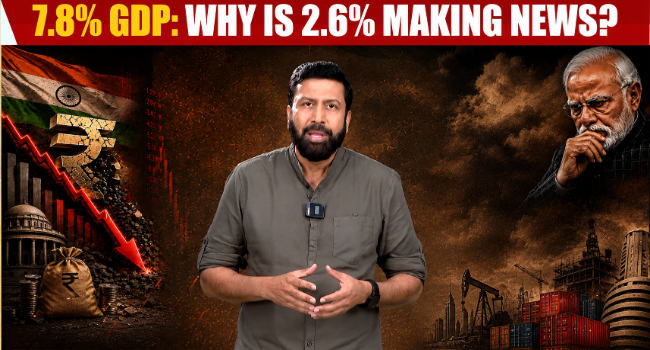
The controversy erupted with the release of the April–June quarterly GDP data. The government announced, with considerable pride, growth of 7.8 percent. On first glance, this appeared to be an extraordinary figure — particularly since it came at a time when the Iran–US conflict was at its peak, petrol and diesel prices had risen, and gold prices had climbed. The Reserve Bank of India had itself projected that growth could slow and inflation could rise. Inflation did indeed rise. Growth, however, did not fall. On its face, this was good news. But it is precisely at this point that the real question emerges.
A Change in the Base
Critics have alleged that the GDP base itself was altered. The issue can be understood through a simple analogy: consider GDP as a pizza. Last year’s pizza measured 10 inches; this year’s measures 12 inches. But suppose someone were to claim that last year’s pizza was never 10 inches to begin with — that it was actually 8 inches. Under that revision, this year’s growth would suddenly appear far larger. This is offered purely as an illustration; the actual calculation of GDP is a far more complex exercise. Nevertheless, this is where the dispute lies.
According to the old GDP series, nominal GDP for the same quarter last year stood at approximately ₹86 lakh crore. Under the new series, the comparable figure stands at approximately ₹80 lakh crore. This year’s figure has reached ₹88 lakh crore. Critics argue that had last year’s figure remained at ₹86 lakh crore, this year’s growth rate would have appeared considerably lower — a calculation that has produced the alternative figure of 2.6 percent circulating in public debate.
It must be stated clearly, however: 2.6 percent is not India’s official real GDP growth rate. That figure results from comparing numbers drawn from two different GDP series. The government’s position is that the base year has changed, the methodology has changed, and the data sources have changed — and that these changes are the reason the earlier figures were revised.
The central question, therefore, is not whether the correct figure is 7.8 percent or 2.6 percent. The central question is why last year’s GDP figure was revised downward from approximately ₹86 lakh crore to approximately ₹80 lakh crore, why a revision of that scale took place, and how credible the government’s explanation for it is. This is where the substantive story begins.
Is the Indian Economy Really Growing at 7.8 Percent?
Setting the 7.8 percent figure aside for a moment — even assuming it is inflated — does that mean the Indian economy is in fact growing at only 2.5 to 3 percent? That conclusion cannot be drawn either, because no single GDP figure can capture the condition of an entire economy in isolation. A review of other indicators is instructive.
Sales of cars and two-wheelers rose by approximately 21 percent. Petrol consumption rose by 6 percent. Electricity consumption rose by 9 percent. Cement production rose by 9 percent. Steel sales rose by 8 percent. E-way bill generation rose by 12 percent. Collectively, these indicators point to rising consumer purchases of vehicles, increased fuel consumption, rising electricity demand, and growing demand for steel and cement — indicative of expanding construction activity. The rise in e-way bills reflects increased movement of goods across the country. In short, the wheels of the economy continue to turn. Questions regarding the 7.8 percent GDP calculation may be legitimate, but the broader indicators do not support the contention that the economy is growing at only 2 to 3 percent.
Is This Growth Sufficient?
A further question arises: even if India is growing, is it growing as fast as it needs to? This brings the discussion to the government’s stated goal of a “Viksit Bharat” — a developed India — by 2047. According to estimates cited by Bloomberg, achieving developed-nation status would require India’s per capita income, currently around $3,000, to rise several-fold, to approximately $15,000. Sustaining such an increase would require growth in the range of 9 to 10 percent maintained over an extended period. Over the past two and a half decades, however, India’s growth has largely remained in the 6 to 7 percent range. This suggests the 2047 target will not be easily achieved.
For this reason, the GDP debate should not be reduced to a purely political contest. India is routinely described as the world’s fifth-largest economy and among the fastest-growing major economies, with current GDP growth reported at 7.8 percent. All of this may be accurate. The more pressing question, however, is how much of this growth is reflected in the lives of ordinary citizens. Is GDP expanding while individual incomes stagnate? Are quality jobs being created? Can households manage their expenses with greater ease? GDP, after all, is not a trophy to be displayed — it is a report card on how a nation’s economy is functioning. What matters is not merely the rate of growth, but whose lives are actually changing as a result of it.
The question, therefore, is not simply whether 7.8 percent is accurate. The larger questions are: who benefits from this growth; how many quality jobs are being generated; whether real incomes are rising; and, ultimately, whether this rate of growth will be sufficient to achieve developed-nation status by 2047. The GDP story is not merely a number — it is the economic story of 1.4 billion people.
Weighing Both Sides
Bringing the full picture together: on one side, the government maintains that the Indian economy is growing at 7.8 percent — a figure substantially higher than prior estimates and, by any measure, a strong growth number. On the other side, former Finance Secretary Subhash Chandra Garg has directly questioned why last year’s GDP base was revised so significantly. It is this revision that gave rise to the alternative 2.6 percent calculation circulating in public discourse.
It bears repeating that 2.6 percent is not India’s official real GDP growth figure, since it results from comparing figures across two distinct GDP series. The government’s position is that it has not manipulated the numbers — that the base year, methodology, data sources, and price-measurement approach have all changed, necessitating revision of the earlier figures. It is also worth noting that GDP revisions have not invariably moved downward; in certain instances, figures have been revised upward as well.
The allegation that the government deliberately understated the previous year’s GDP in order to inflate the appearance of current growth remains, to date, unproven. That does not mean, however, that the questions surrounding it should go unasked. Several questions still warrant clearer answers: why the revision was of such magnitude; what specifically changed under the new methodology; what changed as a result of new data sources; what resulted from the revised price-measurement approach; and, most importantly, how visibly this 7.8 percent growth is being felt in the daily lives of ordinary citizens. GDP cannot remain a figure confined to a government spreadsheet — its impact must be visible in employment, in incomes, and in consumption.
The overall assessment of this debate is straightforward. It would be incorrect to dismiss the 7.8 percent figure as fabricated. It would be equally incorrect to treat 2.6 percent as India’s genuine GDP growth rate. Raising questions about the 7.8 percent figure, however, is not improper. In a democracy, it is the government’s role to produce the numbers; it is the role of journalism to analyze them. That role involves neither applauding uncritically alongside the government nor shouting in step with the opposition — it requires asking a single, direct question: what is the real truth behind this figure?
The numbers should not be tortured to yield a predetermined conclusion. What is supported by the evidence should be acknowledged, and what is not supported should be acknowledged as well. GDP is not merely a number — it is the economic report card of 1.4 billion lives. And on that basis, the final question remains unchanged: what is the real story behind the GDP figures?