





- Ravi Prakash

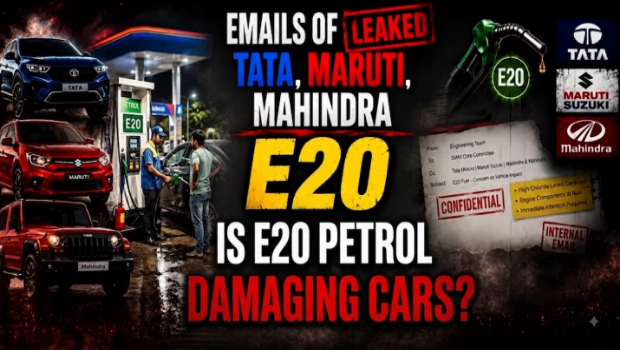
A sensational disclosure is now fueling a major debate: internal warnings from a leading automobile company have surfaced, reportedly cautioning that a contaminant that should not be present in petrol could cause vehicles to deteriorate rapidly. Even more alarming, it is learnt that under certain conditions, engine damage could occur after as little as 200 kilometres of driving. In an even more startling revelation, fuel samples collected from petrol pumps across 21 states and union territories were found to contain contamination levels described as concerning. A Reuters investigation found that in some samples, chloride levels were nearly 190 times higher than the government-mandated limit. The permissible chloride limit set by the government is 3 parts per million (ppm) — but one set of samples reportedly registered as high as 570 ppm. Moisture levels in some samples were also found to be more than four times the prescribed benchmark.
In Andhra Pradesh, reports indicate moisture levels reached as high as 13,000 ppm, against a benchmark of 3,000 ppm. In Uttar Pradesh, levels reportedly touched 12,500 ppm. This raises the central question: what exactly is happening with India’s E20 petrol? Is the problem E20 itself, or fuel contamination? Is there an issue with fuel storage or pipelines? Or is there a bigger story that the ordinary vehicle owner isn’t aware of? Crucially, these figures are not rumours circulating on WhatsApp or unverified social media claims — they emerged from an investigation by Reuters, one of the world’s leading news agencies, which reviewed internal communications and emails exchanged between major Indian automobile companies and the country’s automobile industry body.
What these emails reveal casts the entire E20 debate in a different light. While the government and oil companies have publicly maintained that there is no cause for concern, the internal communications reviewed by Reuters show that automakers were privately discussing chloride and moisture contamination and the potential damage to vehicles. Setting politics aside, the documents raise pointed questions: What did automobile companies actually know about E20? What did they discuss privately among themselves? Why did the industry body first alert the government — and then withdraw that warning? And why does the government’s public position differ so sharply from what the industry was saying internally? This is the real E20 story that deserves scrutiny.
What the Reuters Investigation Found
To be clear, Reuters is not claiming that every vehicle running on E20 in India will necessarily be damaged. The claim is more specific: concern is growing within automobile companies themselves over contamination in E20 petrol. Reuters journalists Aditi Shah and Aditya Kalra reviewed internal communications between some of India’s leading automakers and the Society of Indian Automobile Manufacturers (SIAM), the industry body. The companies involved in these discussions included Maruti Suzuki, Tata Motors, and Mahindra — which together account for roughly 67% of India’s car market.
According to the internal industry data reviewed by Reuters, over 250 fuel samples were collected from petrol pumps over the course of roughly a year, drawn from 21 states and union territories. Of these, 18 states reportedly showed elevated chloride contamination. Chloride levels matter because the government’s permissible limit is just 3 ppm — yet some samples registered far higher: Rajasthan reportedly ranged from 6 to 570 ppm, Delhi from 1.4 to 420 ppm, and Maharashtra from 10 to 357 ppm — variations described as far from minor. A separate issue was water contamination in fuel: moisture levels reportedly reached 13,000 ppm in Andhra Pradesh and 12,500 ppm in Uttar Pradesh, against a government benchmark of 3,000 ppm. It should be stressed that these are industry testing results reviewed by Reuters — not official government findings certifying that E20 fuel nationwide is contaminated.
What the Internal Emails Reportedly Said
According to Reuters, in an internal email dated July 26, Maruti executive Anoop Bhat wrote that the maximum chloride level current fuel injectors could tolerate was 1 ppm, and that keeping E20 chloride content below 1 ppm would align with international standards. Reuters reported that Bhat also referenced discussions held with the Ministry of Petroleum on the matter.
In a separate email, Mahindra’s senior principal engineer of fluids technology, R. Ramaprabhu, reportedly wrote that organic chloride was responsible for a number of rapid vehicle failures being seen across the industry. One line from that email has become the most striking element of the entire controversy: Ramaprabhu reportedly stated that organic chloride could damage engines after as little as 200 kilometres of driving, and that organic chloride was responsible for several vehicle failure cases that appeared shortly after refuelling. He reportedly said the company had strong evidence for this based on fuel samples collected from retail outlets.
Mahindra, however, has strongly disputed how Reuters interpreted these emails, telling Reuters that conclusions drawn from its executives’ emails were “completely baseless and incorrect,” and that the industry data referenced was limited and preliminary. Maruti and Tata Motors did not respond to Reuters’ queries.
It is important to draw a distinction here: the Reuters investigation is primarily about contamination in E20 fuel — it is not proof that E20 itself inevitably damages every vehicle’s engine. This distinction matters, because if contamination is the actual problem, the key question becomes: where is that contamination originating? During E20 production? During fuel transportation? Or is it entering the fuel through underground storage tanks and pipelines at petrol pumps? Or is there some other cause altogether?
The Industry Alerted the Government — Then Withdrew Its Warning
This is where the story takes another dramatic turn. According to the internal emails reviewed by Reuters, automobile companies had already flagged this issue to the government. On July 26, Maruti’s Anoop Bhat reportedly discussed elevated chloride levels in fuel with the Ministry of Petroleum. Just two days later, on July 28, SIAM sent a formal letter to the government expressing concern over rising chloride levels in fuel and requesting that oil marketing companies be directed to investigate the root cause of the contamination. SIAM’s letter also flagged concerns about moisture in fuel, reportedly attributing it to poor maintenance of underground storage tanks and pipelines at petrol pumps — suggesting the industry suspected a problem could exist anywhere along the chain from fuel production to the pump to the vehicle’s tank.
But the situation shifted abruptly soon after. Within days, SIAM withdrew its warning letter, stating that some of the figures in the data still needed to be verified and that there was insufficient data on testing methodology and sample size to draw firm conclusions. SIAM also said the letter had been sent in error, and that it now believes a proper, formal scientific study is required. Yet this is where another curious detail emerges from the Reuters investigation: the internal emails reviewed do not suggest such uncertainty existed at the time — automakers had already been sharing detailed findings with one another, covering 250-plus samples across 21 states and union territories, with elevated chloride levels found in 18 of them. And this wasn’t the data of a single company — Maruti, Tata Motors, and Mahindra, representing about 67% of India’s car market, were all part of these internal discussions.
This naturally raises the question: why did the industry first sound the alarm and then retreat? Was the data genuinely unreliable? Was the sample size inadequate? Or did the industry back off after facing pushback from the government and the public following its warning? There is no clarity on this — which only strengthens the case for a proper, independent scientific investigation.
The Government’s Contradicting Account
While automakers were discussing contamination internally, the government and oil companies presented an entirely different picture. Petroleum Minister Hardeep Singh Puri has said that oil marketing companies began rigorous fuel testing even before SIAM’s letter was received. According to the government’s account, only four contamination cases were found. State-run oil companies — Indian Oil, BPCL, and HPCL — say their extensive testing found no cause for concern: more than 100 petrol samples collected from refineries reportedly showed chloride levels at or below 1 ppm, ethanol was tested from 80 distilleries, E20 samples were tested from over 80 depots and terminals, and inspections were conducted at roughly 90,000 fuel stations, with no evidence found of water entering underground storage tanks anywhere.
This leaves a striking contradiction: on one hand, automakers’ own testing of 250-plus samples showed high contamination levels across several states; on the other, the government and oil companies say their nationwide testing found no cause for concern. This raises perhaps the most important question in the entire controversy — were both sets of tests conducted on comparable samples? If one set of tests shows very high contamination while a separate nationwide testing effort finds almost none, someone needs to explain why the results diverge so sharply.
Beyond Mileage and Performance — A Question of Trust
The E20 controversy is no longer just about mileage or engine performance. It has become a question of fuel quality, testing methodology, accountability, and consumer safety. Another question cannot be ignored: is the core problem E20 itself, or is contamination entering the fuel somewhere along the supply chain? The answer could reshape the entire debate around E20.
Reuters is not claiming every E20 vehicle will fail. What its investigation revealed is that automakers were internally discussing chloride and moisture contamination in E20 fuel, based on data showing elevated contamination levels across several states. Meanwhile, the government and oil companies maintain that their own extensive testing found no such cause for concern. And SIAM, having first alerted the government and then withdrawn its letter citing the need for further verification, has left two competing sets of data and two competing narratives on the table — a situation too significant to simply set aside.
The government should disclose full testing details: Where were samples collected? How many were tested? What laboratory standards were used? What were the actual chloride and moisture readings? And why do industry and government test results differ so dramatically? These are questions the government owes clear answers to — because at the centre of this controversy is not Maruti, not Mahindra, not Tata, not SIAM, and not the government. It is the ordinary vehicle owner. Millions of people are already using E20 petrol, and they cannot be expected to parse technical concepts like parts per million, organic chloride, fuel injectors, or underground storage tanks. What they need is a simple answer: is the fuel going into my car pure, and is it safe?
If contamination is indeed the issue, E20 itself should not be blamed prematurely — the real question is where that contamination is entering the fuel: at the refinery, during transportation, at the depot, or at the petrol pump. If government standards are being violated anywhere along that chain, accountability needs to be established. Equally, if the industry’s preliminary data turns out to be flawed, that too must be established through proper scientific testing — not politics, not propaganda, not WhatsApp forwards. What is needed is independent testing and complete transparency. The Reuters investigation has raised a serious question: what did the automobile industry know about contamination in E20 fuel, and when did it know it? Now the country deserves an equally clear answer from the government: is E20 fuel in India genuinely safe? Full details should be made public.