





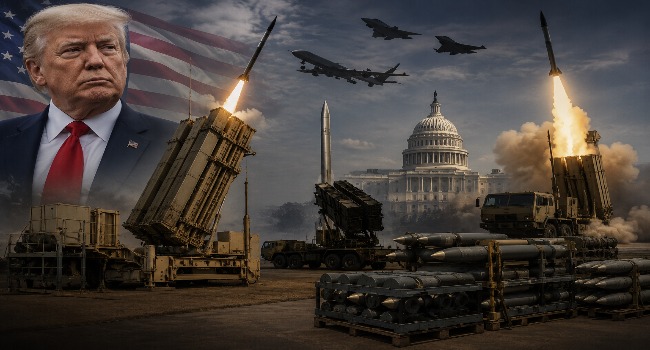
The United States, long known as the world’s foremost military superpower, is now facing a fresh challenge. As the war with Iran continues, America’s air defence weapon stockpiles are steadily depleting. In particular, the shortage of interceptors used to shoot down enemy missiles and drones mid-air is growing more acute. As a result, the US Department of Defense is increasing pressure on weapons manufacturing companies to replenish the dwindling stockpiles as quickly as possible. It has directed these companies to submit clear plans for boosting production capacity. The Pentagon has made it plain that claims it will take years are unacceptable, and that ways to increase production must be found immediately. Why exactly are America’s weapon stockpiles shrinking? By how much have the crucial Patriot and THAAD interceptors declined? And why has replenishing them become so difficult? Let’s understand this clearly in this report.
The war with Iran is inflicting heavy losses on the United States — not just in terms of weaponry, but financially as well. Much like using a cannon to kill a sparrow, the US has spent weapons worth tens of thousands of crores of rupees to intercept Iranian attacks. Over nearly five months of ongoing conflict, it has deployed air defence weapons on a massive scale to protect military bases and troops. Every time Iran has launched an attack using drones and missiles, the US has fired advanced interceptors such as the Patriot and THAAD systems to stop them mid-air. While Iran has been able to launch drones and missiles at relatively low cost, the US has had to use extremely expensive interceptors to counter them. With each attack intercepted, America’s weapon stockpiles have shrunk further. As the war has continued, this stock has depleted even more, and it has now become a challenge for the US in the form of a weapons shortage.
The extent to which America’s weapon stockpiles have declined becomes clear when looking at the Patriot and THAAD figures. According to estimates by the Center for Strategic and International Studies (CSIS), the US had around 2,330 Patriot interceptors before the war began. But by April, that number had fallen to 1,030. It did not stop there — the number has now dropped further, to 827. A similar situation is evident with THAAD. Before the war, there were 452 interceptors; current estimates suggest that number now stands between roughly 234 and 278. In other words, compared to pre-war stock levels, THAAD interceptors too have declined by nearly 38 percent. These figures make clear just how much pressure the war has placed on America’s weapons stocks.
These may look like mere numbers, but their significance in wartime is considerable. This is because every missile or drone fired by the enemy requires an interceptor to be stopped mid-air. Once an interceptor is fired, it is gone — a new missile must be produced to replace it. As a result, America’s stockpile keeps shrinking with every attack it intercepts. And if the number of attacks increases further, questions such as where to deploy the remaining interceptors, which targets to prioritise for interception, and where to conserve stock become critically important. That is why the decline in interceptor stock is not merely a numbers problem — it is a key strategic challenge that the US is facing in this war.
This is why the Pentagon has now focused on rebuilding its weapons stockpiles. US Department of Defense spokesperson Sean Parnell said that the stockpiles of weapons needed by troops are being increased. He said this is part of a large-scale military modernisation effort. In other words, alongside countering Iranian attacks, replenishing the weapons being consumed in the war has also become a priority for the United States.
However, increasing weapon stockpiles is one thing — rebuilding them quickly is another major challenge altogether. Firing an interceptor takes only a few seconds, but manufacturing a new missile and bringing it into stock can take months, and in some cases, years. In other words, there is a massive gap between the speed at which weapons are being consumed in the war and the speed at which they are being manufactured in factories. Closing this gap is now America’s real objective. This is precisely why it is pressuring defence companies to increase production capacity. But increasing production is not easy — new machinery, manpower, raw materials, suppliers, and testing facilities all need to be made available. Any delay in the supply of even one key component affects the entire production process. That is why the Pentagon is focused not just on increasing missile production, but on rapidly expanding the entire defence supply chain.
As part of these efforts, the US has already taken key decisions. It has signed a massive $58.6 billion agreement with Lockheed Martin to boost production of Patriot PAC-3 MSE interceptors. Running from 2026 to 2032, the deal aims to triple Patriot missile production capacity by 2030. In other words, America’s plan is not just to replace the missiles expended so far in the war, but to build up a large weapons stockpile in advance with an eye on future requirements.
However, the results of this capacity expansion will not be visible immediately. Building new facilities, production lines, and sourcing key components will all take time. That is why it is not possible to immediately replace every missile expended in the war. According to CSIS estimates, it could take the US several years to fully rebuild its depleted stockpiles. This is why the Pentagon, without delay, is seeking concrete production-increase plans. In this context, the US Department of Defense has set weapons companies a three-week deadline. It has directed them to submit complete plans detailing which systems will be prioritised, how much capacity can be increased, and how quickly output can be scaled up. Furthermore, the Pentagon has made clear that companies cannot simply throw up their hands and say it will take years — production must be increased as quickly as possible.
However, there is another major obstacle to increasing weapons production: funding. Setting up new factories, expanding machinery, hiring manpower, and purchasing raw materials all require enormous sums of money. But there is no full consensus in Congress on increasing the US defence budget. There is opposition among lawmakers to the proposal to raise defence allocations from $900 billion to $1.5 trillion. As a result, even as the Pentagon pushes for increased production on one hand, it is running into funding obstacles within Congress on the other. This situation is making it even harder for the US to replenish its weapon stockpiles.
Meanwhile, the remarks being made by US President Donald Trump on this matter are also noteworthy. He does not accept that the US is facing a weapons shortage. He has said that the US has weapons in abundance, and that large quantities of weapons are ready to be shipped out whenever needed.
Overall, it is true that America’s weapons have not been completely exhausted. But if the war drags on for a long time, what will really matter is not how much stock remains, but how quickly the expended weapons can be replaced. What kind of plans will weapons companies submit after the three-week deadline? How quickly will production increase? And how soon will the US be able to replenish its depleted Patriot and THAAD stocks? These are the questions that the coming days will answer.