





-Ravi Prakash

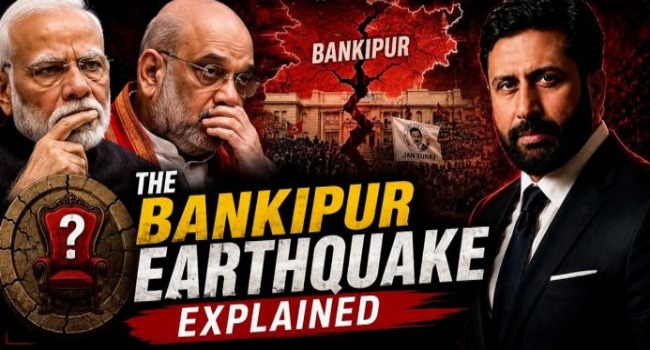
Is this the biggest political setback for Narendra Modi and Amit Shah since the government was formed in Bihar? That’s actually a big question, but after seeing the Bankipore result, this is exactly the question we’re forced to ask. Because this isn’t merely a story about a by-election. The BJP lost in the very constituency of its own National President. Assuming Bankipore was just an ordinary seat would be a mistake. Since 1995, for nearly 30 years, the BJP has never really faced a serious challenge in this seat. This constituency was first represented by Navin Kishore Sinha, and later his son Nitin Nabin won it five times in a row. The message was already clear when Narendra Modi and Amit Shah picked Nitin Nabin as the party’s National President — he was the top face in the party. As a result, Nabin moved into national politics, vacating the Bankipore seat. The BJP was fully confident it would win this seat easily. But the scene there turned completely on its head. It was an unexpected shock. A BJP stronghold that until then seemed unshakeable collapsed right before everyone’s eyes. Unexpectedly, Jan Suraaj party chief Prashant Kishor (PK) achieved a resounding victory from here.
Just look at the timing of this election, and it’s mind-blowing. Bihar has been through a series of controversies over the past several months. This is the first major electoral test to come after all that heated political churn. Repeated questions over governance, public anger over law and order that spilled onto the streets, student protests, the intense debate over the E-20 policy, the movement that stirred the youth, and allegations surrounding the Ram Mandir donation campaign — how much these factors actually influenced this result may remain a matter of debate between parties. But the fact is, voters have sent a strong message — and that too from a seat the BJP never imagined it could lose. There’s another major twist here too. This defeat wasn’t handed to the BJP by the RJD — and certainly not by Congress! A person whom everyone had written off just a few months ago, saying “he had a disastrous performance in the assembly elections, he’s finished” — that very person, Prashant Kishor, has today completely changed that political conversation. So is this merely an upset in a single constituency? Or is this the beginning of one of the biggest disruptions yet to come in Bihar’s political history? Why isn’t Bankipore just an ordinary by-election? Before analyzing the political developments, we first need to understand exactly why Bankipore matters so much.
Because if you don’t understand the significance of Bankipore, you simply cannot understand why this election result shook the BJP so deeply. For nearly three decades, this has been one of the BJP’s safest and strongest seats in Bihar. It’s not that the BJP won here occasionally — for decades, the party held this constituency firmly in its grip and dominated it completely. First, Nitin Nabin’s father laid a strong foundation for the BJP here. Nitin Nabin later strengthened that foundation further, winning five consecutive assembly elections. Party leaders held such strong confidence that the BJP simply could not lose Bankipore. That confidence was clearly visible during the election campaign as well — many BJP leaders campaigned as though victory here was a foregone conclusion. But the voters’ thinking was entirely different. This is exactly where the story becomes even more interesting. Because this wasn’t a victory built on the votes of a single caste or a single community. If the trends emerging booth by booth, and the political analyses, are accurate, then Prashant Kishor did not win by relying on any single caste or social group. He appears to have received support from every section of society — areas dominated by upper castes, regions that have traditionally been a strong vote bank for the NDA, colonies with a high concentration of government employees, and even areas where the BJP has held unshakeable dominance — PK’s wave swept through all of them.
If the final data confirms the same thing, then this wasn’t merely an anti-BJP vote — it was a clear vote from people seeking a new alternative. Understanding this distinction is crucial in politics. Because winning purely out of anger at the government, or anti-incumbency, is one thing; but people voting to elect someone because they truly believe in them as a political leader, as a genuine alternative, is a completely different level altogether. This is the biggest message the Bankipore by-election sends. Here, the BJP hasn’t just lost a prestigious seat — for the first time, Prashant Kishor has succeeded in convincing the public that he is not merely a strategist working behind the scenes, but a serious political alternative in his own right. Once that perception takes hold among people, Bihar’s politics in the days ahead is set to become unimaginably intense and fiercely competitive. But there’s another real question on everyone’s mind here: how did Prashant Kishor manage to bounce back to this level, having watched his own party suffer a crushing defeat just a few months ago? How exactly did he get here? This is where the real story begins. From political failure to political breakthrough — what actually changed within Prashant Kishor? This is perhaps the most fascinating chapter of this entire story. Just a few months ago, everyone had decided that Prashant Kishor was finished.
His party, Jan Suraaj, suffered a crushing defeat in the assembly elections. Many candidates didn’t just lose — they lost their deposits too. Political analysts all said the same thing: that PK had made a huge mistake by stepping into direct politics. Their logic was simple — devising strategies to get someone else elected is one thing, but entering the fray yourself and winning is an entirely different matter. At the time, all those criticisms seemed to ring true. But Prashant Kishor did something most politicians never do. He didn’t run away after losing. He didn’t change his political ideology overnight. He didn’t latch onto some political alliance merely to stay relevant. Instead, he stayed firmly rooted in Bihar. He traveled from town to town. He met people directly.
From the very beginning, he kept raising his voice consistently on the very issues he had always talked about — migration, unemployment, education, healthcare, administration, and Bihar’s future. Whether or not people agreed with him, one powerful message got through clearly: he was not the type to give up. That never-give-up attitude has now started showing results. This by-election marked a mindset shift. There’s another interesting political point here too. Typically, in general assembly elections, even if voters liked what PK had to say, they assumed the real contest was only between the NDA and the RJD alliance, and voted for one of them accordingly. In other words, people still believed that Bihar’s politics revolves solely around these two main forces. Many also carried a fear that voting for a new party would simply be a wasted vote.
But the Bankipore by-election changed that psychology entirely. Here, the contest became completely candidate-centric. That’s exactly when PK made a bold decision — he chose Bankipore, one of the toughest seats possible. Just think about it: had he lost there, critics would have immediately declared that “PK’s political experiment is over.” But instead, he achieved a landmark victory in a seat that was practically a BJP fortress, instantly rewriting the entire narrative around him. Until yesterday, he was seen merely as a successful political strategist — but today, he is a public representative directly elected by the people! This may well be his biggest achievement of all. Because in politics, perception doesn’t take long to turn into reality. Prashant Kishor’s biggest win here isn’t just one assembly seat — a large section of people across Bihar have now started viewing him not merely as a consultant, but as a serious political contender.
While this victory marks a major breakthrough for Prashant Kishor, it has also placed big questions before both the BJP and the RJD. This result signals that major shifts are coming in Bihar’s politics in the days ahead. Why is this by-election shaking national politics so much? Let’s set aside the Bankipore assembly constituency for a moment and look at the bigger picture. Because viewing this election result as merely a local by-election would be a mistake. This is a verdict that has come at an extremely sensitive time. This is the first major political test since Samrat Chaudhary took charge as Bihar’s BJP chief minister. For decades, the BJP has been the junior partner in Bihar politics — but today, it is leading the government. It is precisely at a time like this that the BJP has lost its first big electoral test, and that too, in the assembly seat of its own national president. This single point alone is enough to show just how significant this result is at the national level. And that’s not all — there’s another big reason behind this outcome as well.
Just recall what has happened across the country over the past several weeks. The controversy over Ram Mandir donations created an uproar in the national media. While the opposition tried to corner the government with allegations, the BJP rejected those claims. The E-20 issue sparked intense debate, not just in political circles, but among the general public as well. The Jantar Mantar protest shook the national capital, Delhi, for nearly 25 days. It was the biggest political flashpoint that saw thousands of young people take to the streets. A Union minister’s resignation made the issue so serious that, for the first time in twelve years of Modi’s rule, a Union Cabinet minister was forced to resign from his post. All these developments together have thoroughly heated up the country’s political atmosphere. Now, I’m not saying these national issues alone caused the Bankipore election outcome — no responsible political analyst would claim that. But no serious analyst can ignore this timing either. When the ruling party loses one of its strongest fortress seats at a time when intense political debate is raging across the country, questions naturally arise.
Did the people of Bankipore vote merely for a local candidate? Or does this reflect a broader shift in public mood across the country? This is exactly the question both the BJP and the opposition are now trying to answer. Because now we arrive at the real, interesting question: who should be more worried after the Bankipore result — the BJP or the RJD? At first glance, most people would give the same answer: that the BJP suffered the bigger shock, since it lost one of its strongest constituencies. But think a little deeper, and another angle emerges. The party that actually faces the bigger challenge from this result may not be the BJP — it could be the RJD. Because this single election has challenged a belief that has persisted in Bihar politics for years. Until now, Bihar politics operated on one fixed mindset — the NDA on one side, the RJD alliance on the other — and people held a strong belief accordingly. Everyone assumed that if people were angry at the BJP, those votes would automatically flow into the RJD’s pocket. But the Bankipore result has shattered that belief. It wasn’t the RJD that defeated the BJP. The RJD wasn’t even the main challenger in this election. That position was instead occupied by a third political force — Jan Suraaj. This is the biggest political development of this election. There’s another important matter here too.
Prashant Kishor is not someone who suddenly entered politics right before the by-election. He has spent three years traveling through every corner of Bihar. He turned unemployment, migration, education, and healthcare into his agenda. After the crushing defeat in the assembly elections, everyone assumed Prashant Kishor would step away from politics. But he didn’t back down, and he didn’t stop working. He kept strengthening his organization. Now, Prashant has something in hand that he didn’t have before — political recognition earned through an electoral win. A single MLA winning may not change the numbers in the assembly, but when a powerful leader raises his voice on the floor of the legislature, that heat is felt across the entire political system outside. If Prashant Kishor uses the assembly as a platform to continuously raise public issues, question the government, and convince people that he is a genuine alternative leader, his political influence may not remain confined to a single constituency. That’s exactly where the real challenge for the RJD begins. If voters opposed to the BJP start seeing Jan Suraaj as a better alternative than the traditional opposition, Bihar’s political equations will gradually begin to shift.
Will that actually happen? It would be far too hasty to say so definitively right now. No one can predict the outcome of the upcoming assembly elections based on a single by-election result. Politics has proven countless analysts wrong time and again. However, one thing can be said clearly: Bankipore has completely changed the political conversation in Bihar. This result has served as a warning that no fortress is permanently invincible for the BJP. It has reminded the RJD that the days of assuming the opposition space belongs to it by default are over. For Prashant Kishor, this isn’t just an MLA seat — it is the first and best certification he has received for having left behind the role of election strategist and become a “full-fledged politician.”
Will this remain merely a sensational victory? Or is this the first step toward a much bigger shift in Bihar politics? Time alone will answer that. But one thing is certain: after Bankipore, we can no longer view Bihar politics through the same lens as before. In politics, there are some elections that change governments, but elections that change the political narrative itself are far rarer. The Bankipore by-election seems to fall precisely into that second category. That said, it would be premature to predict the outcome of the upcoming main elections based on a single by-election result.
Because if you look back through the history of by-elections, unexpected, shocking results are actually quite common. But that same history also tells us something clear: political change doesn’t happen overnight. It begins somewhere — with an unexpected result, an unforeseen message, a small thunderbolt striking a fortress that had never known defeat! So is the Bankipore result the first foundation of that bigger change to come? Or is it merely a temporary shock? Time alone will decide. But after today, one thing is crystal clear: the time has come for every major political party in Bihar to rethink its strategy. The BJP can no longer assume that its stronghold seats will forever remain safe.
The RJD would be mistaken to assume that every anti-BJP vote will automatically land in its account. Prashant Kishor can no longer be dismissed as merely an “election strategist.” From today, he has become a powerful political factor that every party must take seriously. But perhaps the biggest lesson this Bankipore election has taught isn’t about who won or who lost — it’s about the true power of the voter. The voter has once again reminded every political party of a simple truth: no vote is permanent! No fortress is forever! No political narrative lasts indefinitely! The very day a party becomes overconfident, believing “our victory is guaranteed,” that is exactly the day democracy begins writing a new story. So is Bankipore the first chapter of that new story? Or is it merely a page that added one twist to Bihar’s politics? Only time will answer all these questions.