





- Ravi Prakash
Have you ever imagined a video like this? The Prime Minister of India, Narendra Modi, picking up his own mobile phone, switching on the front camera, and recording a video in selfie style to speak directly to the people of the nation — not once, not twice, but three times in three consecutive days. Massive public rallies roaring with lakhs of people, live TV speeches that dominate primetime, the nationwide-resonating “Mann Ki Baat,” high-tech videos — a top leader who commands politics through all of this transforming overnight in this way is a truly unimaginable sensation. This did not look like an official Prime Ministerial address; it looked like an ordinary Instagram reel. Before analyzing the real politics behind this, the sequence of these developments must first be understood.
Three Videos, Three Days
At midnight on July 24, Prime Minister Narendra Modi uploaded a selfie video from his official Instagram account. The timing of that video post left even political analysts in the country surprised. There was no official announcement, and not even a press note was released. The Prime Minister chose to come directly in front of his phone camera and speak face-to-face. This was the sensational message he gave, addressing crores of students and the nation’s youth burning over the exam controversy.
But the real twist came right after. Within just a few hours, in an unexpected turn, another video appeared. The next day, July 25, the Prime Minister again appeared in selfie mode. This time he gave special thanks to the youth who had responded to his first video, praising the feedback from students and stating that he had received many valuable suggestions from them. Again, there was no microphone, no teleprompter, no big stage — only the Prime Minister, a phone camera, and a direct message to the youth of India.
Everyone assumed this would end there, but the story did not stop. On July 26 — yesterday — the Prime Minister released another direct video message, his third in just three days. By then, one thing had become clear to everyone: this was not some accidental experiment, but a deliberate political master plan behind it. Three videos, three days, one target audience — Gen Z.
Why the Sudden Shift?
Why is all this happening? Why did Prime Minister Modi suddenly stand directly before the youth? What was the need to change his decades-old communication style overnight like this? What is the real master plan behind this sudden change? Is this merely a new digital strategy, or a signal of a bigger political earthquake on the way? None of these videos fell suddenly from the sky. Over the past few weeks, the country has been witnessing a massive youth wave of anger unlike anything it has seen before.
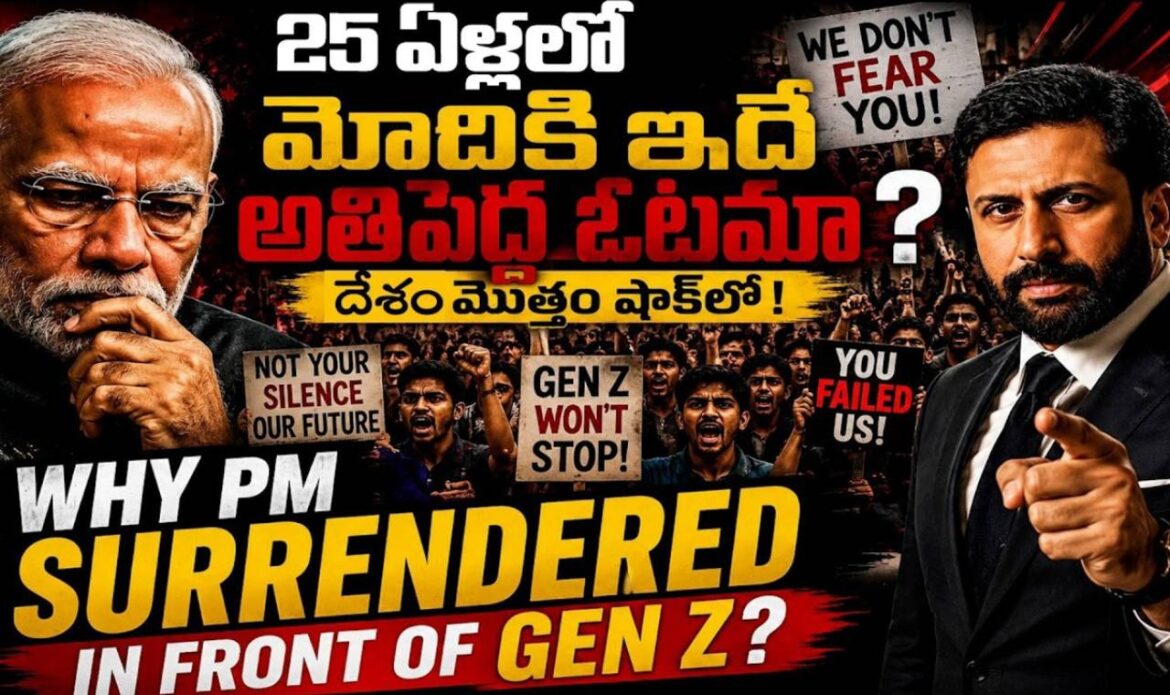
From Jantar Mantar in Delhi to Mumbai, Patna, Prayagraj, Ahmedabad, Nashik, Nagpur — across the country, thousands of students came onto the roads. Many openly confronted the government. Many others raised slogans against Prime Minister Narendra Modi. Social media was shaken up. Instagram, X and YouTube saw thousands of memes and millions of views. For several days, this discussion was led not by big TV studios but by ordinary students holding mobile phones in their hands. Eventually, international media described this as an “all-time biggest movement led by Gen Z.” Along with the street protests, this generation’s memes, reels and viral videos sparked debate over whether they had become destructive political weapons against the government.
A Resignation Follows a Call for Talks
Many questions are being raised here. Did the wave of anger from the youth force a change in Modi’s signature communication style? Was there a political necessity behind connecting directly with Gen Z? Or was this all a coincidence? Even as the Prime Minister’s three videos were shaking media headlines, extremely dramatic developments were unfolding in the background.
A senior BJP leader shocked everyone by openly commenting, “Hold talks with the students immediately.” With this, the political drama reached its peak. After that, the story changed entirely. Union Education Minister Dharmendra Pradhan submitted a sensational resignation. What is the real secret behind Dharmendra Pradhan’s resignation? Did Modi’s master plan work out?
From Crackdowns to Conversation
Going back a few days: when the students’ anger first began, the government’s response was completely different. There was deployment of police, arrests, barricades on roads, allegations of lathi-charges, and use of water cannons. Thousands of students came onto the streets. Videos from Delhi, Mumbai, Patna, Prayagraj and other cities shook up social media. After many years, India was not merely watching a protest — the country was watching a “Gen Z” rebellion in a way it had never seen before. This Gen Z method of struggle is different: they don’t wait for TV debates, they don’t wait for tomorrow’s newspapers, they write their own article themselves. A single viral reel, a single political meme, a single powerful slogan, a single emotional video reaches lakhs of people within moments.
In many of the videos, students directly questioned Prime Minister Modi, holding him responsible for the exam crisis. Whether those allegations were right or wrong aside, one fact could not be dismissed: a severe anger was expressed among the country’s youngest voters. That anger was not confined to the streets — it spread to Instagram, shook up X, roared on YouTube, and flooded every social media platform. Political discussions moved from TV studios directly into mobile phones. This is why political analysts believe this is completely different from earlier student movements. It is not merely a movement on the roads; it is a digital revolution driven by algorithms. Every protest became new content, every arrest became a viral clip, every clash became a trending reel. Even without any TV channel telecasting it, every slogan reached crores of people.
Senior BJP Leader Calls for Dialogue
The real twist came at exactly that point. Senior BJP leader Murli Manohar Joshi entered the scene and openly appealed that “the government must hold talks with the students immediately,” saying this should not be viewed only through the lens of law and order, and that talks alone were the solution. Political analysts would not view a top-level BJP leader speaking openly about talks as an ordinary matter.
Right in the midst of this came another development — Union Education Minister Dharmendra Pradhan resigned. Opposition parties tried to claim this as a victory for the students. The government, however, stated that its goal was to restore trust in the examination system and increase accountability. Political analysts began asking: what exactly changed? The very machinery that, just days earlier, wanted to crack down harshly on the protests had now completely changed its voice, its strategy and its message. The government began speaking directly with students. The Prime Minister himself released back-to-back selfie-style videos. The education minister stepped down from his post. Is all of this linked, or are these separate incidents that happened to occur at the same time? The real debate begins here.
Reading the Response
Some analysts say that before the situation got out of hand, the Prime Minister recognized the political importance of Gen Z voters and directly engaged them in a mind game. Others argue this is simply part of good governance — resolving a problem and communicating properly about it. Another important question is worth considering: over the past decade, Narendra Modi built the image of a tough, fearless leader who does not bow to public pressure. But in this instance, Modi’s signature communication style reversed in an unexpected way. The political message became very personal, reaching directly to people’s hearts. One after another, a stream of videos followed. A government that is usually stern was seen speaking very humbly this time. Is this a new political strategy Modi is implementing, or direct proof of the extraordinary power of this youth movement? The developments of recent weeks teach one lesson: taking “Gen Z” lightly comes at a political cost. Today’s young voters do not merely watch political narratives — if needed, they rewrite the very shape of those narratives to suit themselves. This may be the biggest story within the entire drama.
The Story Goes Global
This story is no longer confined to TV studios — it has become global political news. The same question crores of people in India are asking is now being asked directly by some of the world’s most prestigious publications: did this Gen Z movement force the Narendra Modi government to change its political strategy?
Reuters, known for cautious, unsensational reporting, reported that the nationwide student protests gave opposition parties “a rare political opportunity” against the Modi government, and assessed that it was to withstand the pace of these protests that Prime Minister Modi himself had to step in with selfie-style videos.
The Financial Times made an even more pointed comment, stating that the Gen Z protests had “severely damaged Narendra Modi’s aura of invincibility” — a striking remark given that, for a decade, political observers worldwide have described Modi as an unbeatable leader; the paper attributed the dent in that image not to any rival political party but to India’s Gen Z youth.
France’s Le Monde published an in-depth analysis stating that the youth movement had put the government politically on the defensive, and that the pressure of continuous protests forced the Union Education Minister to resign, describing a government being forced to change its political route under public pressure as an extremely rare development during Modi’s tenure.
The Guardian described this as one of the biggest political challenges Prime Minister Modi has faced in recent times, detailing in depth how memes, short videos, Instagram reels and social media trends turned an ordinary student struggle into a nationwide political upheaval.
Setback or Strategy?
Does this mean Narendra Modi has genuinely been put on the defensive? Not necessarily. Newspapers write analyses, and an analysis is only an opinion, not the ultimate truth. But when Reuters, the Financial Times, Le Monde and The Guardian are all asking the same kind of question at once, it suggests a strong reason behind it — whatever their individual leanings, all are pointing to one fact: the government toned down its voice; the Prime Minister changed his communication style; three selfie-style videos were released back to back, targeting Gen Z with words of conciliation; and the education minister ultimately resigned. These are the plain facts visible to everyone. Interpretations of these facts vary — some call it a “political defeat,” others call it “responsive good governance”; some call it “damage control,” others defend it as “effective political management.”
The Bigger Question: Has Gen Z Rewritten the Rules?
The real question here is not whether the Prime Minister was put on the defensive, but whether Gen Z has changed the rules and regulations of Indian politics itself. A generation that set out with nothing more than smartphones, social media accounts and street protests managed to make the country’s most powerful political machinery change its stance — meaning this story is not merely about one protest, and not merely about one minister’s resignation. It could be the beginning of a whole new political era in India.
There is an old saying in politics: when you are winning, you don’t know your own strength; only when you face a setback and are forced to respond do you learn your true power. For nearly twelve years, Narendra Modi has singularly steered Indian politics — every election, every campaign, every political narrative personally directed by him. Modi’s real political strength has never been merely winning elections, but holding the narrative in his own grip. Normally, the entire country debates only the issues Modi chooses. This time, however, Prime Minister Modi had to respond to an issue raised by the students. This is the first big political point from this entire episode.
The second point: every political party in the country must now understand a truth this movement has proven — “Gen Z” is no longer an invisible force in politics. Until now, political parties focused on caste equations, calculated religious equations, and relied on regional politics. This movement brought another new force to the forefront — digital power. Today’s generation is not tied to caste, not divided by religion or language — all of them were united through the “algorithm.” A viral video uploaded in Delhi reached the streets of Mumbai within moments. A protest slogan raised in Patna reached Bengaluru even before TV debates on it began. This is a new political ecosystem never seen before.
The third point, and the most interesting of all: Narendra Modi is regarded as India’s most talented political communicator. That such a figure released these three videos is not merely a response to the protests — it is direct evidence that the Prime Minister has acknowledged that the style of political communication has completely changed. The era of one-way communication has ended. This is the digital age — today’s voters do not merely listen to speeches and stay quiet; they reply instantly, respond within moments — sometimes very sharply, sometimes very creatively, sometimes through memes, sometimes through protests in the middle of the road. Whether the present government or a future one, this is a hard reality that will have to be faced.
The Bigger Lesson: A Story About Trust
What is the biggest lesson of all? This entire drama is not merely about one exam — it is a story about trust: trust in the examination system, trust in constitutional institutions, trust in accountability. Whenever “trust” among the people becomes questionable, even the most powerful government cannot avoid being put on the defensive — not because of opposition parties, but purely because of public perception. Whether the Modi government has managed to restore that lost trust or not, only time will tell. Whether this protest wave affects the upcoming elections or not, only voters will decide. But one thing has clearly happened: this movement has firmly reminded every political party of one blunt truth — never underestimate a generation with a camera in one hand and a vote in the other. This exam controversy may someday end, but the political lessons it has taught will remain forever.