





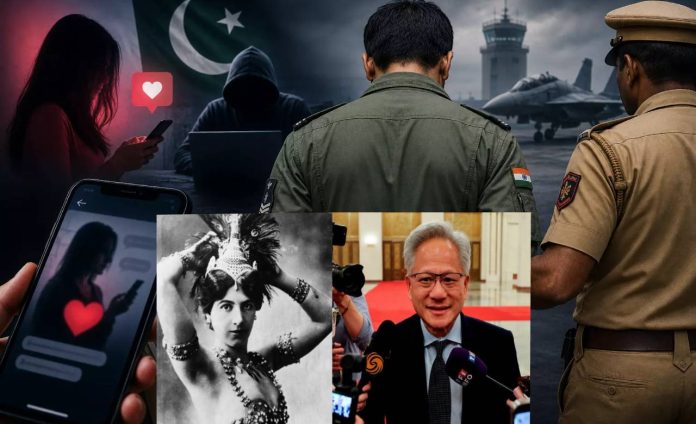
New Delhi: The espionage tactic known as the “honeypot” or “honeytrap” has returned to public debate, following a case in which an Indian Air Force Wing Commander is alleged to have shared sensitive information with a suspected foreign agent. The practice uses romantic or sexual relationships with attractive individuals to extract secret information and has been regarded for decades as one of the most potent and controversial tools of intelligence work. The term has also resurfaced amid a controversy involving Nvidia CEO Jensen Huang.
According to the Oxford Dictionary, the word “honeypot” is long-standing, but its use in espionage gained momentum in the 20th century. During the First World War, exotic dancer Mata Hari was branded a German spy because of her links with military officers and faced execution in 1917. In the Cold War, East Germany’s Stasi deployed handsome male agents, known as “Romeo spies,” to obtain secrets from influential women in West Germany, and also used female agents, called “Miele maidens,” to compromise Western diplomats. Russian intelligence operatives, meanwhile, are said to have widely used illicit relationships to entrap targets and blackmail them later. Children’s author Roald Dahl is also reported to have undertaken similar tasks in the United States during the Second World War.
The tactic has since evolved into cyber-honeytrapping. With the spread of the internet, victims are now lured through fake social media profiles and AI deepfakes rather than physical contact alone.
In India, the threat is considered particularly acute. Pakistani intelligence agencies are alleged to be using cyber-honeytrap techniques to target the Indian defence establishment. In the latest case, an IAF Wing Commander has been booked on allegations that he shared secret war plans in exchange for “nude images” sent by a suspected Pakistani agent he met over WhatsApp.
Earlier cases include that of DRDO scientist Dr Pradeep Kurulkar, who faced allegations of passing information on sensitive defence projects to a Pakistani operative who contacted him under the name “Zara Dasgupta.” The case of soldier Shantimay Rana is also cited as an example of a honeytrap carried out through social media.
In response, the Indian armed forces have stepped up vigilance. They have issued strict guidelines on social media use and set up dedicated information warfare teams to counter hostile propaganda.