





-Ravi Prakash

A video that emerged from Delhi has left viewers shaken to the core. Having watched it repeatedly, many say they were left speechless each time — struck by the same haunting thought that countless parents across the country share: what if the girl in this video were their own daughter? A single voice, a single face, a single question in the footage conveys a truth that a hundred headlines could not.
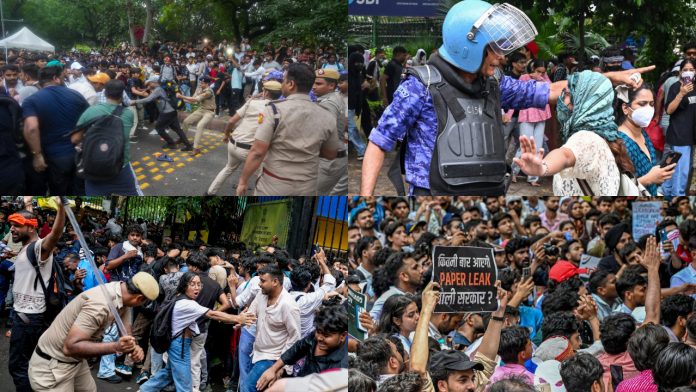
Today, thousands of students marched from Jantar Mantar toward Parliament, with their central demand being the resignation of Union Education Minister Dharmendra Pradhan. Jantar Mantar has not witnessed tensions of this scale in recent memory. As students pushed forward, police responded with a heavy hand — baton charges and tear gas were deployed, and visuals of bloodied protesters have since spread rapidly across social media, sparking outrage nationwide over the conduct of the police.
Among the most widely circulated visuals is one showing a young student protester — believed to be no older than eighteen or nineteen — standing before Delhi Police personnel and directly asking, in visible anguish, “Aap humein kyun maar rahe hain?” (“Why are you beating us?”). In a separate clip, a woman social activist is seen confronting police officers with an equally pointed question: “Aap ladkiyon ke kapde kyun phaad rahe hain?” (“Why are you tearing girls’ clothes?”), with torn clothing visible on camera. These scenes, captured amid what turned into a chaotic standoff, have drawn widespread condemnation.
Another widely shared clip shows a lone student surrounded by a large contingent of police officers, absorbing repeated baton blows without retreating. Rather than fleeing, he is seen looking directly at the officers striking him and repeating the words, “Maaro… mujhe aur maaro” (“Hit me… hit me more”). The visual has drawn comparisons to the iconic 1989 image of a lone protester standing before military tanks during the Tiananmen Square demonstrations in Beijing — a moment separated by geography and context, but similar in the singular image of defiance against overwhelming force.
Separately, footage has surfaced that directly contradicts statements from Delhi Police, who maintained that no baton charge took place and that no force was used against students. Observers say the visuals speak for themselves regarding what transpired on the ground.
According to protesters and eyewitnesses, authorities took extensive measures to prevent today’s march, including suspending internet access in parts of the city, shutting down metro stations, erecting large barricades, and deploying tear gas — actions that led to intense confrontations between police and demonstrators. Despite these obstacles, thousands of students converged on Jantar Mantar and the surrounding area, marking one of the largest student mobilizations seen in the capital in recent years. Drone footage shared by the Cockroach Janata Party shows large crowds gathered near Connaught Place and around the parliamentary complex, with some students chanting “Jai Bhim” and “Vande Mataram” as they advanced.
The protest follows the hospitalization of social activist Sonam Wangchuk by Delhi Police two days earlier. However, the scale of today’s demonstration suggests the movement has grown beyond any single individual or issue, reflecting broader frustration among the country’s youth and their determination to be heard.
Among the most distressing visuals from the day’s events, captured by News Pinch journalist Abhinav Pandey, is footage of a severely injured student, bleeding from multiple wounds but undeterred. Despite his injuries, he is heard saying, “We are prepared to make sacrifices, to keep facing such blows, and to keep standing for our cause — regardless of who tries to stop us.”
In a further escalation, some protesters reportedly broke through police security cordons and entered the parliamentary complex itself — an incident being described as one of the most significant security lapses since the 2001 terrorist attack on Parliament. The situation grew serious enough that all main gates to Parliament were shut for security reasons, and at one point, security personnel were reportedly compelled to point weapons at student protesters. Officials note that Delhi has not witnessed a student protest of this intensity since the current government came to power.
Whatever one’s view of the students’ demands, the scenes from today’s protest have drawn strong reactions nationwide. Analysts note that dialogue, rather than confrontation, remains the preferable path in a democracy, and that the ongoing protest — now in its 23rd day at Jantar Mantar — reflects a broader call for the government to engage with public grievances, even while retaining its right to disagree with them.
Observers describe the movement as reflecting the character of a new generation — one that documents everything, questions authority, and shows little inclination toward silence — suggesting that today’s events may mark a notable moment in the country’s ongoing political narrative.