





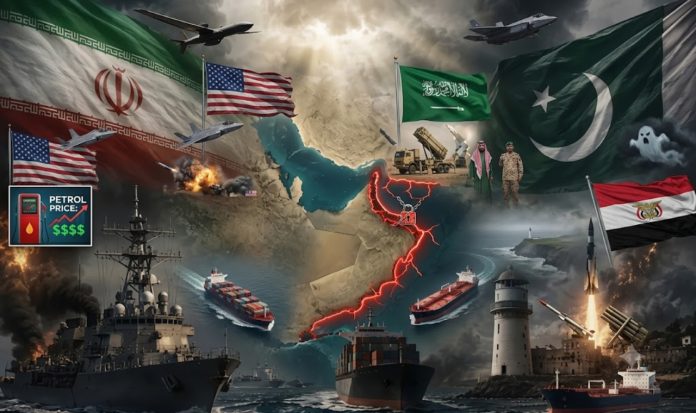
Tensions in West Asia are escalating sharply once again, as the United States continues launching intense strikes on key Iranian targets. In apparent retaliation, Iran is reported to have devised a sweeping strategy of its own — one that could shake global trade far beyond its borders. According to reports, Tehran has signaled to Houthi rebels in Yemen to move toward a complete shutdown of the Bab-el-Mandeb Strait, the narrow but critical waterway often described as the heart of the Red Sea and a linchpin of global commerce. Following Iran’s signal, the Houthis are said to have launched a large-scale mobilization in response.
Reports indicate that advanced missiles and drones have been heavily deployed by the Houthis around the Bab-el-Mandeb Strait. This comes at a time when shipping through the Strait of Hormuz is already facing disruption. Experts warn that if the Red Sea route is shut down as well, global oil transportation could grind to a near-complete halt. The Bab-el-Mandeb Strait, which connects the Red Sea to the Gulf of Aden, is a vital corridor through which thousands of vessels carrying oil, natural gas, and other commercial cargo pass daily between Asia and Europe.
Should the Houthis succeed in blocking this route, international shipping would be forced to reroute thousands of additional miles around the Cape of Good Hope at the southern tip of Africa. Such a diversion would sharply raise shipping costs and insurance premiums, sending petrol and diesel prices soaring once again across the globe. This strategy is believed to be Iran’s response to the ongoing US strikes on its territory — a calculated move to ensure that any damage inflicted on Iran does not remain confined to Iran alone, but instead disrupts global trade at large. The mobilization of the Houthis is seen as a central part of this broader plan.
This development carries a significant, unexpected shock for Pakistan. Houthi rebels have recently resumed missile attacks on Saudi Arabia, placing Islamabad in a delicate bind — unwilling to damage relations with neighboring Iran, yet equally unable to abandon Saudi Arabia, a key economic benefactor. Last year, Pakistan and Saudi Arabia signed a secret defense pact under which thousands of Pakistani troops are currently stationed in Saudi Arabia carrying out defense duties. Should Iran-backed Houthi attacks on Saudi Arabia intensify, Pakistan is unlikely to remain silent.
A Pakistani government official has already responded to the situation, warning that any attack on Saudi Arabia would be treated as an attack on Pakistan itself, calling it a “red line” for Islamabad. If such an attack were to occur, Pakistan could be pulled directly into the conflict. Compounding matters, a shutdown of the Red Sea route would choke off fuel imports for a country already mired in deep economic crisis, further straining its finances. For now, a full-scale war in the region has yet to break out — but with tensions mounting on multiple fronts, the world is watching nervously, uncertain of what might unfold next.